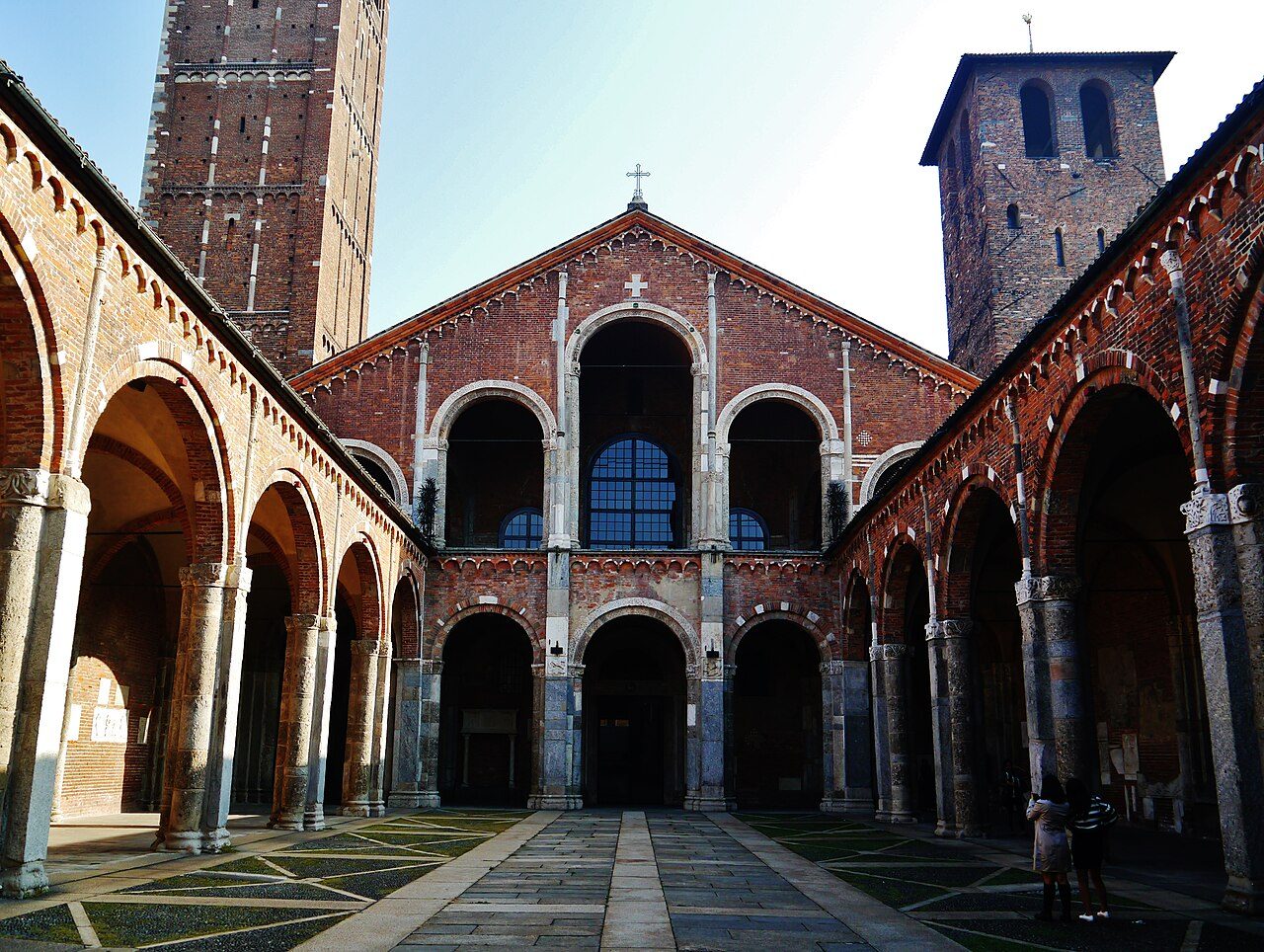
Church · Magenta and Sant'Ambrogio · 379–XII secolo
Basilica di Sant'Ambrogio
The patron saint's church, where Milan keeps its oldest memories
In brief
The basilica founded by Bishop Ambrose in the fourth century and rebuilt in brick in the twelfth: the model for Lombard Romanesque. Inside you'll find a golden altar almost twelve hundred years old, the tomb of Milan's patron saint, and his oldest portrait.
Stories of this place
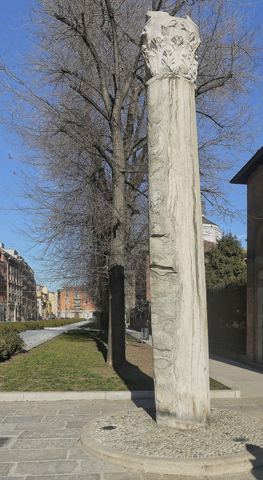
- Legend · The Devil's ColumnReadThe Column with the Devil's Horn MarksIn Piazza Sant'Ambrogio, facing the basilica, a lone Roman column stands with two holes in its marble. According to legend, this is where the devil tried to tempt Ambrose, bishop of Milan. The saint answered with a kick, and the devil ended up with his horns stuck in the column. He stayed there a whole day, then vanished through the two holes. Tradition adds that the holes smell of sulfur and that, if you put your ear to them, you can hear the Styx, the river of hell, gurgling. The writer Carlo Romussi took it philosophically: anyone who cups a hand over an ear hears that hum.
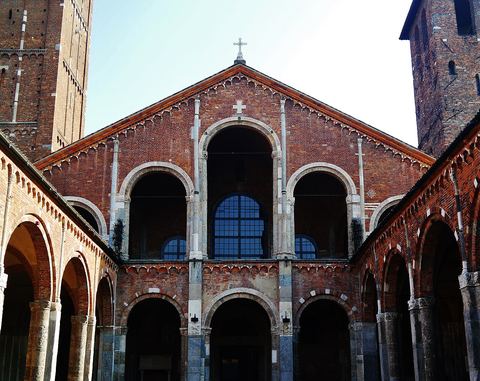
- In culture · The Atrium and the FacadeReadA Sant'Ambrogio in CaliforniaThe facade of the basilica of Sant'Ambrogio, in Milan, has a distant relative, a very distant one. In 1929 the University of California, in Los Angeles, built Royce Hall on the model of this very church. Lombard Romanesque was born for the churches of a medieval city. More than eight centuries later it served to give an old look to a new university, on the other side of the world. If you ever cross that campus and feel you have been there before, now you know why.
- Anecdote · The Two Bell TowersReadThe Canons' CutletIn the Middle Ages monks and canons shared the basilica of Sant'Ambrogio and quarreled even at table. In the twelfth century an archbishop's ruling set the rule: every September 17, feast of Saint Satyrus, the monks owed the canons a nine-dish lunch, in return for their services at the golden altar. The parchment survives, wax seal included, and names lumbolos cum panicio. Some historians call them the ancestors of the cotoletta alla milanese, Milan's breaded veal cutlet. Others are wary: panicio may have meant a side of millet, a grain, not breading. In the 1700s the historian Pietro Verri published the menu and admitted he could not understand it.
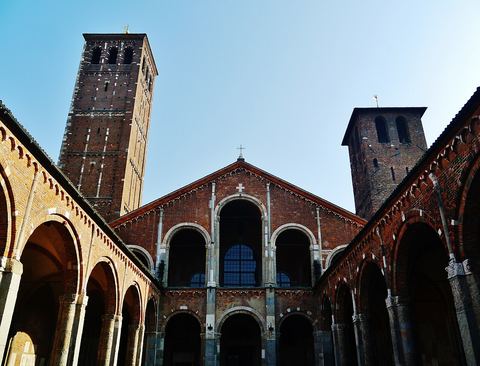
- Anecdote · The Two Bell TowersReadThe Bell That Could Not RingIn the Middle Ages two communities shared the basilica of Sant'Ambrogio: the monks and the canons, the priests who held its services. They quarreled over everything, bells included. In 1128 Archbishop Anselm granted the canons a new tower, on the north side: it is the bell tower to the left of the facade. It was half a victory. The tower was unfinished and had a single bell, which on top of that could not ring: the rope was missing. The canons had to wait decades to make themselves heard. And the bell tower was only truly finished at the end of the nineteenth century, seven hundred years later.
- Legend · The Bronze SerpentReadThe Serpent and the End of the WorldIn the nave of the basilica of Sant'Ambrogio, on top of a column, sits a bronze serpent. It arrived from Constantinople shortly after the year 1000, a gift from Emperor Basil II. In Milan it soon became something more: for centuries people believed it was the one Moses cast in the desert, able to save anyone who looked at it from snakebite. Tradition gives it one last task as well. The day it comes down from its column, the story goes, will be the end of the world. For now it stays up there, and for centuries prayers against certain illnesses were said at its foot.
- Anecdote · The Golden AltarReadAmbrose's Tomb: Three Skeletons in WaterAmbrose, the bishop of Milan who founded the basilica named after him in the fourth century, is buried there, under the golden altar. So the documents said. Nobody saw it with their own eyes until the nineteenth century. In 1864 the parish priest Francesco Maria Rossi uncovered a porphyry sarcophagus down there. It was opened on August 8, 1871. Inside was water, and lying in the water were three well-preserved skeletons: Ambrose and the martyrs Gervasius and Protasius, whom he himself had laid there. Today they rest in the crypt, in an urn of crystal and silver made in 1897.
- Anecdote · The Golden AltarReadThe Altar That Missed the BombsThe golden altar of the basilica of Sant'Ambrogio, a masterpiece of ninth-century goldsmithing, has spent two wars away from home. In 1917, during the First World War, it was moved to the Vatican for safety, and came back three years later. In the Second it was sent there again. That was lucky. In August 1943 the bombs hit the apse squarely, right behind it. The ciborium, the canopy that covers it, survived under a protection of sandbags. The altar, in those days, was not in the basilica. Almost twelve hundred years, two world wars, two round trips: what you see in the case is a professional survivor.
- AnecdoteReadThe Emperor Taken Away from BresciaThe basilica of Sant'Ambrogio still keeps the tomb slab of an emperor, Louis II. To have him here, Milan had to take him from Brescia. Louis died in the Brescia area on August 12, 875, and the local bishop buried him in a church of his city. The archbishop of Milan, Ansperto, asked for the body and was refused. So he went in person, with his clergy and two bishops, and brought the body back in solemn procession. A week after his death the emperor was buried in Sant'Ambrogio. It was a political move: the tomb made the archbishop guardian of the kings of Italy and of their crown.
- In cultureReadPetrarch, the NeighborIn 1353 the poet Petrarch moved to Milan, and for six years he lived beside the basilica of Sant'Ambrogio, then at the very edge of the city. In a letter to his friend Francesco Nelli he says what he often looked up at: a portrait of Bishop Ambrose, patron saint of Milan, high on a wall. It was said to be a very close likeness, and to him it seemed almost alive. To see Ambrose in person, he wrote, only the voice was missing. Scholars identify it with a painted stucco roundel made shortly before the year 1000. Today it belongs to Milan's Museo Diocesano, the diocesan museum.
- In cultureReadGiusti, Verdi and the Foreign SoldiersGiuseppe Giusti, a nineteenth-century poet, was in Milan as a guest of the writer Alessandro Manzoni when he walked into the basilica of Sant'Ambrogio, which in a poem he calls old and out of the way. He found it full of soldiers of the Austrian army, Bohemians and Croats. His irritation did not last. He heard a chorus by the composer Giuseppe Verdi, then a German hymn, and began to see those men as poor souls far from home. The poem is titled Sant'Ambrogio. Verdi passed this way too: his opera I Lombardi alla prima crociata opens in Piazza Sant'Ambrogio, in front of the basilica.
Ready-made questions
A Roman official who became a bishop. He was governing the region when, in 374, he was chosen as bishop of Milan, then the capital of the Western Roman Empire. He led the city until his death on April 4, 397, and had several basilicas built outside the walls, this one among them. He is the patron saint of Milan. His oldest portrait is here, in the di San Vittore in ciel d'oro, the small chapel with the golden dome.
Yes. He died in 397 and was buried under the altar, beside the martyrs Gervasius and Protasius, whom he himself had laid there in 386. In the ninth century Archbishop Angilbert II gathered the three bodies into a porphyry sarcophagus and set the golden altar over it. The sarcophagus was found in 1864 and opened in 1871. Today the remains of the three saints are in the crypt beneath the altar, in an urn of crystal and silver.
Go to stop: The Golden AltarBecause the basilica had two landlords. From 784 a community of Benedictine monks lived beside the church, and alongside them were the canons, the priests who held services in the basilica. They were two separate communities, often at odds. The monks had the tower on the right, from the ninth century. The canons got theirs in the twelfth century, on the left. It is taller, but its top is much more recent: it was added only at the end of the nineteenth century.
Go to stop: The Two Bell TowersBecause of the way it is built. The galleries of the run above the side aisles. That leaves no room on the walls of the nave for a row of high windows, like those in Gothic churches. Light comes in from almost only two places: the loggia on the facade, behind you as you enter, and the at the far end, above the altar. The result is a half-light that draws your eye straight to the gold of the altar.
Go to stop: The NaveFor the most part, yes. The core is a wooden box, but the side facing the nave is covered in sheets of gold worked in repoussé. The back is gilded silver. Around the scenes run frames of filigree, precious stones and colored enamels. It was made between 824 and 859 for Archbishop Angilbert II, under the direction of the goldsmith Vuolvino. But the dedication engraved on the back warns that the treasure more precious than any metal is something else: the bones of the saints kept inside.
Go to stop: The Golden AltarTradition says yes. Several coronations are recorded, from that of Otto I in 961 to that of Charles IV of Luxembourg in 1355. The chronicler Galvano Fiamma, in the fourteenth century, also describes the rite: the emperor took an oath in front of the column that now stands in the square, received the crown, then embraced the column. It meant that his justice would be as straight as that marble.
Go to stop: The Devil's ColumnThe stops
1 The Devil's Column
A Roman column left standing alone in the square, with two holes in the marble. Legend says they are the marks of the devil's horns, after Ambrose got the better of him. Scholars say it is a piece of the emperors' palace.
2 The Atrium and the Facade
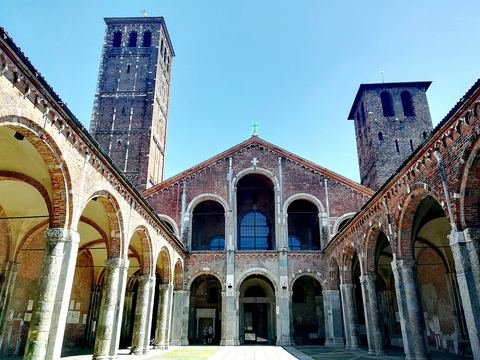
A courtyard ringed by porticoes, all brick, that has served as a waiting room for the unbaptized, a cemetery and a town square. At the far end is the gabled facade, with the loggia from which the bishop blessed the city.
3 The Two Bell Towers
Two different bell towers for two communities that shared one church. On the right the monks' tower, squat and ancient. On the left the canons' tower, taller, and finished only in the nineteenth century.
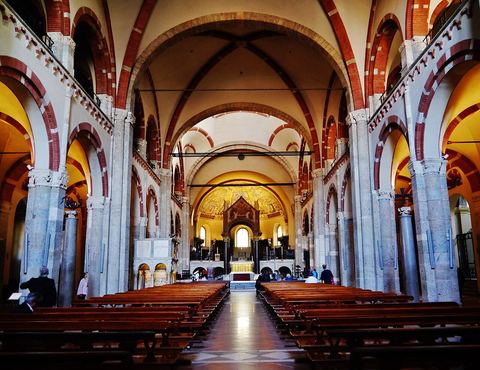
4 The Nave
The church that set the standard: a nave and two aisles, sturdy piers and great brick vaults. It is darker than you expect, and there is a precise reason for that.
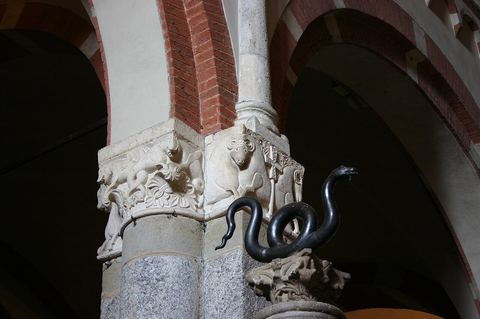
5 The Bronze Serpent
A bronze serpent that arrived from Constantinople shortly after the year 1000. For centuries the Milanese believed it was the one Moses cast in the desert, and they gave it a job: to announce the end of the world.
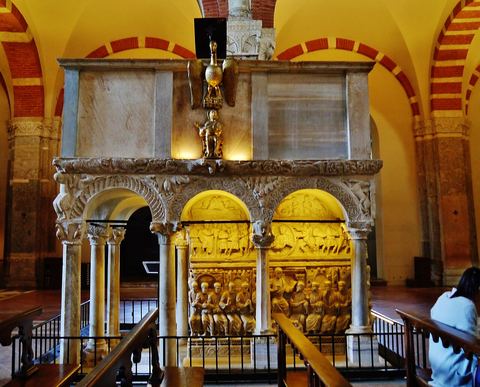
6 The Pulpit and the Sarcophagus of Stilicho
A medieval pulpit built over a fourth-century Roman sarcophagus that still sits where it was set down in Ambrose's time. Tradition assigns it to the general Stilicho, but scholars don't believe it.
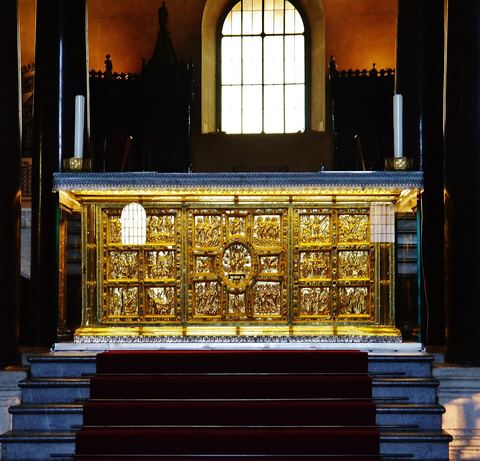
7 The Golden Altar
The most precious thing in the basilica: a casing of gold, silver, enamel and gems, made in the ninth century to mark the spot where Ambrose and two martyrs lie. The goldsmith left his name and his portrait on it.
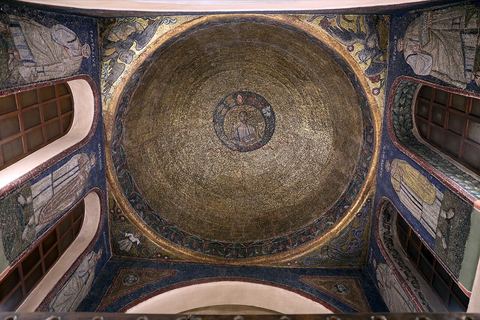
8 The Sacello di San Vittore in ciel d'oro
A chapel that began life on its own in the middle of the martyrs' cemetery, its dome covered in gold mosaic. On the walls is the oldest portrait of Ambrose: a man in civilian dress, not yet the saint of the paintings.
Timeline
- 379–386Bishop Ambrose builds the Basilica of the Martyrs and lays the bodies of Gervasius and Protasius under the altar.
- 397Ambrose dies on April 4 and is buried in the basilica, beside the two martyrs.
- 784A Benedictine monastery is founded next to the church: from then on monks and canons share the basilica.
- 9th centuryArchbishop Angilbert II commissions the golden altar, signed by the goldsmith Vuolvino.
- Early 11th centuryThe bronze serpent arrives from Constantinople, a gift from Emperor Basil II.
- Late 11th centuryThe Romanesque rebuilding in brick begins, and continues into the first half of the 12th century.
- 1492Donato Bramante is commissioned to rebuild the canons' residence: he will complete only one side.
- 1943In August bombs badly damage the basilica. Ferdinando Reggiori's restoration is completed in the 1950s.
Who's who
Ambrose
bishop of Milan from 374 to 397
He founded the basilica and asked to be buried in it beside the martyrs. He is the patron saint of Milan: his tomb and his oldest portrait are here.
Angilbert II
archbishop of Milan from 824 to 859
He commissioned the golden altar to mark the saints' tombs. On the back he had himself portrayed offering it to Ambrose.
Vuolvino
ninth-century goldsmith
He led the workshop that made the golden altar. He signed himself magister phaber and portrayed himself crowned by Ambrose, on a par with the archbishop.
Stilicho
Roman general, died in 408
Commander of the army of the Western Empire. Tradition assigns him the sarcophagus under the pulpit, but scholars consider that a mistake.
Donato Bramante
Renaissance architect
In 1492 he was commissioned to rebuild the canons' residence beside the basilica. Only one side of the courtyard he designed was ever built.
Ferdinando Reggiori
architect, restorer of the basilica
He led the restoration after the bombing of August 1943. Work was completed in the 1950s.
Words to know
Where it is
The neighborhood
Magenta and Sant'Ambrogio
Related places
The story of the place
At the end of the fourth century, the city ended here. There was a cemetery outside the walls, holding the graves of Christians killed during the persecutions. Ambrose, bishop of Milan from 374, chose this spot for a basilica dedicated to the martyrs, and built it between 379 and 386.
Milan was then the capital of the Western Roman Empire. Under the altar Ambrose laid the bodies of two newly discovered martyrs, Gervasius and Protasius. Eleven years later he died, and was buried beside them. The Milanese were already calling the church by his name.
Little of that first basilica is still on view: a sarcophagus, four red columns, a chapel with a golden ceiling. The rest grew on top of it.
Two communities, one church
In 784 a Benedictine monastery was founded next to the church. From then on two communities shared the basilica: the monks and the canons, the priests who held its services. Each wanted its own bell tower, which is why you see two. In the ninth century Archbishop Angilbert II commissioned the golden altar, which is still there.
The rebuilding in brick
The basilica in front of you took shape between the late eleventh century and the first half of the twelfth. An architect whose name we don't know rebuilt it in brick, with great vaults carried on piers. It worked so well that it became the model for Lombard Romanesque.
But he didn't throw away what mattered. The floor plan stayed as Ambrose had laid it out, and the sarcophagus, the altar and the saints' tombs stayed where they were. The new church was built around them.
The centuries after
Then history kept passing through. According to tradition, the kings of Italy were crowned in this church.
At the end of the fifteenth century Donato Bramante, the great Renaissance architect, began a new canonica, the canons' residence, along one side, and it was left half finished. In August 1943 bombs badly damaged the basilica. The restoration, led by the architect Ferdinando Reggiori, was completed in the 1950s.
That is why Sant'Ambrogio is best seen as a family home that has been lived in for sixteen centuries. Every generation added something, and almost none emptied the rooms. It is not the biggest church in Milan, nor the richest. It is the most Milanese.
Sources
- Basilica di Sant'Ambrogio, sito ufficiale: mappa della basilica (opens in a new tab)Official site
- Basilica di Sant'Ambrogio, sito ufficiale: complesso monumentale (opens in a new tab)Official site
- Milano, Enciclopedia dell'Arte Medievale, Treccani (opens in a new tab)Encyclopedia
- Campanile dei canonici di S. Ambrogio, Lombardia Beni Culturali (opens in a new tab)Catalog
- Atrio della Basilica di S. Ambrogio, Lombardia Beni Culturali (opens in a new tab)Catalog
- Ambone di Guglielmo da Pomo, Lombardia Beni Culturali (opens in a new tab)Catalog
- Basilica di Sant'Ambrogio, Wikipedia in italiano (opens in a new tab)Wikipedia
- Basilica of Sant'Ambrogio, Wikipedia in inglese (opens in a new tab)Wikipedia
- Altare di Sant'Ambrogio, Wikipedia in italiano (opens in a new tab)Wikipedia
- Colonna del Diavolo, Wikipedia in italiano (opens in a new tab)Wikipedia
- Sacello di San Vittore in ciel d'oro, Wikipedia in italiano (opens in a new tab)Wikipedia
- Sant'Ambrogio, la poesia di Giuseppe Giusti, Libreriamo (opens in a new tab)Other source
- Sarcofago di Stilicone, Catalogo generale dei beni culturali (opens in a new tab)Catalog
- I Lombardi alla prima crociata, Wikipedia in italiano (opens in a new tab)Wikipedia
- Arnolfo II da Arsago, Wikipedia in italiano (opens in a new tab)Wikipedia
- Basilica di Sant'Ambrogio, sito ufficiale: storia (opens in a new tab)Official site
- Basilica di Sant'Ambrogio, sito ufficiale: tesori nascosti dell'archivio (opens in a new tab)Official site
- Ansperto, Dizionario Biografico degli Italiani, Treccani (opens in a new tab)Encyclopedia
- Petrarca, Francesco, Dizionario Biografico degli Italiani, Treccani (opens in a new tab)Encyclopedia
- Marcello Ciccuto, Petrarca e le arti, Quaderns d'Italià 11 (2006), Universitat Autònoma de Barcelona (opens in a new tab)Institution
- Sant'Ambrogio benedicente, scheda del Museo Diocesano Carlo Maria Martini (opens in a new tab)Institution
- Clipeo di Sant'Ambrogio, Centro Conservazione e Restauro La Venaria Reale (opens in a new tab)Institution
- Ludovico II il Giovane, Wikipedia in italiano (opens in a new tab)Wikipedia
- Cotoletta alla milanese, Wikipedia in italiano (opens in a new tab)Wikipedia
- Pietro Verri, Storia di Milano, capitolo VI, Wikisource (opens in a new tab)Other source
- Marco Petoletti, La produzione epigrafica a Milano ai tempi del vescovo Ansperto (868-881), Italia Medioevale e Umanistica 58 (2017), Università Cattolica del Sacro Cuore (opens in a new tab)Institution
- Mosaico dell'abside di S. Ambrogio, Lombardia Beni Culturali (opens in a new tab)Catalog