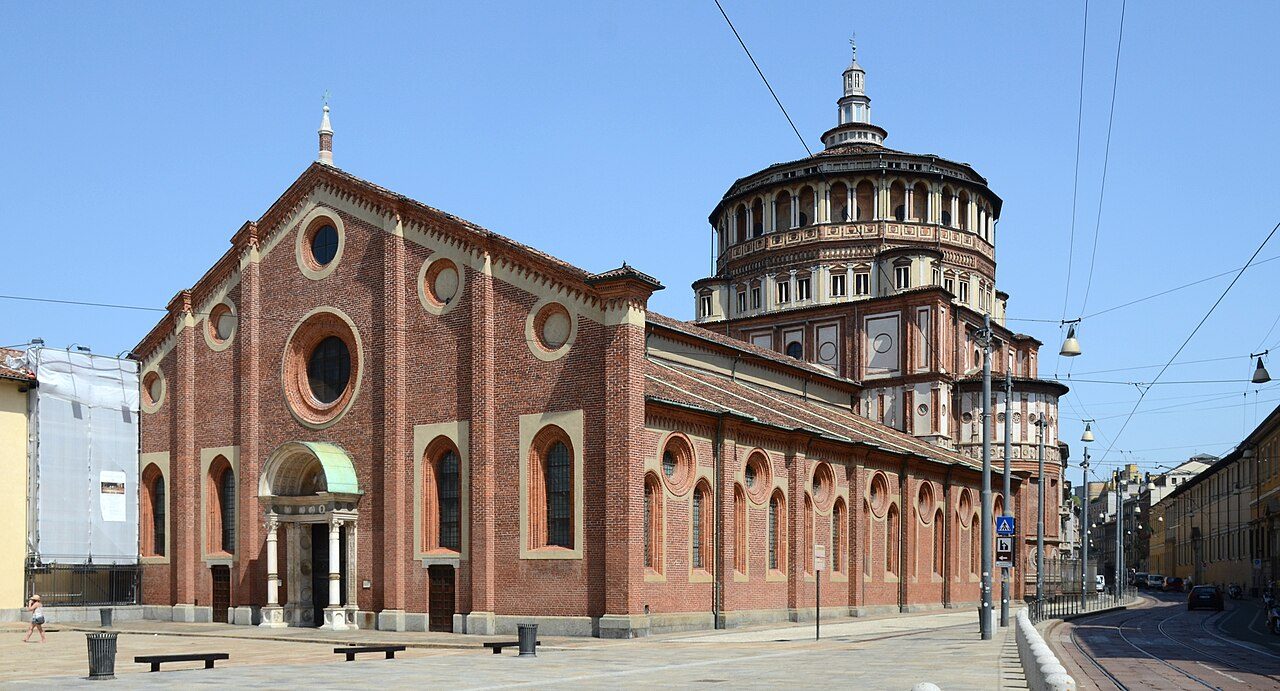
Church · Magenta and Sant'Ambrogio · 1463–1497
Santa Maria delle Grazie
The church everyone brushes past on the way to the Last Supper
In brief
A Gothic brick church that ends inside a Renaissance dome. The Dominican friars wanted it plain; Ludovico il Moro wanted a family mausoleum. The Last Supper is in the refectory next door: everything else is here, and almost nobody looks at it.
Stories of this place
- Anecdote · The tribuna from outsideReadThe fleeing duke and his wife's tombAt the start of September 1499 the French are at the gates and Ludovico il Moro, duke of Milan, has to flee. He rides out of the Castello Sforzesco, the Sforza castle, dressed in black as always since the death of his wife, Beatrice d'Este. Before going into exile, though, he stops at Santa Maria delle Grazie, where she is buried. He enters the church and stays a long time at her tomb. They say the friars walked him to the door in tears and that, as he left, he turned several times to look back. He had wanted this church as his family mausoleum, to stay in it forever.
- In culture · The chapel where it all beganReadThe plague of The Betrothed, in a paintingIn Santa Maria delle Grazie, in the chapel at the end of the left aisle, hangs a canvas by Cerano, a Lombard painter of the 1600s: the Virgin frees Milan from the plague. It was painted as a thanksgiving after the epidemic of 1630 ended. This is the same plague Alessandro Manzoni puts at the heart of I promessi sposi, known in English as The Betrothed, the great Italian novel of the 1800s. But the novel comes two centuries later. The painting dates from those very years.
- Anecdote · Under Il Moro's domeReadThe plaque where an unborn child speaksIn January 1497 Beatrice d'Este, duchess of Milan, died after delivering a stillborn son. Her husband, Duke Ludovico il Moro, wanted a plaque for the child too in Santa Maria delle Grazie, the church where she was buried. It speaks, in Latin, as the son who was never born: “I lost my life before I came into the light. More unhappy still, because in dying I took my mother's.” One thing consoles him: his parents are Ludovico and Beatrice, duke and duchess of Milan. The marble slab, almost two meters wide, is no longer there. It is now at the Castello Sforzesco, the Sforza castle, in the Museo d'Arte Antica.
- Anecdote · Under Il Moro's domeReadThe ducal tomb sold for thirty-eight scudiIn Santa Maria delle Grazie, Ludovico il Moro, duke of Milan, had a tomb carved for himself and his wife Beatrice d'Este. The Carrara marble was brought in from Venice and, according to 1800s studies, the work cost fifteen thousand gold scudi. When it was broken up in 1564, the lid with the statues of the duke and duchess reportedly went for thirty-eight scudi and ended up at the Certosa di Pavia, the Carthusian monastery south of Milan. There the two were long kept apart. Only at the end of the 1800s were they reunited on a single base, lying side by side as they had been carved.
- Legend · Under Il Moro's domeReadWhere is Ludovico il Moro really buried?Ludovico il Moro, duke of Milan, had prepared his tomb in Santa Maria delle Grazie, beside his wife Beatrice d'Este. Instead he died in 1508, a prisoner in the castle of Loches, in France, and where his body ended up is not certain. In the 1600s Father Gattico, the convent's chronicler, wrote that the friars had brought him back to Milan and buried him next to her. There is no proof. Other sources say he stayed in France. At Loches, between 2019 and 2021, archaeologists dug in the castle church and found a burial that, they say, could be his. A possibility, not yet a certainty.
- Anecdote · The Chiostro delle RaneReadThe friars who put out the fireOn the night of August 15, 1943, Allied bombs hit the church and convent of Santa Maria delle Grazie. The Chiostro dei Morti, the Cloister of the Dead, was destroyed; the refectory lost its roof and one wall. Incendiary bombs fell on the Chiostro delle Rane, the Cloister of the Frogs, the smallest in the convent, and the fire began to spread: it was the Dominican friars in person who put it out. In the refectory, the wall with Leonardo's Last Supper was saved by another precaution. It had been protected with sandbags held up by a frame of steel tubes.
- In cultureReadThe novice behind Romeo and JulietIn 1497 a twelve-year-old boy enters the Dominican convent of Santa Maria delle Grazie: Matteo Bandello, the prior's nephew. He will become a friar and then a writer. In one of his tales he recalls watching Leonardo da Vinci at work in the refectory, where he was painting the Last Supper: whole days painting without eating or drinking, then days spent only looking. In another he tells of two young lovers from Verona. Translated into French and then into English, that story traveled all the way to Shakespeare, who turned it into Romeo and Juliet.
- LegendReadLudovico il Moro's tunnelAccording to an old Milanese tradition, Ludovico il Moro, duke of Milan, had an underground tunnel built to link the Castello Sforzesco, the Sforza castle, to the convent of Santa Maria delle Grazie. It is a legend and should be taken as one. But it says a lot about how much this place mattered to the duke: here he had put his court architect and Leonardo da Vinci to work, and here he had wanted his wife's tomb and his own. That he would also want a private road to get here has always seemed natural to the Milanese.
- RecordReadAmong Italy's first Unesco sitesIn 1980 the church and Dominican convent of Santa Maria delle Grazie, together with Leonardo's Last Supper, joined the Unesco World Heritage list. Among Italian sites, only the rock drawings of Val Camonica came earlier, listed the year before. The historic center of Rome also joined the list in 1980. The painting is the most famous guest, but the recognition covers the whole complex: including the nave, the dome and the cloisters that almost everyone rushes through.
Ready-made questions
No, and it is the most common misunderstanding. Leonardo's Last Supper is painted on a wall of the refectory, the hall where the friars ate, which is part of the convent next to the church. Today the refectory is a state museum, separate from the church, which still belongs to the Dominicans. In this guide the Last Supper has a visit of its own. Here you'll find what surrounds it and helps make sense of it: who wanted it, why here of all places, and what he was building in the meantime.
Because it is. The nave and aisles were begun in the 1460s: Lombard Gothic in brick, built by Guiniforte Solari for the Dominican friars. The with its dome came thirty years later: Renaissance, ordered by Ludovico il Moro as a family mausoleum. The duke apparently wanted to redo everything in the new style, nave included. He lost the duchy in 1499 and work stopped. The two halves were left side by side, and today they are the reason the church is unique.
Very probably yes, but no solid document says so. The attribution rests on the forms of the building and on the fact that Donato Bramante was Ludovico il Moro's court architect in those years. A Dominican chronicler of the 1600s writes only that the duke consulted several architects. Scholars think of an idea by Bramante carried out largely by Lombard masters such as Giovanni Antonio Amadeo, especially on the exterior. Some also name Leonardo as a consultant: possible, not proven.
Go to stop: The tribuna from outsideBecause of an image. On the land given to the friars there was already a small chapel with a Madonna and Child known as the Madonna delle Grazie, Our Lady of Graces, believed to work miracles. The new church, first intended for Saint Dominic, was built around the chapel and took its name. The chapel still exists: it is the last one off the left aisle, near the . From the name of the church came that of the whole area, which the Milanese called the Borgo delle Grazie, the Grazie quarter.
Go to stop: The chapel where it all beganIt is in the Louvre, in Paris. Titian painted the Crowning with Thorns in the early 1540s for the altar of the chapel of the Santa Corona, the Holy Crown, the fourth on the right. In 1797 Napoleon's French carried it off. After Napoleon fell, the Austrian government that then ruled Milan did not ask for it back. On the altar today is a Deposition from the 1600s. Gaudenzio Ferrari's frescoes on the walls, however, are still the ones from back then.
Go to stop: The chapel of the missing TitianIt was meant to be the mausoleum of the Sforza, but history went another way. Beatrice d'Este, the young wife of Ludovico il Moro, died in 1497 and was buried in the choir. The duke instead died a prisoner in France, at Loches, in 1508. Their marble monument was never used as a tomb and is now at the Certosa di Pavia, the Carthusian monastery south of Milan. The side chapels still carry the names of the Milanese families that were their patrons, such as the Bolla, the Marliani and the Atellani.
Go to stop: Under Il Moro's domeFor more than two centuries this was its Milan headquarters. In 1558 the tribunal of the Inquisition was moved to the convent of the Grazie from the convent of Sant'Eustorgio, and later it got a building of its own, put up next to the convent. It ended by decision of Maria Theresa of Austria, who ruled in 1775 that inquisitors would no longer be replaced. In Milan the Inquisition came to an end in 1779, when the last inquisitor died.
The stops
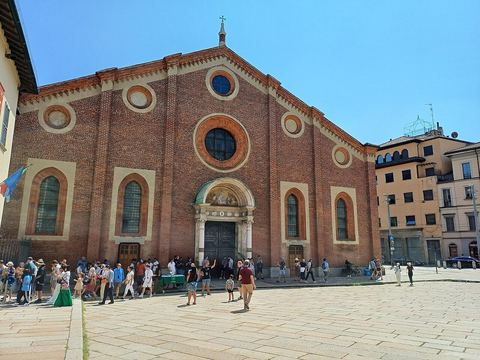
1 The brick facade
Low, wide, all brick: this is the church as the Dominican friars wanted it in the 1400s. The only luxury is the white marble portal, and it isn't theirs. Ludovico il Moro, duke of Milan, added it.
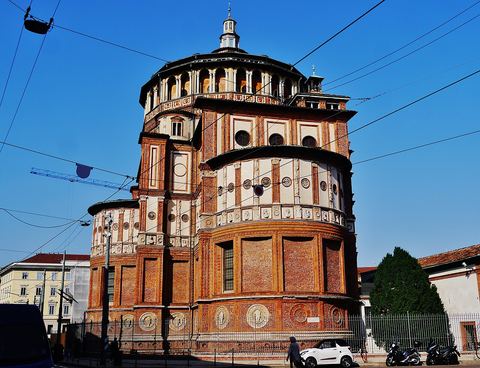
2 The tribuna from outside
Where the friars' church ends, the duke's begins: a cube, three apses and a dome. Ludovico il Moro wanted it in 1492 as the Sforza mausoleum. Everyone says it is by Bramante. No document does.
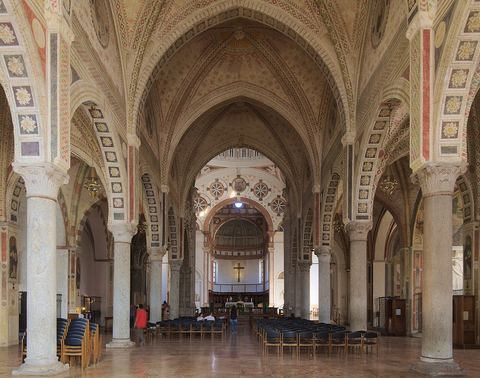
3 The friars' nave
Guiniforte Solari's church: a nave and two aisles, low and wide, with stone columns and painted vaults. This is Lombard Gothic, more horizontal than vertical. At the far end, where the space opens up, the duke's tribuna begins.
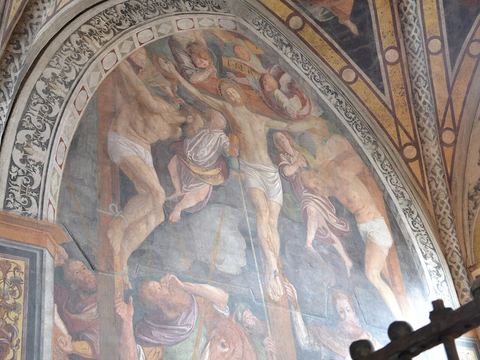
4 The chapel of the missing Titian
One of the most important paintings in Milan used to hang here: Titian's Crowning with Thorns. Since the late 1700s it has been in the Louvre. What stayed are Gaudenzio Ferrari's frescoes, which nobody could load onto a cart.
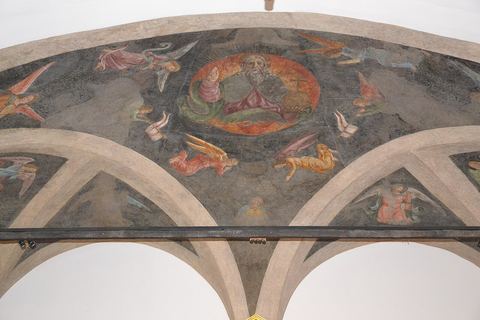
5 The chapel where it all began
The starting point. Here stood the little chapel with the image of the Madonna delle Grazie that gave its name to the church, the convent and the neighborhood. Inside you'll find the founder's portrait and a memory of the plague of 1630.
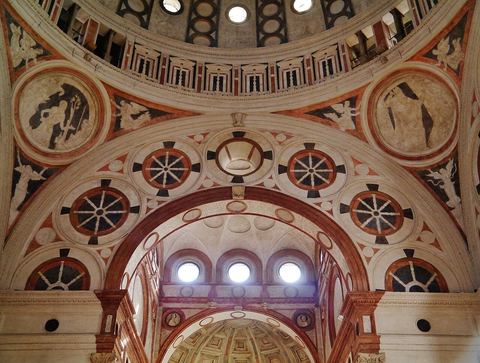
6 Under Il Moro's dome
A cube, a half sphere and a lot of light: the space Ludovico il Moro wanted as the Sforza mausoleum. His wife Beatrice d'Este was buried here. The marble tomb of the duke and duchess existed, but since the 1500s it has been at the Certosa di Pavia.
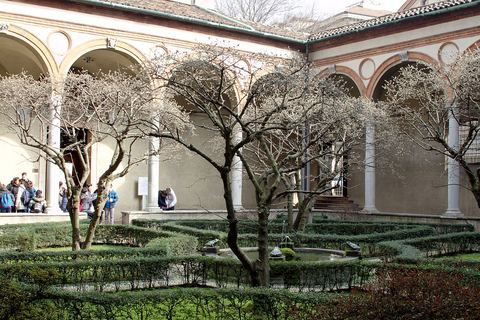
7 The Chiostro delle Rane
The Cloister of the Frogs, the smallest in the convent: five arches a side, a fountain with bronze frogs and the tribuna rising above the roofs. It is attributed to Bramante, like the Sacrestia Vecchia, the Old Sacristy, that opens off one side.
Timeline
- 1460Count Gaspare Vimercati gives the Dominicans a plot of land with a small chapel dedicated to the Madonna delle Grazie.
- 1463The first stone is laid. Guiniforte Solari is put in charge of building the convent and the Gothic church.
- 1492On March 29 the archbishop blesses the first stone of the tribuna, ordered by Ludovico il Moro as the Sforza mausoleum.
- 1497Beatrice d'Este, Ludovico's wife, dies and is buried in the choir. Two years later the duke loses Milan and work stops.
- 1558The tribunal of the Inquisition moves into the convent. It will remain active in Milan until 1779.
- Late 1700sThe French arrive: the Titian in the Santa Corona chapel leaves for Paris, the convent is suppressed and becomes a barracks.
- 1943On the night of August 15 bombs destroy the Chiostro dei Morti and unroof the refectory. The wall with the Last Supper stays standing.
- 1980Church, convent and Last Supper join the Unesco World Heritage list, a year after Italy's first site, Val Camonica.
Who's who
Gaspare Vimercati
count and military commander for the Sforza
He commanded Duke Francesco Sforza's troops. In 1460 he gave the Dominicans the land with the chapel of the Madonna delle Grazie. He is portrayed in that chapel's altarpiece.
Guiniforte Solari
architect of the Gothic church
The most respected architect in the Milan of his day: he also worked on the Duomo, the Ospedale Maggiore and the Certosa di Pavia. The nave, aisles and brick facade are his.
Ludovico il Moro
duke of Milan
He wanted the church as the Sforza mausoleum: he had the tribuna built and brought Leonardo to the refectory. He lost the duchy in 1499 and died a prisoner in France in 1508.
Beatrice d'Este
duchess of Milan, wife of Ludovico il Moro
She died after giving birth on the night between January 2 and 3, 1497, just over twenty, and was buried in the choir. Her funeral statue is now at the Certosa di Pavia.
Donato Bramante
court architect to Ludovico il Moro
Credited, without documents, with the tribuna, the Chiostro delle Rane and the Sacrestia Vecchia. He left Milan when the Sforza fell and in Rome designed the new St. Peter's.
Gaudenzio Ferrari
painter of the 1500s
Around 1540 he frescoed the chapel of the Santa Corona: the stories of the Passion on the walls and the angels in the curved sections of the vault.
Words to know
Where it is
The neighborhood
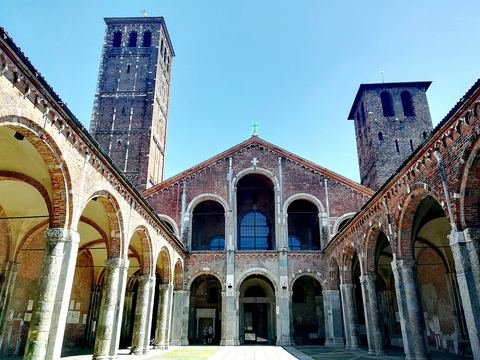
Magenta and Sant'Ambrogio
Related places
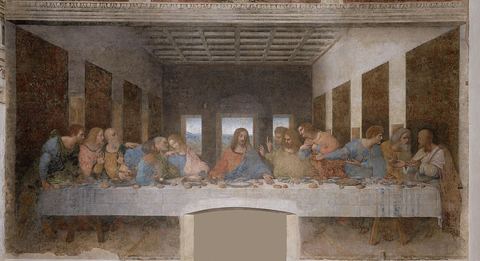
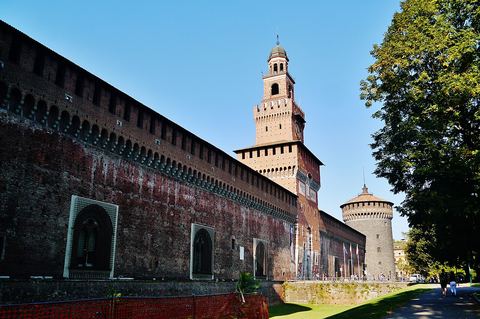
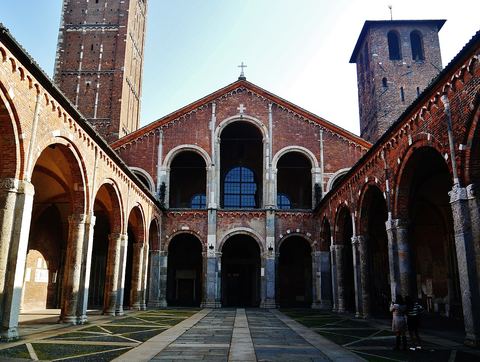
The story of the place
Almost everyone comes to this piazza for the Last Supper and walks past the church without looking up. A pity, because the building tells a story the painting alone doesn't: that of a duke who prepared his own tomb and never lay in it.
Land given to the friars
It all starts with a soldier. In 1460 Count Gaspare Vimercati, a military commander for the Sforza, the ruling family of Milan, gives the Dominican friars a plot of land just outside Porta Vercellina, one of the city gates, where his troops were quartered. On the land stands a chapel with an image of the Madonna delle Grazie, Our Lady of Graces: it will give its name to everything.
Three years later building begins, entrusted to Guiniforte Solari, the most respected architect in Milan at the time. Solari builds the way Lombardy has always built: brick, pointed arches, a low, wide church with no show.
The mausoleum the duke wanted
Then comes Ludovico il Moro, duke of Milan, and the friars' church is too small for him. He wants it as a family mausoleum, in the new style arriving from Tuscany.
In 1492 he has the choir, only just finished, torn down, and in its place raises the : a great cube topped by a dome. Tradition gives it to Donato Bramante, his court architect, though no document confirms it. In those same years, in the refectory next door, Leonardo paints the Last Supper.
The dream doesn't last. In 1497 the young duchess Beatrice d'Este dies and is buried in the choir. Two years later the French take Milan, and Ludovico ends his days a prisoner in France. Work stops, and that is a stroke of luck: the plan apparently called for knocking down the Gothic nave and aisles as well.
From the Inquisition to the bombs
The rest is a long line of tenants. The tribunal of the Inquisition moves into the convent and stays for more than two centuries. At the end of the 1700s the friars are thrown out and soldiers move in: the convent becomes a barracks.
In August 1943 bombs destroy a cloister and tear the roof off the refectory. Since 1980 the church, the convent and the Last Supper have been a Unesco World Heritage site.
The Last Supper has a visit of its own in this guide. This one is about what surrounds it: a brick facade, an unsigned dome, a chapel missing its Titian and a cloister with frogs.
Sources
- Chiesa di S. Maria delle Grazie, Lombardia Beni Culturali (opens in a new tab)Catalog
- Chiostrino di S. Maria delle Grazie, Lombardia Beni Culturali (opens in a new tab)Catalog
- Refettorio di S. Maria delle Grazie, Lombardia Beni Culturali (opens in a new tab)Catalog
- Bramante, Donato, Dizionario Biografico degli Italiani, Treccani (opens in a new tab)Encyclopedia
- Santa Maria delle Grazie, scheda del Museo del Cenacolo Vinciano (opens in a new tab)Institution
- Basilica di Santa Maria delle Grazie, sito dei frati domenicani (opens in a new tab)Official site
- The Inquisition in Santa Maria delle Grazie, Museo del Cenacolo Vinciano (opens in a new tab)Institution
- Bandello, Matteo, Dizionario Biografico degli Italiani, Treccani (opens in a new tab)Encyclopedia
- Solari, Cristoforo, detto il Gobbo, Dizionario Biografico degli Italiani, Treccani (opens in a new tab)Encyclopedia
- Sacrestia del Bramante, FAI Fondo per l'Ambiente Italiano (opens in a new tab)Institution
- Chiesa di Santa Maria delle Grazie (Milano), Wikipedia in italiano (opens in a new tab)Wikipedia
- Santa Maria delle Grazie, Milan, Wikipedia in inglese (opens in a new tab)Wikipedia
- Cenotafio di Ludovico il Moro e Beatrice d'Este, Wikipedia in italiano (opens in a new tab)Wikipedia
- Incoronazione di spine (Tiziano Parigi), Wikipedia in italiano (opens in a new tab)Wikipedia
- The Crowning with Thorns (Titian, Paris), Wikipedia in inglese (opens in a new tab)Wikipedia
- Beatrice d'Este, Wikipedia in italiano (opens in a new tab)Wikipedia
- Ludovico il Moro, Wikipedia in italiano (opens in a new tab)Wikipedia
- Matteo Bandello, Wikipedia in italiano (opens in a new tab)Wikipedia
- Lapide dell'infelice parto di Beatrice d'Este, Lombardia Beni Culturali (opens in a new tab)Catalog
- Julia Cartwright, Beatrice d'Este, Duchess of Milan, 1475-1497 (1899), Internet Archive (opens in a new tab)Other source
- Beatrice d'Este, duchessa di Milano, Dizionario Biografico degli Italiani, Treccani (opens in a new tab)Encyclopedia
- Ludovico Sforza, detto il Moro, Dizionario Biografico degli Italiani, Treccani (opens in a new tab)Encyclopedia
- Leonardo da Vinci, Dizionario Biografico degli Italiani, Treccani (opens in a new tab)Encyclopedia
- Clone della vigna di Leonardo a Milano sarà piantato a Vinci, l'Adige (opens in a new tab)Other source
- Vigna di Leonardo da Vinci, Wikipedia in italiano (opens in a new tab)Wikipedia
- Casa Atellani, Wikipedia in italiano (opens in a new tab)Wikipedia
- Ludovic Sforza, Wikipedia in francese (opens in a new tab)Wikipedia
- Ludovico Sforza, Wikipedia in inglese (opens in a new tab)Wikipedia
- Pietro Verri, Storia di Milano, capitolo XIX, Wikisource (opens in a new tab)Other source
- Loches, collégiale Notre-Dame, tombeau de Ludovic Sforza, Bilan scientifique régional 2020, DRAC Centre-Val de Loire (opens in a new tab)Institution
- La Vigna di Leonardo, FAI Fondo per l'Ambiente Italiano (opens in a new tab)Institution
- Cronologia di Milano dal 1501 al 1525, Storia di Milano (opens in a new tab)Other source