Stop 6 of 8Must-see
The Pulpit and the Sarcophagus of Stilicho
Where to stand
In the nave, in front of the large marble pulpit: look underneath, between the columns that hold it up
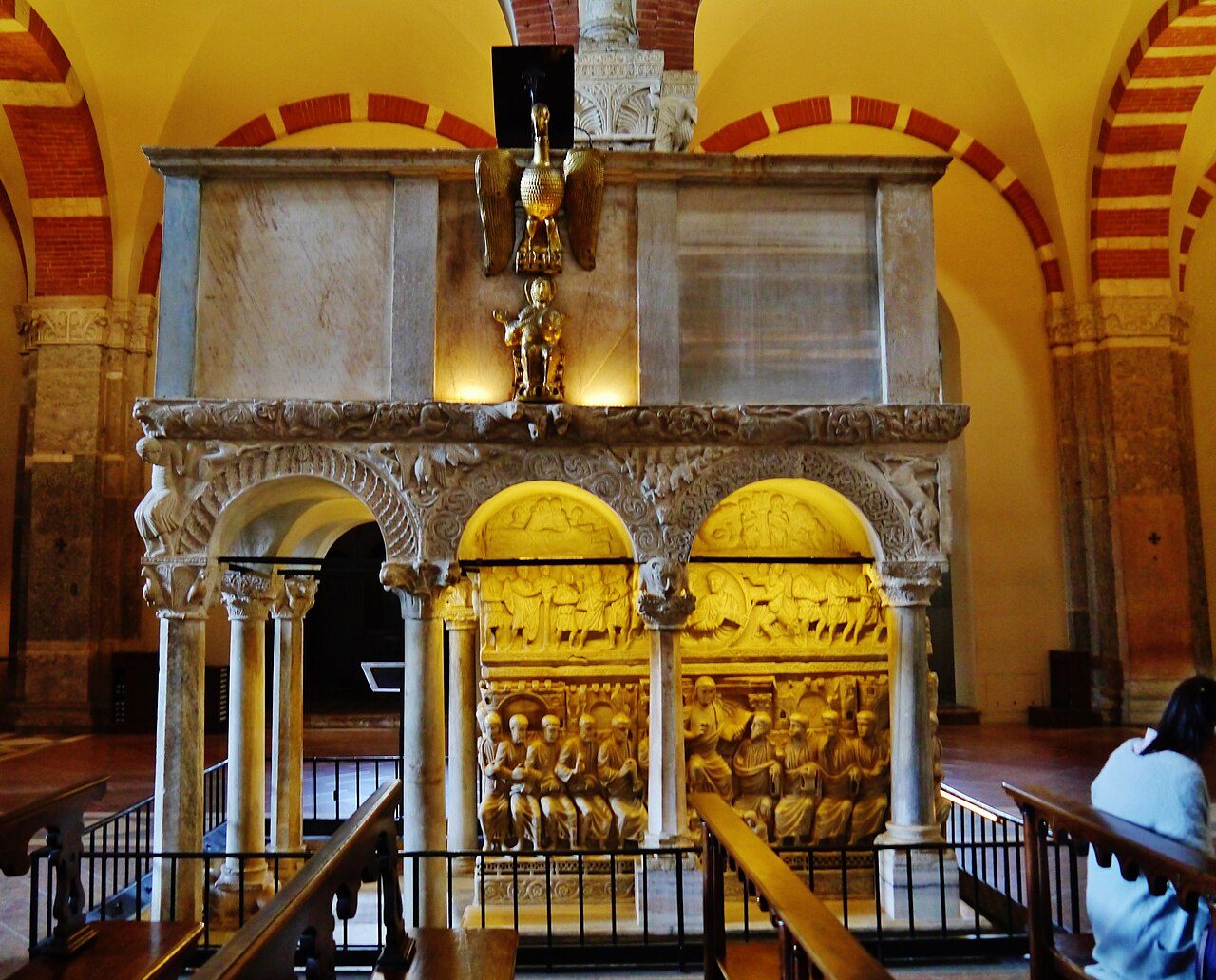
A medieval pulpit built over a fourth-century Roman sarcophagus that still sits where it was set down in Ambrose's time. Tradition assigns it to the general Stilicho, but scholars don't believe it.
Spot the detail
On one of the short sides of the sarcophagus, high up on the lid, look for a birth
The full story
There are two monuments in one here. Eight hundred years separate the piece below from the piece above.
Start at the bottom. Between the columns you can see a large marble sarcophagus, crowded with figures. It dates from the fourth century, the time when Ambrose, bishop of Milan, was building his basilica here. And it is one of the few things in here that he might recognize: scholars believe it still stands on the spot where it was placed back then.
Behind the figures run walls, gates and towers, like a stage backdrop. Scholars call this type a city-gate sarcophagus. The current view is that it came out of a workshop in Rome.
On the side facing the nave, Christ hands his law to the disciples. On the opposite side, Christ teaches among the apostles. The short sides carry scenes from the Bible.
The two portraits on the lid
At the top, in the center of the lid, a roundel holds the portraits of a couple. They are the two people buried here. Tradition named them Stilicho and Serena.
Stilicho was the general who commanded the Roman army, and he died in 408. It is a grand name for a nameless tomb. But scholars consider the attribution a mistake: who those two really were, we don't know.
The pulpit above the sarcophagus
Now look up. Above the sarcophagus is the , the pulpit from which the sacred texts were read and sermons were preached. When the church was rebuilt in the twelfth century, the sarcophagus was there, and nobody thought of removing it. They built the pulpit over it, leaving it in view between the columns.
Then, at the end of that century, a collapse destroyed the pulpit. An inscription in the marble tells the rest. A certain Guglielmo da Pomo, who was the church's overseer, had it put back together at the beginning of the thirteenth century. That is why the is an assembly of pieces from different ages, some older than the Romanesque church.
On the , look also for two copper figures: an eagle and an angel. The eagle is the symbol of John the Evangelist. The angel, that is, the man with wings, is Matthew's.
A Roman sarcophagus, and above it a pulpit made of salvaged pieces. In this church reuse is not a fallback. It is the method.
Next stop
Head for the far end of the nave, to the canopy on four red columns that covers the altar