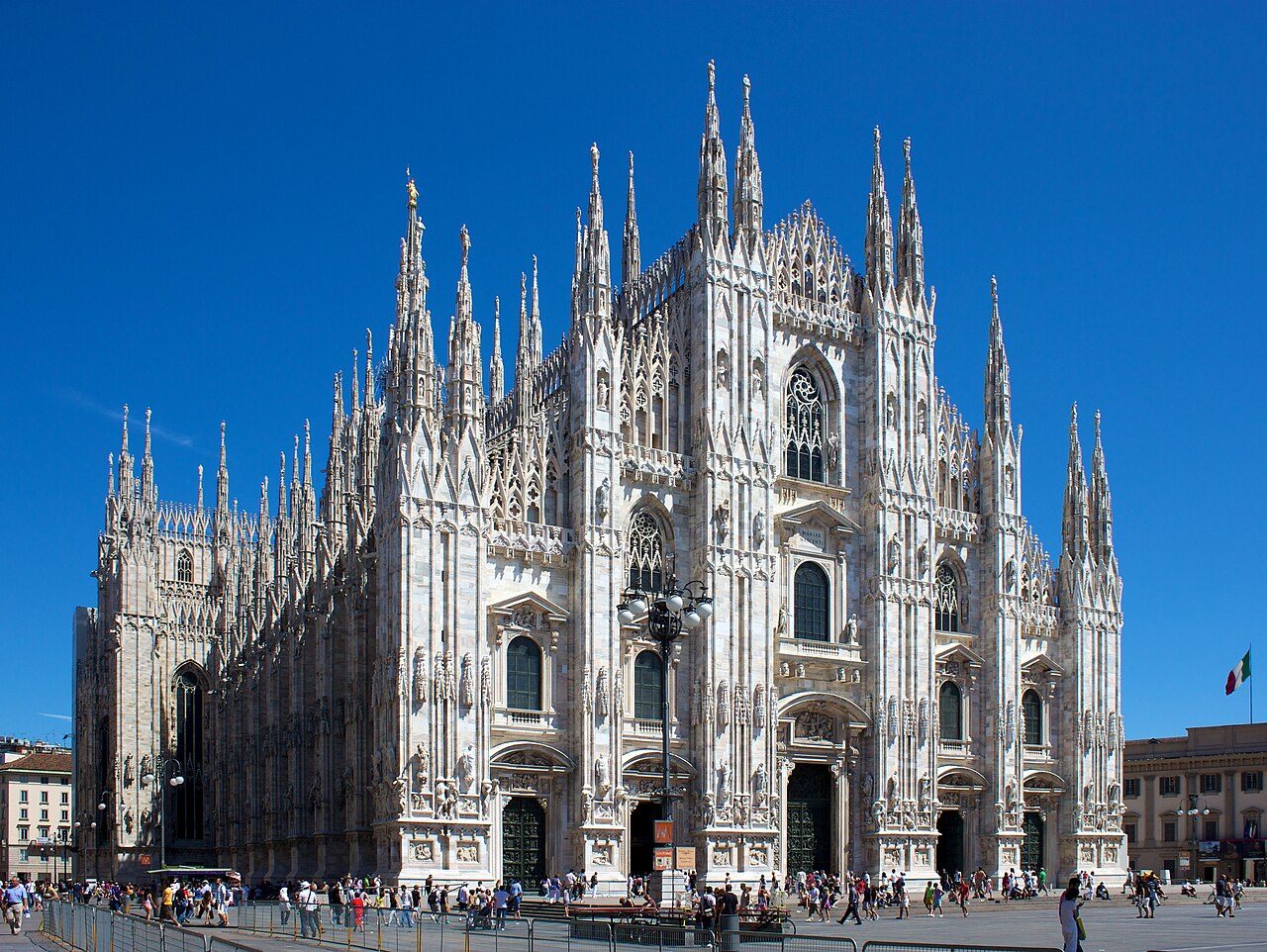
Church · Historic Center · 1386–1965
Duomo di Milano
A mountain of pink marble that Milan has never quite finished building
In brief
The largest church in Italy, begun in 1386 and wrapped up, more or less, in 1965. Outside it is a thicket of spires and statues, inside a forest of pillars. Under the square lies the baptistery of Ambrose, the city's patron saint, and you can walk on the roof.
Stories of this place
- Anecdote · The facadeReadThe Duomo facade you will never seeThe facade of the Duomo di Milano was meant to disappear. In 1886 the Fabbrica, the cathedral's works office, launched an international competition to rebuild it entirely in Gothic style. Two years later a twenty-six-year-old from Milan won, Giuseppe Brentano. The marble was already on order when, at the end of 1889, Brentano died. He was twenty-seven. The project stalled, and protests against demolishing the old portals did the rest. One piece of it survives: the central bronze door, designed for the new facade and then adapted to the old one. Inside, in the right aisle, a plaque shows the Duomo that never existed.
- In culture · The facadeReadMark Twain in front of the DuomoThe Duomo has always gotten travelers talking. Mark Twain, the American writer, visited in the summer of 1867 and wrote about it in his travel book The Innocents Abroad. What a wonder it is, he wrote: so grand, so solemn, so vast. He was an American used to young buildings, and in front of a cathedral that had been growing for almost five centuries he did not hold back on the adjectives. If you want to understand what he felt, stop in the square and look up.
- Legend · The Candoglia marbleReadA ufo: the marble that traveled freeThe marble for the Duomo di Milano came by boat from a quarry near Lake Maggiore, and it traveled free of charge: Gian Galeazzo Visconti, lord of the city, had granted that in 1387. According to a widespread Milanese tradition, the blocks carried the initials AUF, from the Latin ad usum fabricae, meaning for the use of the Fabbrica, the cathedral's works office, and that is supposedly the source of the Italian expression a ufo, without paying. It is a good story, but take it for what it is. Similar stories are told about other great churches, and the Treccani dictionary rates the origin of the expression as unknown.
- Anecdote · The central naveReadThe Frenchman who said the Duomo would fallIn 1399 an expert arrived from Paris at the Duomo's building site, Jean Mignot, and his verdict was scathing. He put dozens of criticisms in writing: the pillars were too weak, he said, and the church was sure to collapse. In January 1400 it came to a showdown. The Lombard master builders answered that science is one thing and craft another. Mignot shot back with a line that became famous, ars sine scientia nihil est: craft without science is worth nothing. The Lombards did not give in, and pointed out that their marble was stronger than the stone of Paris. The Duomo has proved them right.
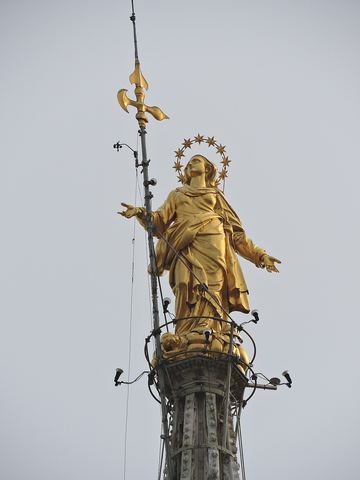
- Anecdote · The terracesReadNever higher than the MadonninaMilan has an unwritten rule: no building may rise above the Madonnina, the gilded Virgin on the Duomo's tallest spire. When the skyscrapers climbed past her, the solution was to put a small copy of the statue on the roof: first on the Pirelli skyscraper, then in 2010 on Palazzo Lombardia and in 2015 on the Allianz Tower, more than 200 meters up. That way a Madonnina always stands on the highest roof in the city. Even the soccer derby between AC Milan and Inter bears her name.
- Anecdote · The terracesReadThe boxers on the Duomo's roofAmong saints, prophets and martyrs, the roof of the Duomo also has boxers. They wear gloves and trunks, and they square off amid the marble lacework of the terraces. They date from the 1930s, when the Fascist regime was glorifying sport. They are recognized as Primo Carnera, world heavyweight champion in 1933, and Erminio Spalla, the first Italian boxer to become European champion. There is even a tennis racket carved in the marble. It is not so strange: on the minor figures the sculptors of the Duomo have always had a free hand, and every era has left its own heroes up here.
- In culture · The terracesReadRocco and His Brothers on the Duomo roofIn 1960 the director Luchino Visconti shot a scene of Rocco and His Brothers among the spires of the Duomo. The film follows a family from Lucania, in the deep south, that has migrated to postwar Milan. The scene is the farewell between Rocco and Nadia, played by Alain Delon and Annie Girardot. The roof of the cathedral, with its spires, becomes the backdrop to a breakup: Milan at its most monumental next to a story of ordinary people.
- AnecdoteReadCaterina's fur, a gift to the DuomoNovember 1387. The Duomo di Milano's building site is new and lives on offerings. Caterina di Abbiateguazzone, old and destitute, has no coins. She leaves her only fur, shabby, at the altar. The next day it is auctioned in the square with the other gifts. A man recognizes it, redeems it for one lira and runs to put it back on her shoulders. The Fabbrica, the cathedral's works office, realizes she had given everything, and three years later gives her three gold florins to go to Rome for the Jubilee. The Duomo grew like this: in 1400 ordinary people's small gifts made up over four fifths of the offerings.
- AnecdoteReadThe prostitute who left all to the DuomoAmong the Duomo's benefactors there is also a prostitute. Her name was Marta de Codevachi, she came from Padua, and the Milanese called her Donona. Her trade made her rich, then she left the brothel and took in an abandoned little girl, Venturina. When she fell ill, she willed her belongings to the Fabbrica del Duomo, the cathedral's works office. She added two clauses: that Venturina be provided for, and that a share go to a friend, a prostitute like her, provided she changed her life. When Marta died, the Fabbrica gave her a solemn funeral procession, with the cathedral's priests, along the streets where she had worked.
- RecordReadThe Duomo di Milano in numbersThe Duomo di Milano is the largest church in Italy: Saint Peter's is bigger, but it stands in Vatican City. It is almost 160 meters long and about 90 wide at the transept. Inside there are 52 pillars and almost 12,000 square meters of floor. Outside, 135 spires. The statues number about 3,400. The Madonnina, the gilded Virgin on the tallest spire, reaches 108 meters, and until the 1950s nothing in Milan stood higher.
Ready-made questions
Because it was a project off the scale, carried forward by an entire city. Work began in 1386, starting from the , and advanced in fits and starts, between wars, plagues, empty coffers and long arguments. The facade stayed unfinished until Napoleon, who ordered it completed in 1805. The bronze doors all date from the twentieth century, and the last is from 1965. And the maintenance has never stopped.
Yes, if you mean on Italian soil. Saint Peter's Basilica is bigger, but it stands in Vatican City, which is another state. The Duomo is almost 160 meters long, has an interior of almost 12,000 square meters and, they say, can hold up to 40,000 people. It is also one of the largest churches in the world.
Out of ambition. Gian Galeazzo Visconti, lord of Milan, wanted a cathedral on a par with the French and German ones, and Gothic was their style. In Milan, though, nobody had mastered it: the Fabbrica, the body in charge of the works, called in architects from Germany and France, and did not always get along with them. The result is a very Lombard Gothic, with details less common north of the Alps, such as the statues of saints at the top of the pillars.
Go to stop: The central naveBecause it comes from Candoglia, near Lake Maggiore, and the marble from that quarry is white streaked with pink. Gian Galeazzo Visconti, lord of Milan, chose it in 1387, in place of the brick called for in the first plan. The quarry is still open, and it is still the , the cathedral's own works office, that runs it. The lowest band of the walls, on the other hand, is a gray stone, harder than marble.
Go to stop: The Candoglia marbleShe is the gilded statue of the Virgin Mary on top of the tallest . She was set in place in 1774: the sculptor Giuseppe Perego designed her, and goldsmiths made her out of sheets of gilded copper. She is about four meters tall. For the Milanese she is the symbol of the city: O mia bela Madunina, the dialect song written by Giovanni D'Anzi in the 1930s, is dedicated to her. Even the soccer derby between AC Milan and Inter is called the derby della Madonnina.
Go to stop: The terracesNobody can prove it. The Sacro Chiodo, the Holy Nail, is a relic: according to tradition it comes from the cross of Jesus, and that is why the faithful venerate it. What is certain is the history of the rite. In 1576, during the plague, the archbishop Carlo Borromeo carried it in procession and ordered that the gesture be repeated every year. Today the nail is lowered from the vault with the nivola, a mechanical lift that in its present form dates from 1624.
Go to stop: The presbytery and the Sacro ChiodoA whole complex of churches. In the fourth century, when Milan was a capital of the Roman Empire, this was the site of the basilica of Santa Tecla and the baptistery of San Giovanni alle Fonti, where the bishop Ambrose baptized Augustine. Then there was Santa Maria Maggiore, the old cathedral that the Duomo replaced a piece at a time. The remains of the baptistery and of Santa Tecla can still be seen, under the square.
Go to stop: The baptistery under the squareThe stops
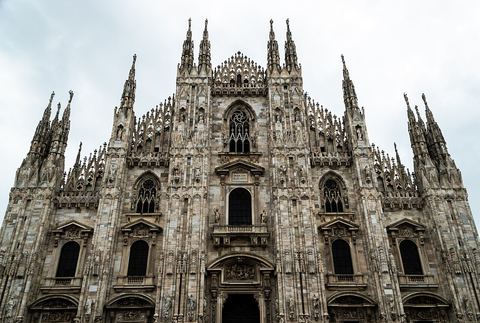
1 The facade
The last part of the Duomo to be finished. Napoleon wanted it done, and in 1805 he had himself crowned king of Italy here. The lower half is classical, the upper half Gothic, and the bronze doors all date from the twentieth century.
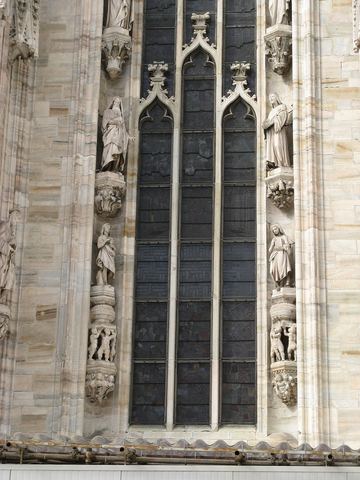
2 The Candoglia marble
All the marble of the Duomo comes from a single quarry near Lake Maggiore. It reached Milan by boat, with no charge for transport. The quarry is still open, and it is still the Fabbrica del Duomo, the cathedral's own works office, that runs it.
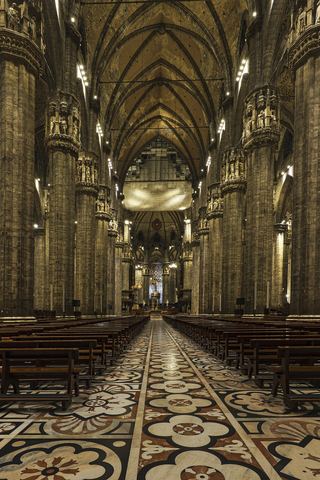
3 The central nave
Fifty-two pillars and vaults 45 meters above the floor: this is the most powerful view in the Duomo. A Gothic style that came from northern Europe, and that the Milanese builders remade in their own way.
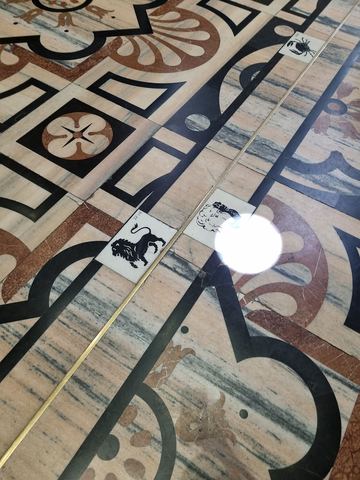
4 The sundial
A brass line in the floor and a tiny hole high above: this is a sundial from 1786. At noon a ray of sunlight falls on the strip, and for years Milan set its clocks this way.
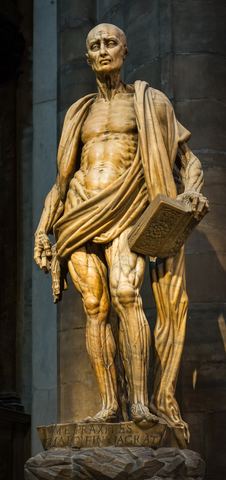
5 Saint Bartholomew and the transept
Perhaps the most famous statue in the Duomo: a flayed saint who carries his own skin over his shoulders. Marco d'Agrate carved it in 1562, and he was so proud of it that he signed it with a cocky line.
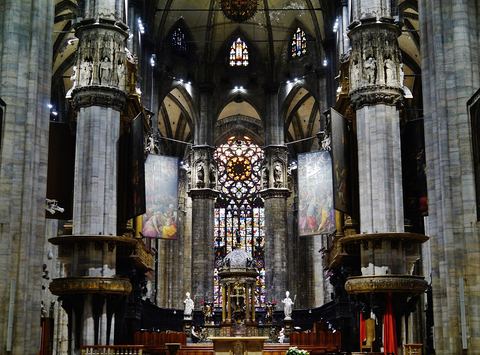
6 The presbytery and the Sacro Chiodo
The heart of the Duomo holds its most precious relic: the Sacro Chiodo, a nail that tradition says came from the cross of Jesus. It sits at the top of the vault, and to fetch it they use a seventeenth-century machine called the cloud.
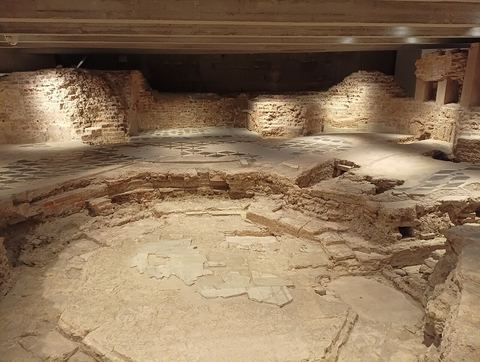
7 The baptistery under the square
Four meters below the square lie the remains of a fourth-century baptistery. Here, on Easter night in 387, the bishop Ambrose baptized Augustine. It is a thousand years older than the Duomo.
8 The terraces
You can walk on the roof of the Duomo. You have 135 spires within reach, thousands of statues seen from arm's length and, on top of it all, the Madonnina: the gilded statue of the Virgin that is the symbol of Milan.
Timeline
- 387On Easter night the bishop Ambrose baptizes Augustine in the baptistery of San Giovanni alle Fonti, now under the square.
- 1386The archbishop Antonio da Saluzzo launches the construction of the new cathedral.
- 1387Gian Galeazzo Visconti grants the Fabbrica the Candoglia quarry: the Duomo will be built of marble, not brick.
- 1490–1500Amadeo and Dolcebuono build the tiburio, after advice from various architects, including Leonardo da Vinci.
- 1576During the plague Carlo Borromeo carries the Sacro Chiodo in procession and orders the rite repeated every year.
- 1774The Madonnina, in gilded copper, is set on the tallest spire.
- 1805–1813Napoleon has himself crowned king of Italy in the Duomo and orders the facade finished; it is completed in 1813.
- 1965The last of the five bronze doors is unveiled: by convention, this is the date that closes the building works.
Who's who
Gian Galeazzo Visconti
lord of Milan
He wanted a Gothic cathedral in marble, able to rival those north of the Alps. In 1387 he granted the Candoglia quarry. His emblem, a radiant sun, is in the rose window of the apse.
Ambrose
bishop of Milan in the fourth century
Ambrogio in Italian. He had the baptistery of San Giovanni alle Fonti built, now in ruins under the square, and baptized Augustine there in 387. He is the city's patron saint.
Carlo Borromeo
archbishop of Milan, later a saint
In the later 1500s he redesigned the interior to follow the Council of Trent. In 1576, during the plague, he carried the Sacro Chiodo in procession. His body lies in the scurolo, under the altar.
Pellegrino Tibaldi
architect of the Fabbrica from 1567
Carlo Borromeo's trusted man, he redesigned the presbytery and drew up the first facade, in a classical taste. The classical forms on the lower part come from his design.
Marco d'Agrate
Lombard sculptor of the sixteenth century
He made the flayed Saint Bartholomew, dated 1562. He signed it on the base, comparing himself to Praxiteles, the great Greek sculptor.
Napoleon Bonaparte
emperor of the French and king of Italy
In 1805 he had himself crowned king of Italy in the Duomo and ordered the completion of the facade, stalled for centuries. The work ended in 1813.
Words to know
Where it is
The neighborhood
Historic Center
Related places
The story of the place
In 1386 Milan decides to rebuild its cathedral, the Duomo. The idea comes from the archbishop, Antonio da Saluzzo, but the man who gives it the scale you see is Gian Galeazzo Visconti, lord of the city. He wants a church that can compete with the great cathedrals of northern Europe.
That is why the Duomo is Gothic, a rare thing in Italy, and why it is not built of brick like almost everything else in Lombardy. Gian Galeazzo hands over a marble quarry at Candoglia, near Lake Maggiore, and has the blocks shipped by water all the way into the city.
How the building site grows
The trouble is that nobody in Milan has ever built anything like it. Experts arrive from Germany and France, argue with the local master builders, and leave again.
Meanwhile the church grows from the back: first the , then the , and much later the and aisles. The old cathedral stays standing in the middle of the building site and disappears a piece at a time. Around 1500 the is closed, the tower over the point where the arms of the church cross, after years of proposals and outside advice, including that of Leonardo da Vinci.
From Borromeo to Napoleon
In the sixteenth century comes Carlo Borromeo, an energetic archbishop, who redesigns the interior according to the rules of the Council of Trent and moves the altar to where you see it today. In 1774 the Madonnina, the gilded statue of the Virgin, goes up on the tallest .
The facade is still missing. Napoleon gets it moving in 1805, because he wants to be crowned king of Italy inside. The last bronze door dates from 1965.
A building site never closed
Almost six centuries, then. The Milanese got a saying out of it, lungo come la , as long as the building of the Duomo, for things that never end. And in fact it has not ended. The Veneranda Fabbrica, the body founded to build the church, still exists, still works the quarry and keeps replacing the worn stones.
Not everyone likes the result. Some consider it a marvel, others an overdose of stone lace. But it is hard to stay indifferent, and the best way to visit is to look at it from every height: from the square, from the floor, from underground and from the roof.
Sources
- Veneranda Fabbrica del Duomo di Milano, La cava di Candoglia (opens in a new tab)Official site
- Duomo, Catalogo generale dei beni culturali, scheda ICCD13909857 (opens in a new tab)Catalog
- Duomo di Milano, Lombardia Beni Culturali, scheda LMD80-00004 (opens in a new tab)Catalog
- Riprese del film «Rocco e i suoi fratelli», Lombardia Beni Culturali, scheda IMM-3a400-0000041 (opens in a new tab)Catalog
- Ufo, Vocabolario Treccani (opens in a new tab)Encyclopedia
- Rocco e i suoi fratelli, Italy for Movies (opens in a new tab)Institution
- Duomo di Milano, Wikipedia in italiano (opens in a new tab)Wikipedia
- Milan Cathedral, Wikipedia in inglese (opens in a new tab)Wikipedia
- Battistero di San Giovanni alle Fonti, Wikipedia in italiano (opens in a new tab)Wikipedia
- Madonnina (statue), Wikipedia in inglese (opens in a new tab)Wikipedia
- O mia bela Madunina, Wikipedia in italiano (opens in a new tab)Wikipedia
- Duomo di Milano, relazione OpenStreetMap (Wikidata Q18068) (opens in a new tab)Other source
- Il rito della Nivola e il Sacro Chiodo, MilanoFree (opens in a new tab)Other source
- La meridiana del Duomo, MilanoFree (opens in a new tab)Other source
- La Madonnina compie 250 anni, Avvenire (opens in a new tab)Other source
- Perché c'è una meridiana solare nel Duomo di Milano, Focus (opens in a new tab)Other source
- A ufo, Wikipedia in italiano (opens in a new tab)Wikipedia
- Living Stones of the Duomo, di Martina Saltamacchia, Catholic Rural Life (opens in a new tab)Other source
- La cattedrale, frutto di un popolo, La Nuova Bussola Quotidiana (opens in a new tab)Other source
- Il Duomo e la prostituta, Avvenire (opens in a new tab)Other source
- Giuseppe Brentano, Wikipedia in italiano (opens in a new tab)Wikipedia
- Giuseppe Brentano, Wikipedia in inglese (opens in a new tab)Wikipedia
- Progetto di Giuseppe Brentano per la facciata del Duomo, Lombardia Beni Culturali, scheda IMM-3a010-0002391 (opens in a new tab)Catalog
- Cosa ci fanno due pugili sulla facciata del Duomo di Milano, Focus (opens in a new tab)Other source
- Perché sul tetto del Duomo di Milano ci sono due pugili, Geopop (opens in a new tab)Other source
- Le origini del cantiere del Duomo, MilanoFree (opens in a new tab)Other source
- Giulia Ceriani Sebregondi, The Debate of 1400 on the Elevation of Milan Cathedral, Resourceedings (opens in a new tab)Other source
- Ad usum fabricae, la costruzione del Duomo di Milano: trascrizione del convegno con Martina Saltamacchia, Meeting di Rimini (opens in a new tab)Institution
- La via della bellezza su cui è costruito il Duomo di Milano, Tempi (opens in a new tab)Other source
- Brentano, Giuseppe, Dizionario Biografico degli Italiani, Treccani (opens in a new tab)Encyclopedia
- Le porte bronzee del Duomo di Milano, MilanoFree (opens in a new tab)Other source
- I milanesi si prendono cura del loro Duomo, di Elisabetta Povoledo, Internazionale (opens in a new tab)Other source
- Giulia Ceriani Sebregondi, The Debate of 1400 on the Elevation of Milan Cathedral, testo completo su Zenodo (opens in a new tab)Institution