Stop 1 of 8
The Devil's Column
Where to stand
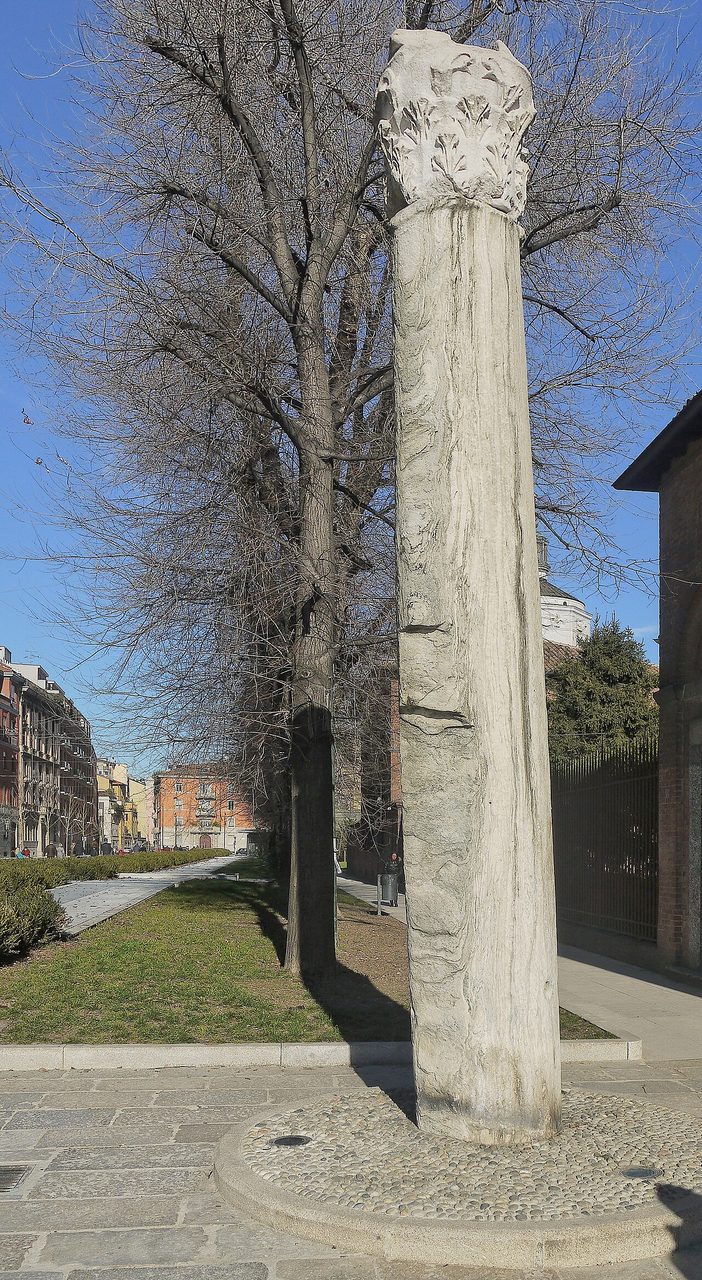
In Piazza Sant'Ambrogio, facing the basilica: a lone marble column with its capital still on top
A Roman column left standing alone in the square, with two holes in the marble. Legend says they are the marks of the devil's horns, after Ambrose got the better of him. Scholars say it is a piece of the emperors' palace.
Spot the detail
The two holes in the marble, side by side
The full story
Before you go into the basilica, look around the square for a column that holds up nothing. It is marble, topped by a Corinthian capital, meaning one carved with leaves. It stands there on its own, and the Milanese have a name for it that is hard to forget: the Colonna del Diavolo, the Devil's Column.
Here is the story, and take it for what it is: a legend. One day the devil came to Ambrose, bishop of Milan, to tempt him. The saint lost his patience and gave him a kick.
The devil ended up with his horns stuck in the column. He stayed wedged there for a whole day. Then he vanished through the two holes, down toward hell. In another version he was the one who charged, head down: he missed the bishop and hit the marble.
The two holes really are there. Popular tradition insists they give off a smell of sulfur. And that if you press your ear to the stone, you can hear the Styx, the river of hell, gurgling below. The writer Carlo Romussi took the miracle apart in one line: anyone who cups a hand over an ear hears the same hum.
A piece of the imperial palace
The true story is quieter, but bigger. The column is Roman. Scholars believe it comes from Milan's imperial palace, built at the end of the third century, when the city became capital of the Western Roman Empire.
Over the following centuries the palace was taken apart piece by piece, and the column ended up here, in the area of the old martyrs' cemetery. A nineteenth-century dig found a tomb right beneath its base: perhaps the column was there to mark it.
The emperors' oath
In the Middle Ages this column was serious business. Galvano Fiamma, a fourteenth-century chronicler, describes what an emperor had to do when he came to be crowned king of Italy in Sant'Ambrogio.
He came here, before the column, and swore loyalty to the pope and the Church. He received the crown. Then he embraced the column. The gesture meant that his justice would be as straight as that marble.
So you are looking at one stone playing three parts: a piece of a palace, a witness to kings, a souvenir of a brawl with the devil. Milan has chosen to remember the last one most of all.
It is a good warning for what awaits you inside. At Sant'Ambrogio every ancient object has two stories, the archaeologists' and the Milanese people's. It pays to listen to both.
About this stop
Legend
The Column with the Devil's Horn Marks
In Piazza Sant'Ambrogio, facing the basilica, a lone Roman column stands with two holes in its marble. According to legend, this is where the devil tried to tempt Ambrose, bishop of Milan. The saint answered with a kick, and the devil ended up with his horns stuck in the column. He stayed there a whole day, then vanished through the two holes. Tradition adds that the holes smell of sulfur and that, if you put your ear to them, you can hear the Styx, the river of hell, gurgling. The writer Carlo Romussi took it philosophically: anyone who cups a hand over an ear hears that hum.
Tradition says yes. Several coronations are recorded, from that of Otto I in 961 to that of Charles IV of Luxembourg in 1355. The chronicler Galvano Fiamma, in the fourteenth century, also describes the rite: the emperor took an oath in front of the column that now stands in the square, received the crown, then embraced the column. It meant that his justice would be as straight as that marble.
This stop on the map
Next stop
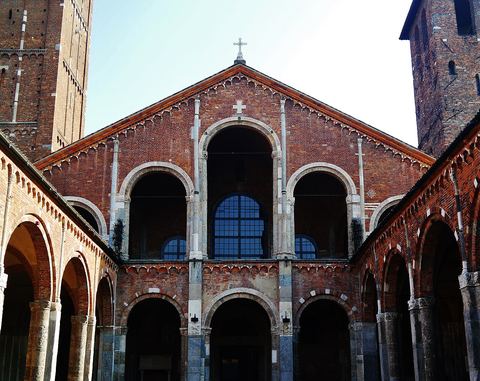
Go into the basilica precinct and stop in the middle of the porticoed courtyard, facing the facade