Museum · Historic Center · 1775–1911
Gallerie d'Italia
Three palaces stitched together, and a bank that opened its rooms to paintings
In brief
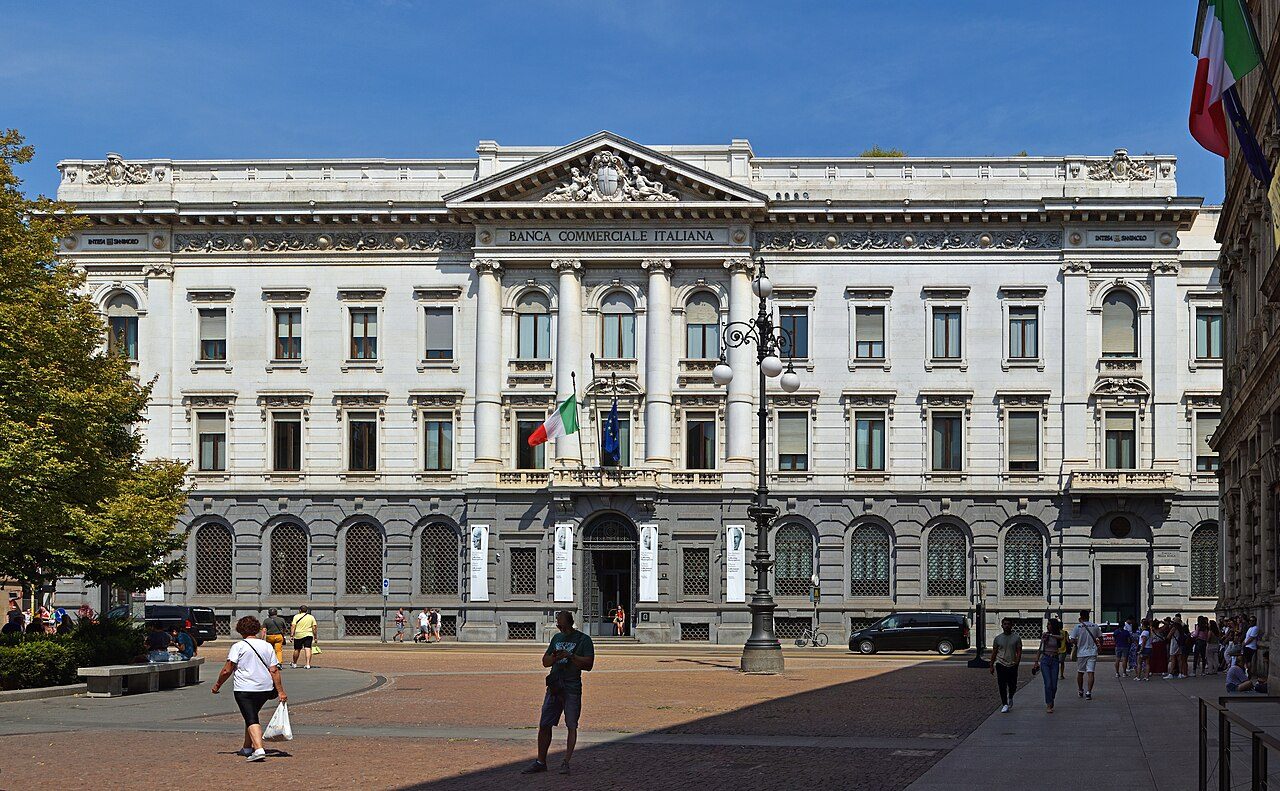
The museum on Piazza della Scala fills three palaces, from the 1700s to the early 1900s, and follows Italian art from Antonio Canova to Umberto Boccioni and on into the later twentieth century. You walk into a bank and end up in a count's house, by way of the vault.
Stories of this place
- Anecdote · The bank buildingReadThe broken houses under the bankWhere you now enter the Gallerie d'Italia, on Piazza della Scala, there used to be a church: San Giovanni Decollato alle Case Rotte. The name comes from revenge. In 1311 the Torriani, a powerful Milanese family, were defeated and lost power. Their houses were pulled down and the city banned rebuilding. The ruins stayed, and people called them the case rotte, the broken houses. The church rose on top and was demolished in late 1907 for the Banca Commerciale Italiana, the bank building that is now the museum entrance. The facade survived: it was taken apart and reassembled in 1924 on the side of the church of Santa Maria Segreta.
- Anecdote · The bank buildingReadThe register of the executed and BeccariaWhere you enter the Gallerie d'Italia, on Piazza della Scala, a church stood until 1907: San Giovanni Decollato alle Case Rotte. It was home to the Bianchi, the Whites, a confraternity with a grim task: comforting those condemned to death and walking them to the scaffold. The brothers logged the executions in registers, from 1471 to 1783: more than three thousand. One such register was found among the papers of Cesare Beccaria, the Milanese thinker, and stops in 1764: the year his Dei delitti e delle pene, the book against the death penalty, came out. Whether it inspired him is uncertain: one historian thinks it possible, another scholar doubts it.
- Anecdote · The bank buildingReadThe banker, the anti-Fascists and the booksIn the historic headquarters of the Banca Commerciale Italiana, today the Gallerie d'Italia, from 1933 to 1972 the top man was Raffaele Mattioli, no ordinary banker. In the last years of Fascism the bank's research office, run by its director Ugo La Malfa, became an organizing center for the anti-Fascist Partito d'Azione, the Action Party. In 1938, quietly, Mattioli took over the Ricciardi publishing house of Naples, which later brought out a great series of Italian classics. By one account he also helped keep in a bank safe in Rome the notebooks written in prison by Antonio Gramsci, the Communist thinker and leader. There is, however, no written proof.
- Anecdote · The vaultReadThe vault as seen by a film pioneerAt the Gallerie d'Italia, the museum on Piazza della Scala, the vault of the former Banca Commerciale Italiana was photographed in 1911, brand new. Several of those pictures are by Luca Comerio, a Milanese photographer whose life is worth a movie. Not yet twenty, he had photographed the 1898 Milan riots, among barricades and soldiers. He became court photographer, then switched to the movie camera and in 1907 founded Milan's first film production company. In 1911 he also filmed the war in Libya. It ended badly: jobless, poor and ill, he died in 1940 in the Mombello psychiatric hospital. He had filmed kings and battles. And, once, a safe.
- Record · The vaultReadFive hundred paintings in a bank vaultAt the Gallerie d'Italia, the museum born inside a bank on Piazza della Scala, the twentieth-century works rotate, and the numbers explain why. The collection of twentieth-century and present-day art of Intesa Sanpaolo, the bank behind the museum, alone runs to more than three thousand works. In 2011, when the museum opened, the group owned about ten thousand in all. There are never enough walls. That is why about five hundred paintings are kept in the vault, the strongroom in the basement, hung on sliding panels where the safe-deposit boxes used to be. It is a storeroom where, for once, you are allowed to peek.
- In culture · Hayez and I due FoscariReadThe Foscari of Byron, Hayez and VerdiAt the Gallerie d'Italia, in the room of painter Francesco Hayez, the big canvas I due Foscari shows Francesco Foscari, doge of Venice, forced to exile his son Jacopo. That story has done the rounds of the arts. The English poet Lord Byron made a tragedy of it in 1821. Hayez painted it between 1838 and 1840, working from the Frenchman Pierre Daru's history of Venice. The composer Giuseppe Verdi set it to music in 1844, in an opera of the same name. So the painting does not illustrate the opera: it comes four years earlier. But it speaks the same language: sweeping gestures, sumptuous costumes and unhappy fathers.
- Anecdote · The Risorgimento and the Milan that vanishedReadInduno, the soldier painterAt the Gallerie d'Italia, in the Risorgimento rooms, the huge Battaglia della Cernaia is by Milanese painter Gerolamo Induno. He painted wars because he fought them. In 1848 he joined the Cinque Giornate, Milan's five-day uprising, and had to flee to Switzerland. In 1849 he volunteered to defend Rome against the French and was badly wounded. He went to Crimea with the Piedmontese bersaglieri, the light infantry, drawing the war on the spot. Then he followed General Giuseppe Garibaldi. He also had a temper. In 1861 another painting of his, the Battaglia di Magenta, won a gold medal in Florence: he turned it down, in solidarity with artists left unrewarded.
- Anecdote · Boccioni before FuturismReadBoccioni painted the outskirts by his homeAt the Gallerie d'Italia, in the room of painter Umberto Boccioni, hangs Officine a Porta Romana: a view of the outskirts, with smoke from chimneys in the distance. Boccioni did not go far for his subject. He lived on Via Adige, in Milan, in a still rural area where streets and factories were arriving. The painting, from 1909 to 1910, shows the landscape around his home. The balcony on Via Adige is also where the woman stands in a later painting of his, La strada entra nella casa. The painter who would soon celebrate the modern city did not need to look for it: it was growing on his doorstep.
- AnecdoteReadA shot at King Carlo AlbertoThe Gallerie d'Italia, the museum on Piazza della Scala, fills three palaces, and one has a balcony that made history: the one on Palazzo Brentani, above the main door on Via Manzoni. In early August 1848 Carlo Alberto, king of Sardinia, stepped out onto it. Just beaten by the Austrians at Custoza, he was the guest of the Greppi counts, the owners then. Below was a furious crowd: the Milanese would not hear of surrender. The king tried to calm them and, as the story goes, a rifle shot narrowly missed him. The painter Carlo Bossoli painted the scene in 1860: the picture is in Milan's Museo del Risorgimento.
- In cultureReadThe stone mask that spat out the trashThe Gallerie d'Italia, the museum on Piazza della Scala, also includes Palazzo Brentani, on Via Manzoni. Look on the facade, left of the main door: the Lombardy heritage catalog records a stone mask there, with a monstrous mouth. The Milanese called it boffacrusca, and it was no ornament: through that mouth household trash went into the street. It was so famous that Carlo Porta, the great Milanese dialect poet, made an insult of it. In an 1816 poem he mocks bullies who think themselves the cream of the wise just for being related to the boffacrusca de la cà Brentana. Related, that is, to a stone face that spits garbage.
Ready-made questions
Because banks bought a lot of art over the years, and merger after merger the collections added up. Milan was home to those of Cariplo, a savings bank, now owned by the Fondazione Cariplo, and of the Banca Commerciale Italiana, later absorbed into Intesa Sanpaolo. For a long time those works stayed in the bank's buildings, enjoyed by a lucky few. In 2011 the decision was made to show them to everyone, using the historic premises on Piazza della Scala.
Because it is not just one museum. Gallerie d'Italia, the galleries of Italy, is the name that brings together Intesa Sanpaolo's museums in several cities: Milan, Naples, Turin and Vicenza. Each one occupies a historic building and has its own collections. The Milan museum, opened in 2011, was at first called Gallerie di piazza Scala. And the plural suits it anyway: there are three palaces here, one inside the other.
Three things, in order of date. Canova's plaster reliefs, white and thin, which open the nineteenth-century route. I due Foscari by Hayez, the big painting with the old doge and his condemned son. And the last room, with Tre donne by Boccioni. They are the beginning, the heart and the end of the same story. If you have a minute to spare and find it open, go down and see the : it is a sight you rarely get in a museum.
By choice. When Luca Beltrami designed it, in the early 1900s, the fashion was for Liberty, the Italian Art Nouveau. He preferred columns, a and symmetry: a style, serious and imposing, fit for an institution that looked after money. There was also a matter of good neighborliness. The square already had two stars, the Teatro alla Scala and Palazzo Marino, and Beltrami designed the facade to converse with both, picking up the rhythm of the arches of the one and the three bands of the other.
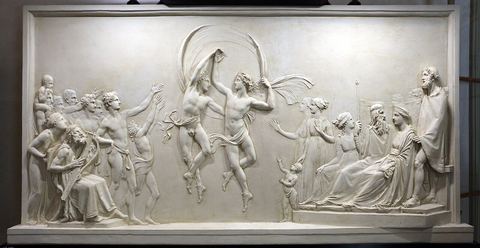
Go to stop: The bank buildingBecause these reliefs are not preparatory models: they were made to stay this way. Canova most probably worked out the scenes between 1787 and 1792, then had copies cast in plaster for Prince Abbondio Rezzonico, who wanted them for his villa at Bassano. None was ever translated into marble. Each piece was taken from a model and finished by hand, and Canova was keen to present it as an original. The sources disagree on one point: for some it was a gift, for others a commission.
Go to stop: Canova's plaster reliefsHe became one, but a moment later. The four works in this room date from the years around 1910, when Boccioni was still working in the technique of , with small separate strokes of color. In 1910 itself he signed the manifesto of the Futurist painters, and from then on everything changed. That is why Tre donne is so interesting: it is a transitional painting, the last step before the leap. The Futurist Boccioni is at the Museo del Novecento, in Piazza del Duomo.
Go to stop: Boccioni before FuturismNot the ones in the center. The nineteenth-century show a Milan crisscrossed by water, with locks, bridges, barges and washerwomen. The museum itself notes that they no longer exist today. In the twentieth century the inner canals were covered over and became streets. To see water you have to head south, where the Naviglio Grande canal and the Darsena, the old city dock, survive. These paintings are the most precise record of what the city was like before.
Go to stop: The Risorgimento and the Milan that vanishedThe stops
1 The bank building
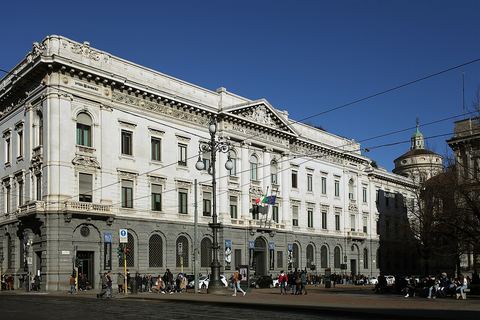
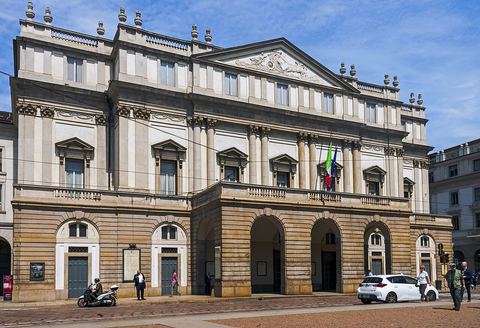
It looks like a temple; it was a bank. Luca Beltrami designed it between 1906 and 1911 for the Banca Commerciale Italiana, tuning it to the buildings next door. Today it is the entrance to the museum.
2 The banking hall and the Cantiere del '900
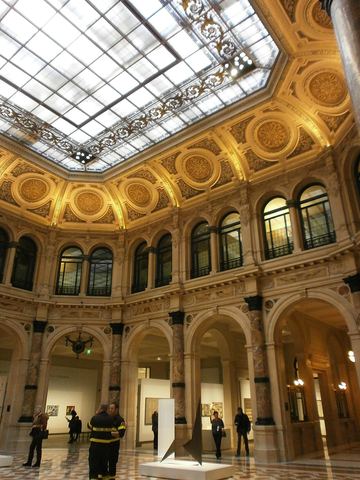
Where banking went on for a century you now find Italian art of the later twentieth century: Fontana, Burri, Vedova, Dorazio. It is called the Cantiere, the worksite, because it never stands still: the works rotate, picked from a collection of over three thousand.
3 The vault
The bank's strongroom, designed by Beltrami in the early 1900s, now holds about five hundred paintings instead of jewels and securities. It is a storeroom that lets itself be looked at.
4 Canova's plaster reliefs
Thirteen plaster bas-reliefs in which Antonio Canova tells Homer, the death of Socrates and the works of mercy. They are not drafts: they were born in plaster and in plaster they stayed.
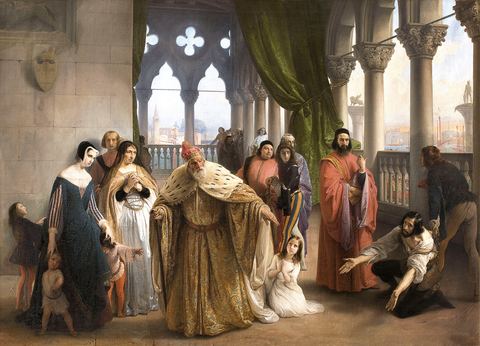
5 Hayez and I due Foscari
A father forced to send his son into exile: Francesco Hayez turns a page of Venetian history into a painted melodrama. The picture was made for the emperor of Austria and stayed in the imperial collections for almost ninety years.
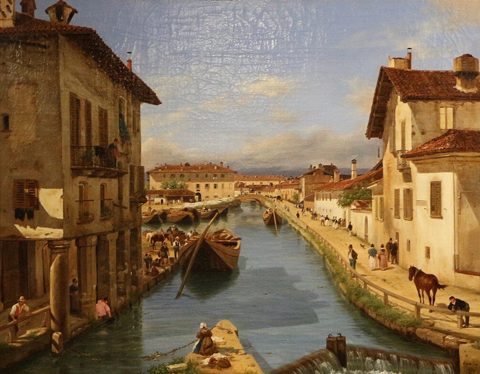
6 The Risorgimento and the Milan that vanished
Two ways of telling the nineteenth century: battles painted by men who had fought in them, and views of a Milan full of canals and boats. The first shows an Italy being born, the second a city that is no longer there.
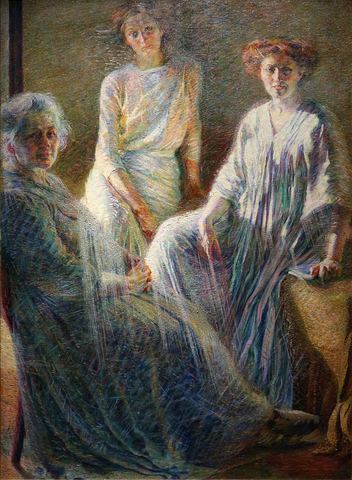
7 Boccioni before Futurism
Four works from the years around 1910, a moment before Umberto Boccioni becomes the painter of Futurism. Tre donne, three women, portrays his mother, his sister and Ines, the woman he was involved with, in a light that floods the whole room.
8 The cloister and the Garden of Alessandro
Luigi Canonica's neoclassical courtyard, now closed in with glass, is the hinge between a count's house and a lawyer's. Behind it is a garden that borders the home of Alessandro Manzoni.
Timeline
- by 1720Giuseppe Brentani has his palace built on what is now Via Manzoni.
- 1775–1778Carlo Felice Soave turns Count Anguissola's house into one of the most elegant homes in Milan.
- 1829Luigi Canonica builds the wing on Via Manzoni, with the cloister, for the lawyer Traversi, and redesigns Palazzo Brentani.
- 1848In early August King Carlo Alberto steps out onto the balcony of Palazzo Brentani before a hostile crowd.
- 1906–1911Luca Beltrami builds the headquarters of the Banca Commerciale Italiana on Piazza della Scala.
- 2011In November the Gallerie open in the palaces on Via Manzoni, with the nineteenth century from Canova to Boccioni.
- 2012The bank building joins the museum with the Cantiere del '900.
- 2015The garden between the museum and the Casa del Manzoni opens to the public.
Who's who
Luca Beltrami
architect
Between 1906 and 1911 he designed the Banca Commerciale headquarters, vault included. On the same square he had already designed the facade of Palazzo Marino.
Luigi Canonica
architect from Ticino
In 1829 he built the wing on Via Manzoni for the lawyer Traversi, with the cloister and the grand staircase, and gave Palazzo Brentani its sober look.
Antonio Canova
sculptor
One of the greatest masters of Neoclassicism. His thirteen plaster bas-reliefs, made for Prince Abbondio Rezzonico, open the nineteenth-century route.
Francesco Hayez
painter
Born in Venice in 1791, died in Milan in 1882. With I due Foscari he puts on canvas a Venetian story that looks like an opera.
Gerolamo Induno
painter and soldier
Milanese, born in 1825. He fought in Milan and in Rome, followed the army to Crimea, and painted the battles of the Risorgimento after seeing them from the inside.
Umberto Boccioni
painter and sculptor
Born in 1882, died in 1916. Here he is in the months just before Futurism, with Tre donne and three other works that close the route.
Words to know
Where it is
The neighborhood
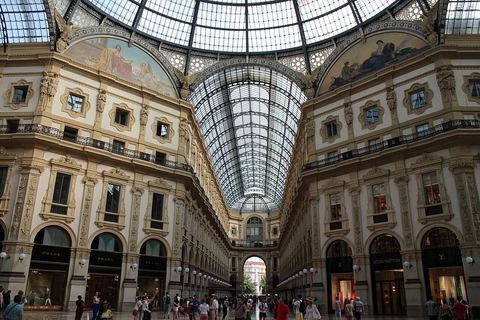
Historic Center
Related places
The story of the place
From outside you see a bank with columns. Inside you discover it is only the last of three palaces stitched together: a whole city block between Piazza della Scala, Via Manzoni and Via Morone. This is the museum a bank carved out of its own rooms.
Three palaces, three Milans
The oldest is Palazzo Anguissola Antona Traversi, which grew out of a noble house that already stood here in the 1500s. Between 1775 and 1778 the architect Carlo Felice Soave turned the house of Count Antonio Carlo Anguissola into one of the most elegant homes in the city. In 1817 it was bought by a wealthy lawyer, Giovanni Battista Traversi, who in 1829 had the architect Luigi Canonica add the wing on Via Manzoni.
Next door is Palazzo Brentani, built by 1720 and redesigned by the same Canonica. It is a sober building, with a row of medallions on the facade and a balcony that has watched history go by.
The third is the showiest: the headquarters of the Banca Commerciale Italiana, built between 1906 and 1911 by Luca Beltrami, the architect to whom the square owes much of its look. This is where you go in.
From the safes to the walls
The works come from the collections of two Milanese institutions: the Fondazione Cariplo, a banking foundation, and Intesa Sanpaolo, the bank that absorbed the Commerciale. For a long time very few people saw them, hanging as they did in offices and reception rooms.
In November 2011 the palaces on Via Manzoni opened with about two hundred nineteenth-century works, from Antonio Canova to Umberto Boccioni. A year later the bank building joined them, with Italian art of the later twentieth century.
How the visit unfolds
You start in the square, in front of the facade. Then you step into the banking hall and go down to see the , the bank's strongroom. From there the nineteenth-century route begins: Canova's plaster reliefs, the history paintings of Francesco Hayez, the battles of the Risorgimento, the Milan of the canals, all the way to the last room with Boccioni. You finish in the cloister and the garden.
If you only have time for three things, make them Canova, Hayez and Boccioni. The rest is the pleasure of crossing three Milanese houses without ever stepping out into the street.
Sources
- Gallerie d'Italia Milano, il museo e i suoi palazzi (opens in a new tab)Official site
- Gallerie d'Italia, Palazzo Beltrami ex Banca Commerciale Italiana (opens in a new tab)Official site
- Gallerie d'Italia, Palazzo Anguissola Antona Traversi (opens in a new tab)Official site
- Gallerie d'Italia, Palazzo Brentani (opens in a new tab)Official site
- Gallerie d'Italia, il giardino di Alessandro Manzoni (opens in a new tab)Official site
- Gallerie d'Italia Milano, le collezioni permanenti (opens in a new tab)Official site
- Gallerie d'Italia Milano, l'Ottocento: da Canova a Boccioni (opens in a new tab)Official site
- Gallerie d'Italia Milano, il Novecento: Cantiere del '900 (opens in a new tab)Official site
- Gallerie d'Italia Milano, il Caveau (opens in a new tab)Official site
- Gallerie d'Italia Milano, il Giardino d'Alessandro (opens in a new tab)Official site
- Gallerie d'Italia, scheda di Tre donne di Umberto Boccioni (opens in a new tab)Official site
- Gallerie d'Italia, In viaggio con Hector: Antonio Canova, Danza dei figli di Alcinoo (opens in a new tab)Official site
- Intesa Sanpaolo, le collezioni permanenti di Milano in piazza Scala (opens in a new tab)Institution
- Intesa Sanpaolo Progetto Cultura, The Secret Garden nel chiostro delle Gallerie d'Italia (opens in a new tab)Institution
- Antonio Canova, La Speranza, Fondazione Cariplo su Google Arts & Culture (opens in a new tab)Catalog
- Antonio Canova, La Carità, Fondazione Cariplo su Google Arts & Culture (opens in a new tab)Catalog
- Francesco Hayez, I due Foscari, Fondazione Cariplo su Google Arts & Culture (opens in a new tab)Catalog
- Gerolamo Induno, La battaglia della Cernaia, Fondazione Cariplo su Google Arts & Culture (opens in a new tab)Catalog
- Giuseppe Canella, Veduta del Naviglio dal ponte di San Marco, Fondazione Cariplo su Google Arts & Culture (opens in a new tab)Catalog
- Induno, Gerolamo, Enciclopedia Treccani (opens in a new tab)Encyclopedia
- Mattioli, Raffaele, Dizionario Biografico degli Italiani, Enciclopedia Treccani (opens in a new tab)Encyclopedia
- Palazzo Brentani Greppi, Lombardia Beni Culturali, scheda LMD80-00292 (opens in a new tab)Catalog
- Umberto Boccioni, Officine a Porta Romana, Lombardia Beni Culturali, scheda RL480-00055 (opens in a new tab)Catalog
- Luca Comerio, Moti del 1898: soldati presso una barricata, Lombardia Beni Culturali, scheda IMM-LOM60-0003743 (opens in a new tab)Catalog
- Carlo Porta, Al sur Tommas Gross a Trevij, 21 agosto 1816, Wikisource (opens in a new tab)Other source
- Carlo Porta, Poesie milanesi, introduzione «A Milano con Carlo Porta», Wikisource (opens in a new tab)Other source
- Boccioni prima di Boccioni, mostra al Gabinetto dei Disegni del Castello Sforzesco, Artsupp (opens in a new tab)Other source
- Loredana Garlati, Pink crimes. Criminalità femminile e condanne capitali nelle sentenze del Senato di Milano (1471-1783), Historia et ius 17/2020, Università di Milano-Bicocca (opens in a new tab)Institution
- Iscrizione dei confratelli di San Giovanni Battista Decollato, Lombardia Beni Culturali, scheda B0310-00281 (opens in a new tab)Catalog
- Milano, chiesa di San Giovanni Decollato alle Case Rotte, interno durante la demolizione, 1907, Lombardia Beni Culturali, scheda IMM-3a010-0001650 (opens in a new tab)Catalog
- Pierre Musitelli, «Giustizia fatta»: observations sur un registre des condamnés à mort (1471–1764) de la bibliothèque de Beccaria, Modern Languages Open, 2024 (opens in a new tab)Institution
- Pierfranco Bianchetti, Luca Comerio, un fotografo con la cinepresa, Lombardia Spettacolo (opens in a new tab)Other source
- Luca Comerio & C., i manifesti storici al Museo Interattivo del Cinema di Milano, CinemaItaliano.info (opens in a new tab)Other source
- Speciale Gallerie di piazza Scala, Artribune, dicembre 2011 (opens in a new tab)Other source
- Gallerie di piazza Scala, Wikipedia in italiano (opens in a new tab)Wikipedia
- Gallerie di Piazza Scala, Wikipedia in inglese (opens in a new tab)Wikipedia
- Palazzo Anguissola Antona Traversi, Wikipedia in italiano (opens in a new tab)Wikipedia
- Palazzo Brentani, Wikipedia in italiano (opens in a new tab)Wikipedia
- Palazzo della Banca Commerciale Italiana, Wikipedia in italiano (opens in a new tab)Wikipedia
- Chiesa di San Giovanni Decollato alle Case Rotte, Wikipedia in italiano (opens in a new tab)Wikipedia
- Three Women (Boccioni), Wikipedia in inglese (opens in a new tab)Wikipedia
- Charles Albert on the Balcony of Casa Greppi, Wikipedia in inglese (opens in a new tab)Wikipedia
- Luca Comerio, Wikipedia in italiano (opens in a new tab)Wikipedia
- Officine a Porta Romana, Wikipedia in italiano (opens in a new tab)Wikipedia
- La strada entra nella casa, Wikipedia in italiano (opens in a new tab)Wikipedia
- Raffaele Mattioli, Wikipedia in italiano (opens in a new tab)Wikipedia
- Gallerie d'Italia – Milano, Wikidata (Q2054135) (opens in a new tab)Other source
- Gallerie d'Italia, OpenStreetMap (node 2324825968) (opens in a new tab)Other source