Stop 1 of 8
The bank building
Where to stand
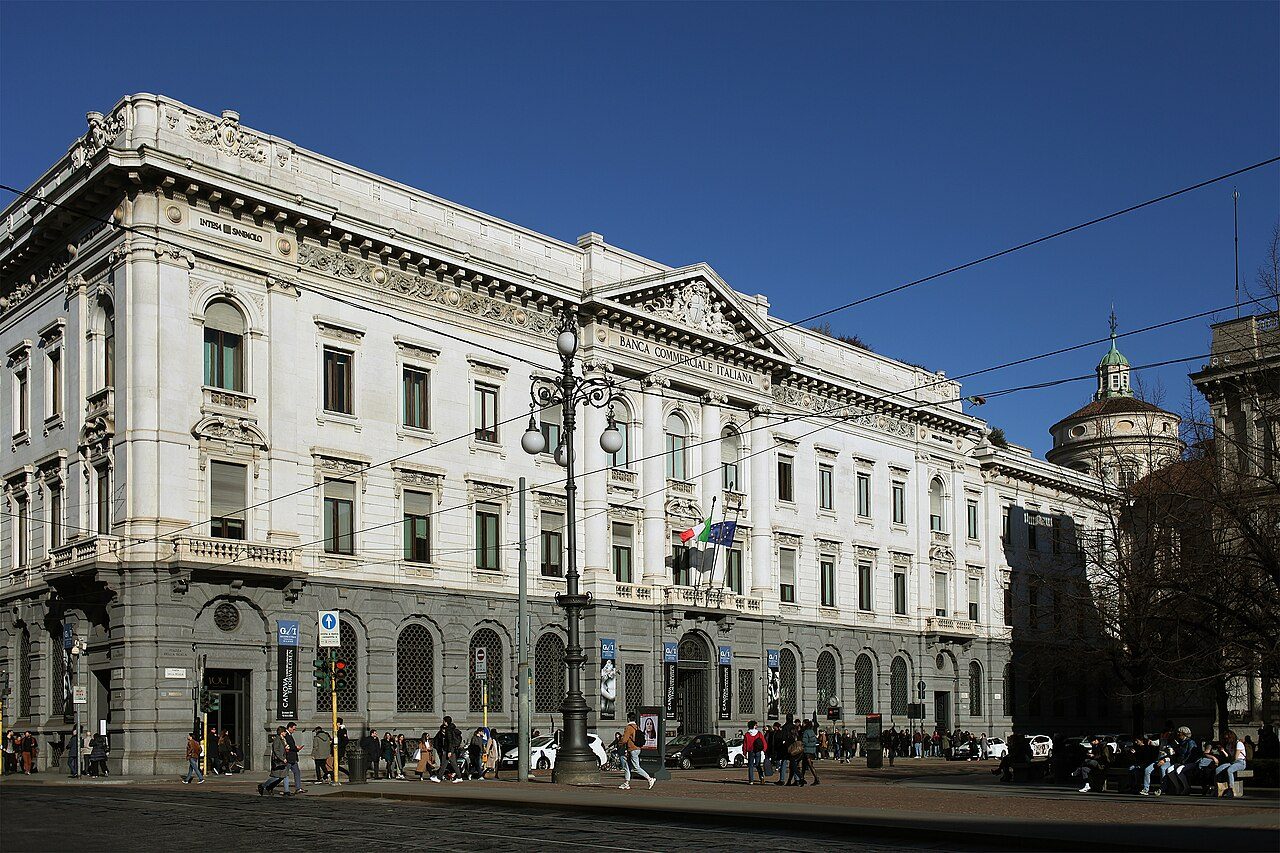
In Piazza della Scala, facing the facade with the columns and the pediment, far enough back to take it all in
It looks like a temple; it was a bank. Luca Beltrami designed it between 1906 and 1911 for the Banca Commerciale Italiana, tuning it to the buildings next door. Today it is the entrance to the museum.
Spot the detail
Look at the building's dark base, then at the portico of the Teatro alla Scala: what do they have in common?
The full story
Without the banners you would walk straight past. It could be a ministry, or a courthouse. It was a bank, and it was keen to look like one.
Read it from the bottom up. At street level there is a dark base of polished granite, cut in blocks. Above it the building turns pale, and at the center four Ionic columns rise to carry a , as on a temple. The contrast between dark and light lifts a facade that would otherwise weigh a ton.
A hometown architect
The Banca Commerciale Italiana wanted a new headquarters, and it entrusted the job to Luca Beltrami, a Milanese architect then at the height of his fame. Everyone in town knew him: he was the man who had saved and restored the Castello Sforzesco, the city's castle. And this square was already partly his, because he had designed the facade of Palazzo Marino, the city hall.
The fashion in those years was Liberty, the Italian Art Nouveau, all curves and flowers. Beltrami went the other way: a style, severe and symmetrical. A bank is supposed to inspire trust, not cheerfulness.
But there is another reason too, and you can see it by turning your head. The base picks up the beat of La Scala's arches. The three bands of the facade repeat those of Palazzo Marino. The building was born to sing in chorus with its neighbors.
There was a church underneath
To make room for it, an old church was torn down at the end of 1907: San Giovanni Decollato alle Case Rotte. It had long been deconsecrated and had served as the city archive for some thirty years, but its end still drew protests from an artists' association.
Something was saved. The facade was taken apart piece by piece and put back together in 1924 in another part of the city, on the side of the church of Santa Maria Segreta.
The bank stayed here for a century. Then it changed trades and opened its doors: the temple of money became a home for paintings.
About this stop
Anecdote
The broken houses under the bank
Where you now enter the Gallerie d'Italia, on Piazza della Scala, there used to be a church: San Giovanni Decollato alle Case Rotte. The name comes from revenge. In 1311 the Torriani, a powerful Milanese family, were defeated and lost power. Their houses were pulled down and the city banned rebuilding. The ruins stayed, and people called them the case rotte, the broken houses. The church rose on top and was demolished in late 1907 for the Banca Commerciale Italiana, the bank building that is now the museum entrance. The facade survived: it was taken apart and reassembled in 1924 on the side of the church of Santa Maria Segreta.
Anecdote
The register of the executed and Beccaria
Where you enter the Gallerie d'Italia, on Piazza della Scala, a church stood until 1907: San Giovanni Decollato alle Case Rotte. It was home to the Bianchi, the Whites, a confraternity with a grim task: comforting those condemned to death and walking them to the scaffold. The brothers logged the executions in registers, from 1471 to 1783: more than three thousand. One such register was found among the papers of Cesare Beccaria, the Milanese thinker, and stops in 1764: the year his Dei delitti e delle pene, the book against the death penalty, came out. Whether it inspired him is uncertain: one historian thinks it possible, another scholar doubts it.
Anecdote
The banker, the anti-Fascists and the books
In the historic headquarters of the Banca Commerciale Italiana, today the Gallerie d'Italia, from 1933 to 1972 the top man was Raffaele Mattioli, no ordinary banker. In the last years of Fascism the bank's research office, run by its director Ugo La Malfa, became an organizing center for the anti-Fascist Partito d'Azione, the Action Party. In 1938, quietly, Mattioli took over the Ricciardi publishing house of Naples, which later brought out a great series of Italian classics. By one account he also helped keep in a bank safe in Rome the notebooks written in prison by Antonio Gramsci, the Communist thinker and leader. There is, however, no written proof.
By choice. When Luca Beltrami designed it, in the early 1900s, the fashion was for Liberty, the Italian Art Nouveau. He preferred columns, a and symmetry: a style, serious and imposing, fit for an institution that looked after money. There was also a matter of good neighborliness. The square already had two stars, the Teatro alla Scala and Palazzo Marino, and Beltrami designed the facade to converse with both, picking up the rhythm of the arches of the one and the three bands of the other.
This stop on the map
Next stop
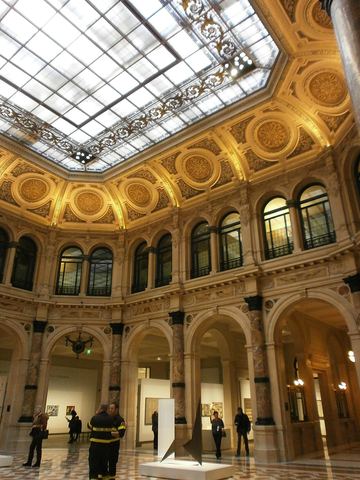
Go in through the main door and stop in the bank's great hall