Stop 6 of 8
The Risorgimento and the Milan that vanished
Where to stand
In the rooms after Hayez, among the big battle canvases and the views of Milan
Two ways of telling the nineteenth century: battles painted by men who had fought in them, and views of a Milan full of canals and boats. The first shows an Italy being born, the second a city that is no longer there.
Spot the detail
In the huge Battaglia della Cernaia, look for a gesture of pity among the soldiers
The full story
Up to here painting told faraway stories, of doges and Greek heroes. In these rooms it becomes reporting. The painters paint what they saw, and some of them what they risked.
The painter who was there
The picture you cannot miss is the Battaglia della Cernaia, the Battle of the Chernaya: it is nearly five meters wide, about 16 feet. It shows a clash of August 16, 1855, in Crimea, where the Piedmontese army was fighting the Russians alongside the British and the French. General Alfonso La Marmora dominates the center on horseback. On the horizon the troop movements along the river are no more than a glimmer.
It was painted by Gerolamo Induno, a Milanese, and not from hearsay. He joined the Crimean expedition with the bersaglieri, the light infantry, drawing on the spot: his views were used by the War Ministry. Two years later he turned them into this canvas, which King Victor Emmanuel II bought for his castle at Racconigi.
Induno knew war well. He had taken part in the Cinque Giornate, the five days of Milan's 1848 uprising, had been badly wounded defending Rome in 1849, and later followed Garibaldi. In his paintings uniforms and light have the precision of someone who was there.
His brother Domenico Induno, a painter too, looks at the same history from the other side: that of the people who stay home. In his pictures a war bulletin arrives, or a wounded soldier comes back. They are household scenes, and often the truest ones.
The city with water
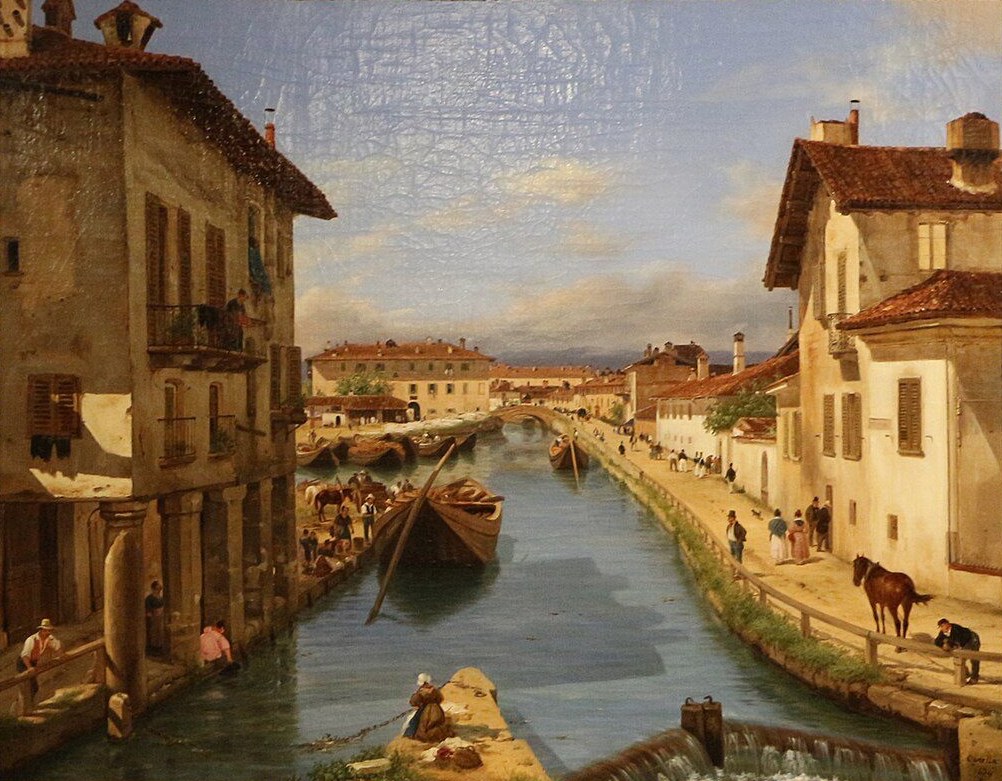
Then the subjects change, and Milan appears. These are the , or views: portraits of squares, churches and canals, painted with photographic precision before photography.
Look for the one by Giuseppe Canella with the Naviglio, the city canal, seen from the San Marco bridge, from 1834. In the foreground there is a lock. Barges loaded with marble and granite pass on the water, washerwomen work on the banks, and above is a blue sky with white clouds.
When it was shown at Brera, some of the critics found that light cold and unnatural. Today it is precisely the light that enchants.
Canella had a rival, Giovanni Migliara, the specialist in city scenes. You will find here his Piazza del Duomo too, painted around 1820. Look at it slowly and compare it with the one you know: it is another world.
That Milan has vanished. These paintings are the easiest way to take a stroll in it.
About this stop
Anecdote
Induno, the soldier painter
At the Gallerie d'Italia, in the Risorgimento rooms, the huge Battaglia della Cernaia is by Milanese painter Gerolamo Induno. He painted wars because he fought them. In 1848 he joined the Cinque Giornate, Milan's five-day uprising, and had to flee to Switzerland. In 1849 he volunteered to defend Rome against the French and was badly wounded. He went to Crimea with the Piedmontese bersaglieri, the light infantry, drawing the war on the spot. Then he followed General Giuseppe Garibaldi. He also had a temper. In 1861 another painting of his, the Battaglia di Magenta, won a gold medal in Florence: he turned it down, in solidarity with artists left unrewarded.
Not the ones in the center. The nineteenth-century show a Milan crisscrossed by water, with locks, bridges, barges and washerwomen. The museum itself notes that they no longer exist today. In the twentieth century the inner canals were covered over and became streets. To see water you have to head south, where the Naviglio Grande canal and the Darsena, the old city dock, survive. These paintings are the most precise record of what the city was like before.
Next stop
Go to the very end of the nineteenth-century route: the last room is Boccioni's