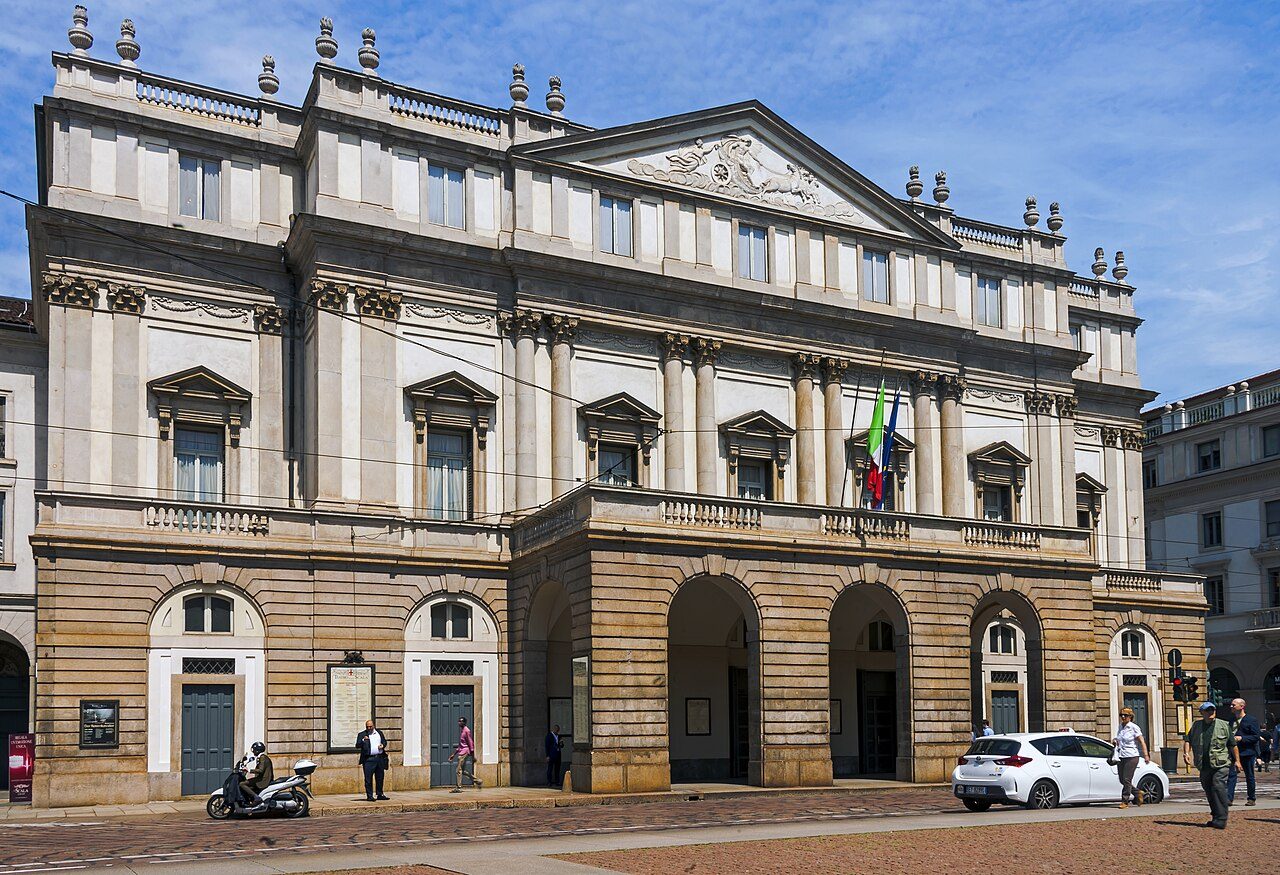
Monument · Historic Center · 1776–1778
Teatro alla Scala
A stern building outside, the world's most famous opera house inside
In brief
The home of Italian opera, opened in 1778 on the site of a church. Operas by Verdi and Puccini were born here, and the loggione, the top gallery, still decides who deserves applause. Outside it is sober to the point of shyness: the red and gold are all inside.
Stories of this place
- Legend · Piazza della ScalaReadThe curse of Palazzo MarinoPalazzo Marino, Milan's city hall facing La Scala, began as the home of Tommaso Marino, a 1500s Genoese banker, hugely rich and disliked by the Milanese. According to legend, an enemy cursed him: that palace, the fruit of his plunder, would end in ruin. It nearly did. Marino died in 1572 drowning in debt; the palace, left unfinished, passed to the state. The side facing Piazza della Scala waited three centuries for its facade. Tradition adds another shadow: his granddaughter Marianna de Leyva is said to have been born here, the nun who inspired the Nun of Monza in the writer Alessandro Manzoni's novel I promessi sposi, The Betrothed.
- Anecdote · The monument to LeonardoReadThe Leonardo monument, a liter for fourIn the middle of Piazza della Scala, in front of the theater, stands the monument to Leonardo da Vinci, with four pupils at his feet. The Milanese gave it a nickname: on liter in quatter, a liter for four. The tall statue in the middle is supposed to be the bottle, the four pupils the glasses. The joke is credited to the writer Giuseppe Rovani. As the anecdote goes, during a quarrel in a tavern with Pietro Magni, the sculptor who made it, Rovani set a liter of wine among four drinkers and said that this was Magni's monument. Magni is said to have stayed offended for years.
- In culture · The monument to LeonardoReadLeonardo wrapped by ChristoIn November 1970 the monument to Leonardo da Vinci, in the middle of Piazza della Scala, vanished under a sheet of fabric. It had been wrapped by Christo and Jeanne-Claude, the artist couple famous for wrapping monuments, during an event staged by Nouveau Réalisme, an avant-garde movement of those years. The work was short-lived. On November 28 some young people set fire to the wrapping, and the firefighters had to remove it. For a moment, though, the statue the Milanese jokingly call a liter for four had been contemporary art.
- Anecdote · The facadeReadEggs on the furs at La Scala's opening nightOn December 7, 1968, the crowd for opening night, the evening that starts the season, reached La Scala in tuxedos and furs. Waiting were the young people of the Movimento studentesco, the student movement, with a volley of eggs and vegetables. Verdi's Don Carlo was on stage, but the music was not the point. Days earlier in Avola, Sicily, the police had killed two farm laborers at a demonstration. Mario Capanna, one of the protest's leaders, defended it years later as nonviolent: eggs against a few fur coats. Never before had a social protest targeted that evening. In later years, reports say, many ladies chose black and hid their jewels.
- Record · The bombs of 1943 and Botta's towersReadTen thousand truckloads to rebuild La ScalaBetween 2002 and 2004 La Scala was a construction site: the stage rebuilt from scratch and, above the roof, the two modern volumes by the architect Mario Botta. It was the biggest intervention on the theater since the reconstruction after the bombs of World War II. About four hundred workers were on the job. A hundred and twenty thousand cubic meters of rubble were hauled out of the center of Milan, in at least ten thousand truck trips. In the meantime the orchestra, chorus, and singers carried on with their seasons in another theater in the city.
- Anecdote · Under the portico: opening night, 1778ReadThe café boy who invented barbajadaThe impresario Domenico Barbaja, who ran the gambling at La Scala, was born in Milan in 1778, the same year as the theater, into a very poor family. He started out as a café boy, and there he had an idea: mix coffee, chocolate, and cream. The drink took his name, barbajada, and in 1800s Milan it was all the rage. With the profits came the rest: the gambling concession in La Scala's foyer, then the running of the great theaters, from Naples to Vienna. They called him the prince of impresarios, and he hired the young composer Gioachino Rossini. A career that began with a cup.
- Anecdote · The Museo TeatraleReadThe collection snatched from financier MorganThe Museo Teatrale, the theater museum next to La Scala, was born from a contested collection. In 1911 the antiques dealer Jules Sambon put his collection of theater objects up for auction and asked 450,000 lire. A group of Milanese wanted it for La Scala and, with help from the state and contributions from fifty private citizens, raised the sum. But Sambon backed out: another buyer wanted it too, one he could not name, but very powerful. It was the American financier John Pierpont Morgan. According to the museum's account, La Scala's international prestige persuaded him to step aside. That collection is still the heart of the museum.
- Anecdote · The auditorium and the opening nightsReadThe night Toscanini stoppedOn April 25, 1926, La Scala staged the opera Turandot for the first time. Its composer, Giacomo Puccini, had died more than a year earlier without finishing it. The conductor was Arturo Toscanini. Halfway through the third act, after the death of the slave girl Liù, Toscanini stopped the orchestra, laid down his baton, and turned to the audience. He said the opera ended there, because at that point the maestro had died. The exact words change from one reporter to the next; the gesture does not. The curtain came down. For one night La Scala heard only Puccini's notes, up to the last page he had completed.
- Anecdote · The auditorium and the opening nightsReadThe tenor who walked off La Scala's stageLa Scala's loggione, the top gallery, forgives no one. In 2006, during a performance of Verdi's Aida, the tenor Roberto Alagna was heckled by the audience. Instead of carrying on, he walked off the stage. The show did not stop: his understudy, Antonello Palombi, had to come on with the scene already under way and continue in his place. It is the episode most often cited when people talk about the loggionisti, the regulars up there, famous for the severity of their verdicts.
- In cultureReadLa Scala as seen by Stendhal and Mary ShelleyTwo great writers left two opposite portraits of La Scala. In 1816 the Frenchman Stendhal called it the first theater in the world. In 1840 the Englishwoman Mary Shelley, the author of Frankenstein, was far less enchanted: she reported that on the main floor people did business and chatted so much that only rare fragments of the music got through. Both were right. The Scala of the 1800s was at once the temple of opera and the noisiest drawing room in Milan.
Ready-made questions
It has nothing to do with a staircase, which is what scala means in Italian. The theater was built on the site of a church, Santa Maria alla Scala, demolished in 1776 to make room for it. The church in turn owed its name to its founder, Regina della Scala, who belonged to the family that ruled Verona. The new building was called the theater alla Scala, meaning at the Scala, and the name stuck. Every time you say La Scala, you are repeating the surname of a noblewoman from Verona.
Go to stop: Under the portico: opening night, 1778For two reasons. The first is style: the architect Giuseppe Piermarini worked in the taste, which prefers restraint and proportion to special effects. The second is the place: in the 1700s there was no square in front of the theater, only a narrow street. The facade was conceived to be seen at an angle, in passing, and not from a distance as you see it today. The square arrived only in 1858.
Go to stop: The facadeFrom the Museo Teatrale, the theater's museum, housed in the small building next to the theater. The museum route passes through the of the and lets you look out over the auditorium from some of the third-tier boxes. There is one condition: the view is available only when there are no rehearsals, performances, or other events in the hall. If you find the boxes closed, the last stop of this visit will describe the auditorium for you.
Go to stop: The auditorium and the opening nightsBecause it is the feast of Saint Ambrose, the patron saint of Milan. The December 7 opening night was introduced in 1940 and became a fixed rule from 1951, at the wish of the conductor Victor De Sabata. On that very evening in 1951 Maria Callas had her first great success here. Since then, opening night at La Scala has been one of the most eagerly awaited events of the year in Milan.
Go to stop: The auditorium and the opening nightsThey are the additions designed by the architect Mario Botta and finished in 2004. The boxy volume, in line with the facade, is the : it holds the machinery that lifts and moves the sets. The ellipse-shaped one houses, among other things, the performers' dressing rooms. Both are clad in botticino, a pale stone. When they were built they set off plenty of arguments: some feared the theater would lose the traces of its history.
Go to stop: The bombs of 1943 and Botta's towersThey are the audience of the , the highest gallery in the auditorium. They are enthusiasts who follow opera with great expertise and are famous for the severity of their verdicts: they applaud with enthusiasm, but they boo even the most celebrated names without fear. In 2006 their heckling drove the tenor Roberto Alagna to walk off the stage during Aida. For a singer, winning over the loggione at La Scala is a kind of final exam.
Go to stop: The auditorium and the opening nightsYes, and quite openly. People gambled in the , as was normal in the theaters of the time. From 1788 gambling was strictly forbidden in the city of Milan, but not in theaters during performances: so La Scala remained one of the few places where trying your luck was allowed. In 1805 the impresario Domenico Barbaja introduced roulette there as well. On those evenings, the music had fierce competition.
Go to stop: Under the portico: opening night, 1778The stops
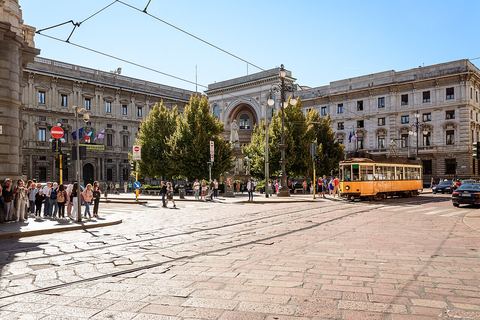
1 Piazza della Scala
It looks like the theater's natural forecourt, but the square is eighty years younger: it was opened in 1858 by tearing down the houses that stood in front of La Scala. Around you, each side tells of a different era of Milan.
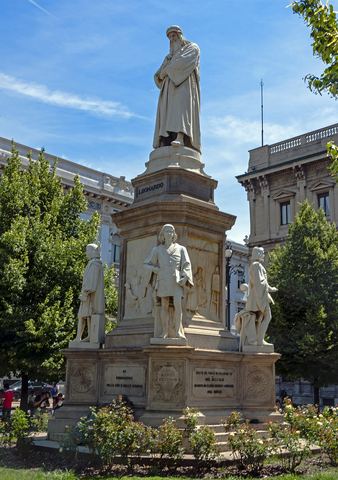
2 The monument to Leonardo
Leonardo da Vinci in marble, with four pupils at his feet. The Milanese renamed it "a liter for four," and finishing it cost the sculptor Pietro Magni nearly everything he had.
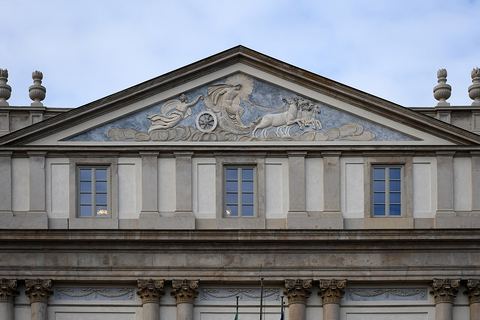
3 The facade
No statues, no domes: the facade by the architect Giuseppe Piermarini is an exercise in restraint. It was designed for a narrow street, where nobody could see the whole of it the way you can.
4 The bombs of 1943 and Botta's towers
Two pale, modern volumes rise behind the facade. They tell of the two times La Scala was rebuilt: after the bombs of 1943, and in the major project by the architect Mario Botta, completed in 2004.
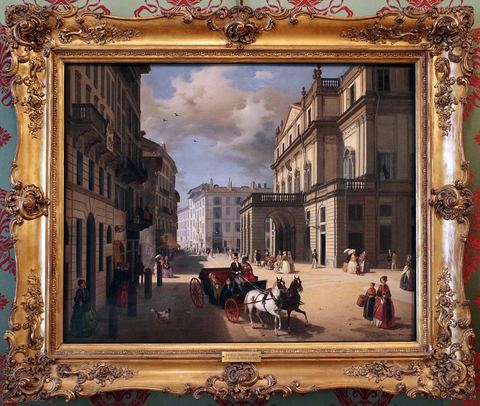
5 Under the portico: opening night, 1778
This is where the carriages pulled up. The theater was wanted and paid for by the nobles who owned the boxes, and for decades they used it as a drawing room, dining room, and gaming house. The music was often just background.
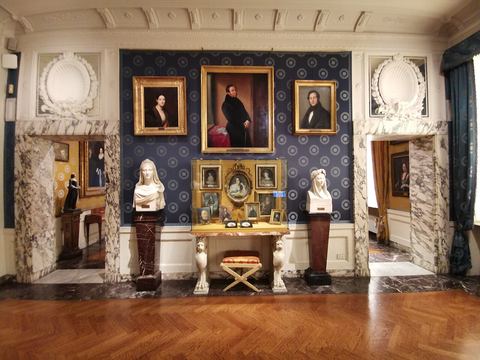
6 The Museo Teatrale
Portraits of divas, antique instruments, Liszt's piano, Verdi's death mask. The theater's museum opened in 1913 thanks to a collection snatched from one of the richest men in the world.
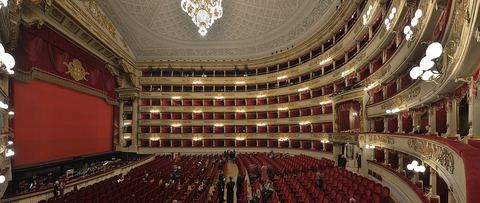
7 The auditorium and the opening nights
A red and gold horseshoe, with four tiers of boxes and two galleries. The people sitting down below are not in charge here: the loggione is, the gallery at the very top, which applauds and boos without fear or favor.
Timeline
- 1776A fire destroys the court theater. To build the new one, the church of Santa Maria alla Scala is demolished.
- 1778On August 3 Giuseppe Piermarini's theater opens with L'Europa riconosciuta by Antonio Salieri.
- 1842Triumph of Nabucco by Giuseppe Verdi, who had made his debut at La Scala three years earlier.
- 1858The houses in front of the theater are torn down: Piazza della Scala is born.
- 1913The Museo Teatrale opens, born from the collection of the antiques dealer Jules Sambon.
- 1943On the night of August 15 to 16 an incendiary bomb brings down the ceiling of the auditorium.
- 1946On May 11 the rebuilt theater reopens with a concert conducted by Arturo Toscanini.
- 2004After nearly three years of work and Mario Botta's additions, La Scala reopens on December 7 with the opera of 1778.
Who's who
Giuseppe Piermarini
court architect
He designed La Scala in the neoclassical style and delivered it in two years. In the Museo Teatrale a portrait shows him with a compass in his hand.
Antonio Salieri
composer
His opera L'Europa riconosciuta opened the theater in 1778. It was chosen again for the 2004 reopening, after the major restoration.
Giuseppe Verdi
composer
He made his debut at La Scala in 1839 and triumphed there with Nabucco. He fell out with the theater, then returned for the premieres of Otello and Falstaff. He died in Milan in 1901.
Arturo Toscanini
conductor
His name is bound to La Scala; he then left Italy during the Fascist years. He returned to conduct the reopening concert on May 11, 1946.
Pietro Magni
sculptor
Creator of the monument to Leonardo, unveiled in 1872. To finish it he paid for the materials up front and saw his models seized.
Mario Botta
architect
He designed the fly tower and the elliptical volume built behind the facade between 2002 and 2004. They are the most debated parts of the theater.
Words to know
Where it is
The neighborhood
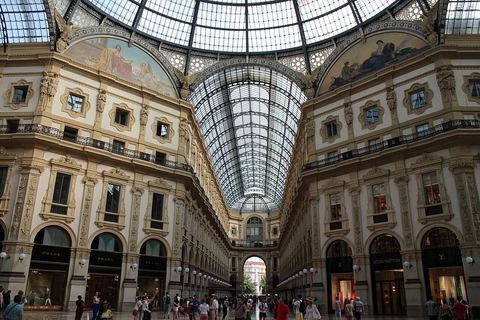
Historic Center
Related places
The story of the place
If you come here expecting a temple, you will be disappointed for about half a minute. From the outside, La Scala is a pale, well-behaved building, almost shy. Then you start to learn what has happened behind that portico, and the square looks different.
From fire to drawing room
It all begins with a fire. In February 1776 the court theater, inside the Palazzo Reale, the royal palace, burns down. The noble families who owned there have no intention of going without opera. They ask for a new theater and pay for it, in exchange for ownership of the future boxes. Maria Theresa of Austria, the empress who ruled Milan at the time, approves.
The job goes to Giuseppe Piermarini, the court architect. To make room for it a church is torn down, Santa Maria alla Scala, and the theater inherits its name. Two years later, on August 3, 1778, the curtain rises on an opera by Antonio Salieri.
For a long time La Scala is Milan's drawing room more than a concert hall. In the people receive guests, dine, and chat; in the they gamble. Meanwhile the history of music crosses the stage: Rossini, Bellini, Donizetti, then Giuseppe Verdi, who makes his debut here and triumphs here with Nabucco. Later come Giacomo Puccini, with the fiasco of Madama Butterfly, and Arturo Toscanini, the conductor whose name is bound to the theater.
From the bombs to Botta
In August 1943 a bomb smashes through the auditorium. The city chooses to rebuild it as it was, where it was, and in May 1946 it is Toscanini himself, back in Italy, who conducts the reopening concert. The latest transformation ends in 2004, when the architect Mario Botta adds two modern volumes behind the facade that people still argue about.
How the visit works
Almost all of the visit happens in the square: the space in front of the theater, the monument to Leonardo, the facade, the portico. Then you go into the Museo Teatrale, the theater's museum, and from there, if nobody is rehearsing in the auditorium, you look out from a over the red and gold horseshoe. Save it for last: it is the moment when everything you have heard up to then takes shape.
Sources
- Teatro alla Scala, la storia del teatro (opens in a new tab)Official site
- Museo Teatrale alla Scala, storia del museo (opens in a new tab)Official site
- Museo Teatrale alla Scala, l'affaccio sul teatro dai palchi (opens in a new tab)Official site
- Le sale del Museo Teatrale alla Scala, Google Arts & Culture (opens in a new tab)Institution
- Teatro alla Scala, Enciclopedia Treccani (opens in a new tab)Encyclopedia
- Teatro alla Scala, complesso, Lombardia Beni Culturali (opens in a new tab)Catalog
- Ridotti del Teatro alla Scala, Lombardia Beni Culturali (opens in a new tab)Catalog
- Teatro alla Scala, Wikipedia in italiano (opens in a new tab)Wikipedia
- La Scala, Wikipedia in inglese (opens in a new tab)Wikipedia
- Piazza della Scala, Wikipedia in italiano (opens in a new tab)Wikipedia
- Monumento a Leonardo da Vinci, Wikipedia in italiano (opens in a new tab)Wikipedia
- Museo teatrale alla Scala, Wikipedia in italiano (opens in a new tab)Wikipedia
- Museo Teatrale alla Scala, curiosità sul teatro (opens in a new tab)Official site
- Museo Teatrale alla Scala, storia del teatro (opens in a new tab)Official site
- Floating Piers: how Italy learnt to love Christo, The Art Newspaper (opens in a new tab)Other source
- La Scala, Wikidata Q5471 (opens in a new tab)Other source
- Norma, Wikipedia in italiano (opens in a new tab)Wikipedia
- Turandot, Wikipedia in italiano (opens in a new tab)Wikipedia
- Turandot, Wikipedia in inglese (opens in a new tab)Wikipedia
- La Turandot secondo Livermore, Il Giorno (opens in a new tab)Other source
- Facts about La Scala: unfinished masterpiece, Classic FM (opens in a new tab)Other source
- Barbaia, Domenico, Dizionario Biografico degli Italiani, Treccani (opens in a new tab)Encyclopedia
- Domenico Barbaja, Wikipedia in italiano (opens in a new tab)Wikipedia
- Barbajada, Wikipedia in italiano (opens in a new tab)Wikipedia
- Palazzo Marino, Lombardia Beni Culturali (opens in a new tab)Catalog
- Marino, Tommaso, Dizionario Biografico degli Italiani, Treccani (opens in a new tab)Encyclopedia
- Palazzo Marino, Wikipedia in italiano (opens in a new tab)Wikipedia
- Tommaso Marino, banchiere, Wikipedia in italiano (opens in a new tab)Wikipedia
- 1968 a Milano, la rivoluzione approda in teatro, Il Giorno (opens in a new tab)Other source
- Capanna: la contestazione alla Scala, Il Foglio (opens in a new tab)Other source
- Scala, Turandot più psicologica che orientale, Il Giornale (opens in a new tab)Other source
- In cucina: barbajada, Italy Segreta (opens in a new tab)Other source
- Breve storia (sofferta) di Palazzo Marino a Milano, Artribune (opens in a new tab)Other source
- Carrellata di inciampi antichi e nervosismi recenti alle prime della Scala, Il Foglio (opens in a new tab)Other source
- Eccidio di Avola, Wikipedia in italiano (opens in a new tab)Wikipedia