Museum · Historic Center · 1936–1956
Museo del Novecento
Italy's twentieth century in a palace built for a regime, with the Duomo at the window
In brief
Milan's city museum of twentieth-century art: about four hundred works, nearly all Italian, from Futurism to Arte Povera. It lives in the Arengario, a marble palace designed for Fascist rallies, and at the top it puts the Duomo right back in front of you.
Stories of this place
- Anecdote · The ArengarioReadThe Arengario that lost its arengoThe Arengario on Piazza del Duomo, the building that now houses the Museo del Novecento, Milan's twentieth-century art museum, was commissioned by the Fascist regime for addressing the crowd. Twenty-nine designs were entered in the 1937 competition, and construction began in 1939. Then came the war and the bombs, and there was never an official inauguration. After the war the building was an awkward reminder. In 1947 the arengo proper, the part meant for speeches, was demolished, and in the following years the interiors were converted into offices. Ever since, Milan has had an Arengario without an arengo: it bears the name of something that is no longer there.
- Anecdote · The spiral rampReadDe Chirico's bathers, in from the parkAt the center of the ramp of the Museo del Novecento, Milan's twentieth-century art museum, are two stone bathers and a fish, from the Bagni misteriosi, the Mysterious Baths, by Giorgio de Chirico, a founder of Metaphysical painting. They are pieces of a fountain he made for the 1973 Milan Triennale, the year he turned eighty-five. The basin is still in Parco Sempione. The idea was decades old: in a house with a wax-polished floor he watched a gentleman walk, legs reflected, and felt he might sink as into a pool. Outdoors the stone was deteriorating. So the originals came into the museum, and the copies bathe in the park.
- In culture · The spiral rampReadIl Quarto Stato, a painting on the moveFor years a visit to Milan's Museo del Novecento began with Il Quarto Stato, The Fourth Estate, by Giuseppe Pellizza da Volpedo, the great canvas of marching workers. The 1901 painting is one of the most quoted images of twentieth-century Italy: it appears behind the opening credits of Bernardo Bertolucci's film Novecento. Milan bought it by public subscription and in 1921 showed it at the Castello Sforzesco. Under Fascism it went into storage, after the war to a room at city hall, then to the Galleria d'Arte Moderna. In 2010 it came here, along the entrance ramp. Since July 2022 it has been back at the Galleria d'Arte Moderna.
- Anecdote · Boccioni, Unique Forms of Continuity in SpaceReadBoccioni, the Futurist killed by a horseUmberto Boccioni, the Futurist who modeled the Unique Forms on display at the Museo del Novecento, Milan's twentieth-century art museum, had made engines and speed his banner. When Italy entered the war in 1915, he volunteered with a battalion of cyclists. The following year he was called up again into the artillery, near Verona. On August 16, 1916, during an exercise, his mare bolted, frightened, the story goes, by a passing truck, and threw him. He died the next day, at thirty-three. If that is how it went, the bard of machines was killed by an animal that had been scared by an engine.
- In culture · Boccioni, Unique Forms of Continuity in SpaceReadThe Boccioni sculpture in your pocketA bronze figure strides through Milan's Museo del Novecento: Unique Forms of Continuity in Space, by the Futurist Umberto Boccioni. It is probably the most handled Italian sculpture in the world: it is on the Italian side of the twenty-cent coin. Its run did not end there. In 1981 it inspired a creature in the British series Doctor Who. Since 2018 a scale replica has been the trophy of the world championship of the racing video game Gran Turismo: it was made from a laser scan of the sculpture. A work created to celebrate speed has ended up as the prize for whoever races fastest, even while sitting still.
- Anecdote · Boccioni, Unique Forms of Continuity in SpaceReadBoccioni's plasters that ended up as scrapAt Milan's Museo del Novecento, Unique Forms by the Futurist Umberto Boccioni is bronze. The original was plaster: Boccioni died in 1916 without casting any of his sculptures. What happened to the plasters afterward is unclear. By the most widely told account they stayed in the storeroom of a Lombard sculptor and years later were smashed and dumped. Someone is said to have recognized them and reassembled the least damaged. The plaster of Unique Forms passed from the painter Fedele Azari to the poet Marinetti in 1928. In 1952 Marinetti's widow sold it to a Brazilian industrialist, who donated it to a museum in São Paulo in 1963.
- In culture · Morandi and his bottlesReadMorandi's still lifes at the moviesOne room at Milan's Museo del Novecento is devoted to Giorgio Morandi, the painter from Bologna who spent a lifetime painting bottles, vases, and boxes in his bedroom. For such a reclusive man, he has an enviable filmography. His still lifes appear in Federico Fellini's La dolce vita and Michelangelo Antonioni's La notte, in the comedy Il boom, in a 1950s American crime film, Kiss Me Deadly, and more recently in I Am Love. The job is always the same: to say in a single shot that someone cultured lives in that house. In 2008 the Metropolitan Museum in New York also devoted a major exhibition to him.
- Anecdote · Fontana and the neonReadThe hotel ceiling saved in piecesAmong the Lucio Fontana rooms at the Museo del Novecento, Milan's twentieth-century art museum, is a ceiling that came from a hotel. Fontana, the artist of the slashed canvases, made it in 1956 for the dining room of the Hotel del Golfo, on the island of Elba: he incised and pierced the fresh plaster on site, with long rods and the builders' help. In 2000 a renovation was about to destroy it. The work was not yet fifty years old, too young for the law to protect it. So the state bought it. Restorers divided it into twenty-five panels, planned so no hole was touched, and brought it to Milan.
- Anecdote · Fontana and the neonReadFontana's neon, made to spite the criticsIn the windowed hall of Milan's Museo del Novecento hangs an arabesque of light a hundred meters long: the Struttura al neon by Lucio Fontana, the artist of the slashed canvases. It is a reconstruction. The original hung at the 1951 Milan Triennale, over the grand staircase, in a space by the architect Luciano Baldessari. Fontana first made a small wire model, later lost. In a letter to the architect Gio Ponti he claimed its novelty: made, he said, to spite the critics. The jury gave him the Grand Prize, shared with the company that bent the tubes. One other reconstruction was destroyed; another went to Barcelona.
- Anecdote · Manzoni, Merda d'artistaReadThe can of Merda d'artista that leakedOn display at Milan's Museo del Novecento is a small tin of Merda d'artista, Artist's Shit: the artist Piero Manzoni packaged ninety of them in 1961. Nobody knows what they contain, because opening one means destroying the work. But at least one has shown signs of life. In 1994 one was exhibited in a museum in Randers, Denmark. The collector John Hunov later accused the museum of having made it leak by keeping it too warm. The dispute ended with compensation. If the leak really happened, it is tempting to think there is more inside than plaster, which is what Agostino Bonalumi, an artist and a friend of Manzoni's, maintained.
Ready-made questions
is another name for the broletto, the palace where the government of a medieval city sat. In Milan the oldest broletto stood right next door, where the Palazzo Reale, the royal palace, is today. In the 1930s the Fascist regime revived the word for a new building, designed for speeches to the crowd in the square. Construction only ended in 1956, when that regime was long gone. The name stuck.
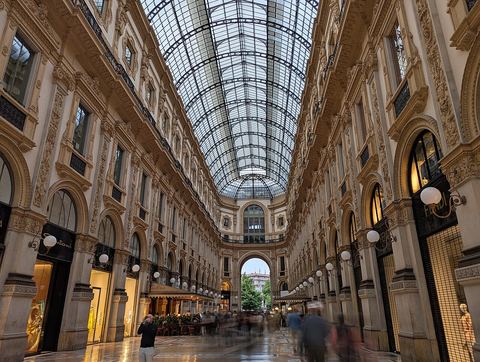
Go to stop: The ArengarioThey are twins because together they were meant to give the square a symmetrical backdrop, answering the arch of the Galleria Vittorio Emanuele, the glass-roofed arcade on the opposite side. The museum occupies only one, plus some rooms in the Palazzo Reale reached by a suspended walkway. The other long remained city offices. In 2020 the city launched a project to extend the museum into it as well, with over a thousand square meters more and about a hundred new works, bringing the story up to the 2000s.
Go to stop: The ArengarioBecause this is a city's collection. The works come from the art collections of the City of Milan, founded at the start of the twentieth century and enlarged by purchases and by gifts from collectors, such as the husband and wife Boschi Di Stefano. So they tell the century as seen from Italy. The foreigners are clustered at the start of the route, among the : Picasso, Braque, Klee, Kandinsky, Matisse, Mondrian. They are there to remind you who Boccioni and the others were in conversation with.
An art equal to the modern world: engines, cities, crowds, speed. The movement was born in 1909 with a manifesto by the poet Filippo Tommaso Marinetti, for whom a roaring car was more beautiful than the Victory of Samothrace. The group's painters and sculptors, from Boccioni to Balla, tried to get movement into works that by their nature stand still. This museum is known precisely for its collection.
Go to stop: Boccioni, Unique Forms of Continuity in SpaceBecause Fontana did not want to ruin a painting: he wanted to open it. For him the canvas was not a surface to fill but a boundary to cross, and the hole or the cut shows that there is real space behind it. He started with the holes in 1949, and at first he met with puzzlement from critics and ridicule from the public. The cuts came in 1958. He called them all , Spatial Concepts: the title warns you that what counts is the idea, not the skill of the hand. On the back of many canvases he wrote a phrase by hand, ironic or poetic.
Go to stop: Fontana and the neonIt is a provocation with an argument. Manzoni explained it in a 1961 letter to the artist Ben Vautier: if collectors are after something intimate and personal from the artist, nothing is more so than his shit. The work mocks the cult of the signature, by which an object is valuable because someone famous touched it, like a relic. The painter Enrico Baj called it an act of defiance and mockery aimed at the art world, artists, and critics. That the same world then bought it and put it in a display case is part of the work.
Go to stop: Manzoni, Merda d'artistaThe stops
1 The Arengario
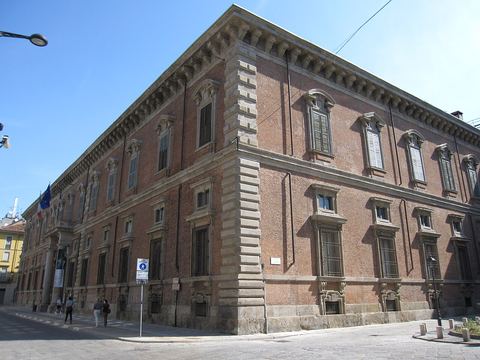
Two identical marble palaces, conceived in the late 1930s as a rostrum for the Fascist regime and finished only in 1956. One of them is now the museum. They share their marble with the Duomo, and nothing else.
2 The spiral ramp
The entrance is a spiral about 140 meters long, slipped into a 1930s palace. It is the idea the architect Italo Rota used to turn an office building into a museum: before you see a single painting, you climb.
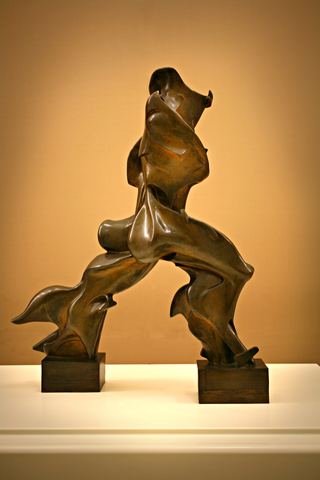
3 Boccioni, Unique Forms of Continuity in Space
The most famous sculpture of Futurism: a body at full stride that the air seems to shape as it goes. Umberto Boccioni made it in plaster in 1913 and never saw it in bronze. You already know it: it is on Italy's twenty-cent coin.
4 Morandi and his bottles
While the Futurists were chasing speed, Giorgio Morandi stayed in Bologna painting bottles, vases, and boxes. The same ones, for a lifetime. It sounds like very little, and it is some of the best-loved painting of the twentieth century.
5 Fontana and the neon
An arabesque of light a hundred meters long, hanging over your head. Lucio Fontana devised it in 1951 to show that a work of art can be made of space and light instead of canvas and paint. If you only have time for one room, this is it.
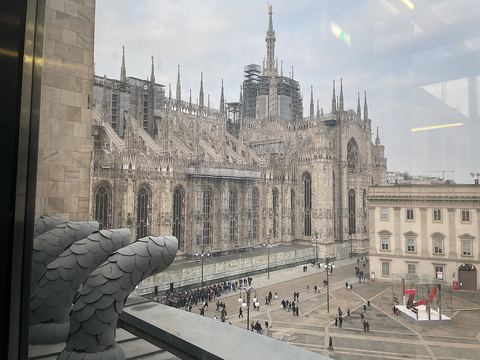
6 The window on the Duomo
The best view in the museum is not a work of art. From the windows of the Arengario you have the Duomo at eye level and the whole square below you. And you understand why this palace stands exactly here.
7 Manzoni, Merda d'artista
A thirty-gram can called Artist's Shit, dated 1961 and sold for its weight in gold. Inside, the label says, is just what you think. It is the cheekiest work in the museum and one of the century's most serious questions: who decides what art is worth?
Timeline
- 1903Milan establishes the Galleria d'Arte Moderna: the city collections now shown at the Museo del Novecento descend from it.
- 1913Umberto Boccioni models Unique Forms of Continuity in Space in plaster.
- 1937A competition selects the design for the Arengario: twin palaces in place of the Manica Lunga wing of the Palazzo Reale.
- 1951Lucio Fontana hangs his Struttura al neon over the grand staircase of the ninth Milan Triennale.
- 1956Work ends on the Arengario, which is never inaugurated. That same year Fontana creates the Soffitto spaziale for a hotel on Elba.
- 1961Piero Manzoni packages the ninety cans of Merda d'artista.
- 2010On December 6 the Museo del Novecento opens, in the Arengario transformed by Italo Rota and his team.
- 2022In July Il Quarto Stato returns to the Galleria d'Arte Moderna. In October twenty-six works from the Mattioli collection join the route.
Who's who
Umberto Boccioni
Futurist painter and sculptor
The greatest talent of Futurism. He took up sculpture in 1912 and died in 1916, without seeing Unique Forms in bronze. Today it is on Italy's twenty-cent coin.
Giorgio Morandi
painter and printmaker from Bologna
Born in 1890, died in 1964, both in Bologna. He painted bottles and landscapes in his bedroom on Via Fondazza and taught printmaking at the academy for a quarter of a century.
Lucio Fontana
artist, founder of Spatialism
Born in Argentina in 1899 to an Italian father, he studied sculpture at Brera. He pierced canvases from 1949 and slashed them from 1958. His neon in the windowed hall can be seen from the square.
Piero Manzoni
artist, a driving force of the magazine Azimuth
In 1961 he made the ninety cans of Merda d'artista, priced at their weight in gold. He also sold balloons he had inflated himself, under the title Fiato d'artista.
Piero Portaluppi
architect, one of the designers of the Arengario
Designed the twin palaces with Muzio, Magistretti, and Griffini. In 1951 he chaired the Triennale jury that honored Fontana's neon, which now hangs inside his own building.
Italo Rota
architect of the museum
Milanese, died in 2024. As a young man he worked with Gae Aulenti on the Musée d'Orsay in Paris. With his team he turned the Arengario into a museum and invented the spiral ramp.
Words to know
Where it is
The neighborhood
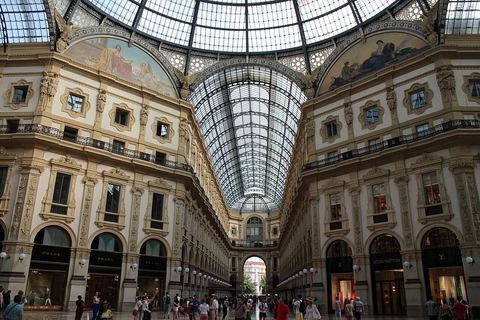
Historic Center
Related places
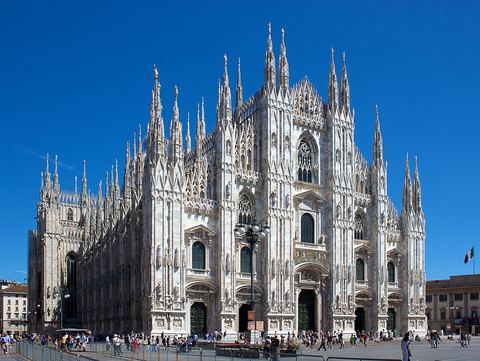
The story of the place
A modern art museum inside a building commissioned by the Fascist regime, a few steps from a Gothic cathedral. Put like that, it sounds like a mess. It is exactly why the place works.
Two palaces for a regime
The building is called the , and there are two of it: twin palaces clad in the same marble as the Duomo, Milan's cathedral. They were designed in the late 1930s by a group of architects that included Piero Portaluppi and Giovanni Muzio, to close off the side of the square that the nineteenth century had left unfinished. To make room, the city tore down the Manica Lunga, the long wing of the Palazzo Reale, the royal palace, which jutted out toward the square.
The new building was meant to be the regime's rostrum, the place to address the crowd from. Then came the war, and the bombs. Construction only wrapped up in 1956, the palace never had an opening ceremony, and it ended up housing offices.
A collection without a home
The art, meanwhile, was taking a different road. The city's modern art collections were founded in 1903 and grew through the century by purchase and donation, until they numbered several thousand pieces. From 1984 to 1998 part of them was on show next door in the Palazzo Reale, in a municipal museum of contemporary art. Then those rooms closed, and Milan's twentieth century was homeless for more than ten years.
The museum opens in 2010
The home arrived on December 6, 2010. The architect Italo Rota and his team kept the facades and rebuilt the interior, threading a spiral ramp into the tower.
Upstairs, room after room, a century unfolds in chronological order: the , the of Umberto Boccioni, Giorgio Morandi's bottles, Lucio Fontana's neon and slashed canvases, Piero Manzoni's provocations, all the way to . About four hundred works are on display. A suspended walkway carries the last rooms into the Palazzo Reale.
One thing to know before you go looking for it: Il Quarto Stato, The Fourth Estate, by Giuseppe Pellizza da Volpedo, the huge painting of workers on the march that opened the visit for years, went back to the Galleria d'Arte Moderna, the city's modern art gallery, in 2022. That same year, twenty-six works from the Mattioli collection joined the route.
You do not need to know anything about modern art. Many of these works are questions rather than answers, and some were made on purpose to annoy you. Let them. At the top, just when you feel you have lost the thread, a wall of glass puts the Duomo right back in front of you.
Sources
- Museo del Novecento, Italia.it (Ministero del Turismo) (opens in a new tab)Institution
- Arengario, Italia.it (Ministero del Turismo) (opens in a new tab)Institution
- Lucio Fontana, Struttura al neon per la IX Triennale di Milano, scheda del Museo del Novecento su Google Arts & Culture (opens in a new tab)Catalog
- Morandi, Giorgio, Enciclopedia Treccani (opens in a new tab)Encyclopedia
- Boccioni, Forme uniche della continuità nello spazio, Finestre sull'Arte (opens in a new tab)Other source
- Milano, il Museo del Novecento raddoppia i suoi spazi, Finestre sull'Arte (opens in a new tab)Other source
- Museo del Novecento, progetto di Italo Rota e Fabio Fornasari, Divisare (opens in a new tab)Other source
- Il nuovo Museo del Novecento a Milano, Meer (opens in a new tab)Other source
- Museo del Novecento, Palazzo dell'Arengario, Il Turista (opens in a new tab)Other source
- Museo del Novecento (Q261233), Wikidata (opens in a new tab)Other source
- Manzoni, Piero, Enciclopedia Treccani (opens in a new tab)Encyclopedia
- La biografia di Cochi Ponzoni e le scatolette di Manzoni, Il Fatto Quotidiano (opens in a new tab)Other source
- Arengario, Milano, scheda di Lombardia Beni Culturali (opens in a new tab)Catalog
- Lucio Fontana. Il Soffitto salvato, Segretariato regionale del Ministero della Cultura per la Lombardia (opens in a new tab)Institution
- Lucio Fontana, Soffitto spaziale, scheda del Museo del Novecento su Google Arts & Culture (opens in a new tab)Catalog
- The Mysterious Baths of Giorgio de Chirico told through the archives, Triennale Milano (opens in a new tab)Institution
- Boccioni, Umberto, Dizionario Biografico degli Italiani, Treccani (opens in a new tab)Encyclopedia
- La linea d'ombra piena di luce di Umberto Boccioni, Il Dolomiti (opens in a new tab)Other source
- Rovereto, omaggio a Boccioni artista e cavaliere, Cavallo Magazine (notizia ANSA) (opens in a new tab)Other source
- Umberto Boccioni: la vita e le opere del grande futurista, Finestre sull'Arte (opens in a new tab)Other source
- Umberto Boccioni, Collezione Peggy Guggenheim, Venezia (opens in a new tab)Institution
- The Mysterious Baths by Giorgio de Chirico get a facelift, Mapei (opens in a new tab)Other source
- Museo del Novecento, Wikipedia in italiano (opens in a new tab)Wikipedia
- Museo del Novecento, Wikipedia in inglese (opens in a new tab)Wikipedia
- Palazzo dell'Arengario, Wikipedia in italiano (opens in a new tab)Wikipedia
- Palazzo dell'Arengario, Wikipedia in inglese (opens in a new tab)Wikipedia
- Piazza del Duomo (Milano), Wikipedia in italiano (opens in a new tab)Wikipedia
- Forme uniche della continuità nello spazio, Wikipedia in italiano (opens in a new tab)Wikipedia
- Unique Forms of Continuity in Space, Wikipedia in inglese (opens in a new tab)Wikipedia
- Giorgio Morandi, Wikipedia in italiano (opens in a new tab)Wikipedia
- Lucio Fontana, Wikipedia in italiano (opens in a new tab)Wikipedia
- Merda d'artista, Wikipedia in italiano (opens in a new tab)Wikipedia
- Artist's Shit, Wikipedia in inglese (opens in a new tab)Wikipedia
- Il quarto stato, Wikipedia in italiano (opens in a new tab)Wikipedia
- Italo Rota, Wikipedia in italiano (opens in a new tab)Wikipedia
- The Keeper of Traken, Wikipedia in inglese (opens in a new tab)Wikipedia
- I bagni misteriosi, Wikipedia in italiano (opens in a new tab)Wikipedia
- Umberto Boccioni, Wikipedia in italiano (opens in a new tab)Wikipedia
- Museo del Novecento, Wikipedia in tedesco (opens in a new tab)Wikipedia