Stop 5 of 8Must-see
Hayez and I due Foscari
Where to stand
In the room of Francesco Hayez's big history paintings, facing the scene with the old doge
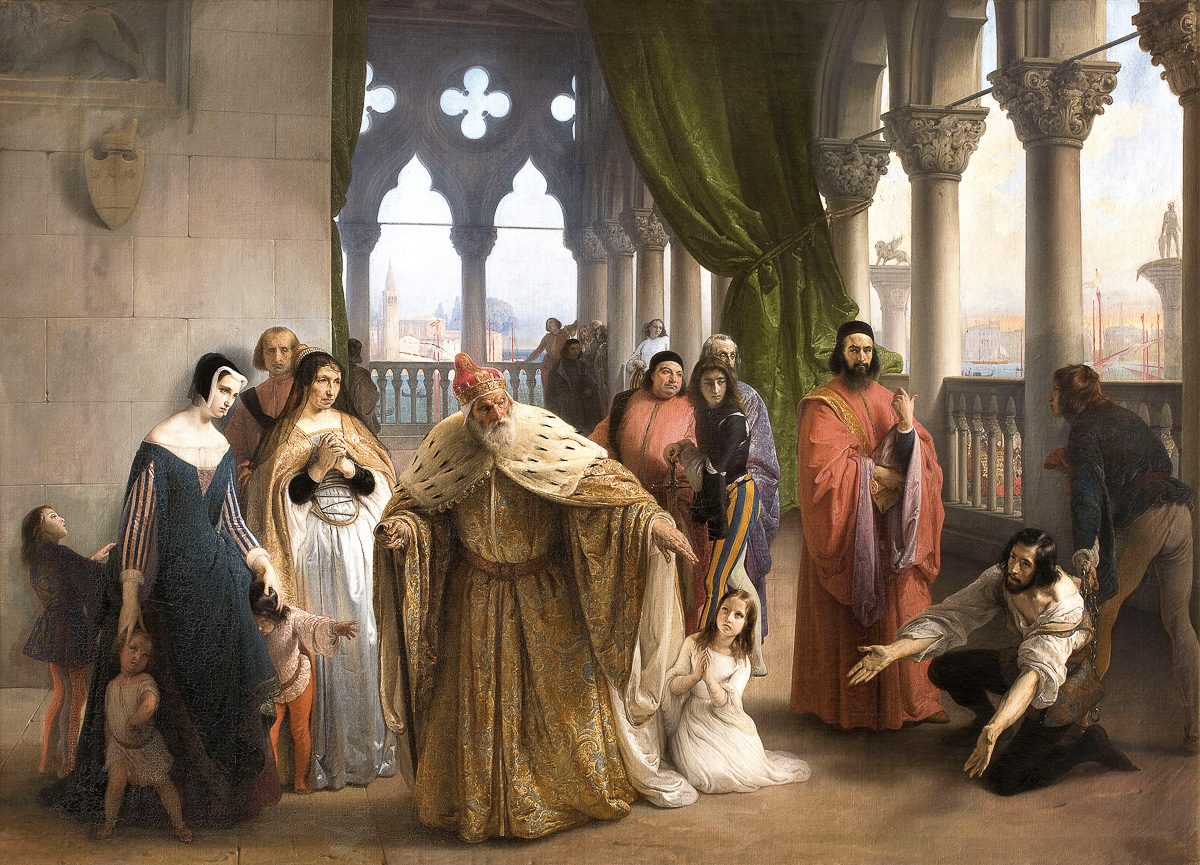
A father forced to send his son into exile: Francesco Hayez turns a page of Venetian history into a painted melodrama. The picture was made for the emperor of Austria and stayed in the imperial collections for almost ninety years.
Spot the detail
Take a good look at the old doge leaning on his stick: who does he resemble?
The full story
If this painting looks to you like a scene from an opera, you have it right. All that is missing is the orchestra and the curtain.
We are in Venice, under the portico of the Palazzo Ducale, the Doge's Palace. Jacopo Foscari, the doge's son, has been accused of treason and sentenced to exile. The sentence comes from the Council of Ten, the Republic's powerful tribunal, and no one can oppose it. Not even his father.
Read the scene
Jacopo stretches his hands toward his father. Doge Francesco Foscari, leaning on his stick, does the cruelest thing a parent can do: he tells him to obey. Beside him stands Loredano, Jacopo's enemy, looking on.
Then look at the others. The women suffer in silence, the children each react in their own way. In the background, beyond the arches, you can see the lagoon with the ships already waiting to sail. Hayez leaves you no doubt about how this will end.
A painting for the emperor
Francesco Hayez was Venetian by birth and Milanese by adoption, and he was the master of Romantic history painting. This picture was ordered from him in 1838 by Ferdinand I, the emperor of Austria who at the time also ruled Milan. It was meant for the Belvedere gallery in Vienna.
Before it left it was shown at Brera, Milan's art academy, in 1840. Then it stayed in the imperial collections for almost ninety years. It came back to Milan only in 1928, sold at auction, and later entered the collections of the Fondazione Cariplo.
Byron, Hayez, Verdi
The Romantics loved the story of the Foscari. The English poet Lord Byron had made a tragedy of it. Giuseppe Verdi would make an opera of it in 1844, four years after the painting. Hayez stands in between, and works like a director: he picks the costumes, measures the gestures, places the lights.
The same room holds other history canvases of his. But if you look at only one, look at this. It holds the taste of an entire age: ancient history used to move the viewer.
About this stop
In culture
The Foscari of Byron, Hayez and Verdi
At the Gallerie d'Italia, in the room of painter Francesco Hayez, the big canvas I due Foscari shows Francesco Foscari, doge of Venice, forced to exile his son Jacopo. That story has done the rounds of the arts. The English poet Lord Byron made a tragedy of it in 1821. Hayez painted it between 1838 and 1840, working from the Frenchman Pierre Daru's history of Venice. The composer Giuseppe Verdi set it to music in 1844, in an opera of the same name. So the painting does not illustrate the opera: it comes four years earlier. But it speaks the same language: sweeping gestures, sumptuous costumes and unhappy fathers.
Next stop
Continue into the next rooms, among the battles of the Risorgimento and the views of Milan