Stop 2 of 8
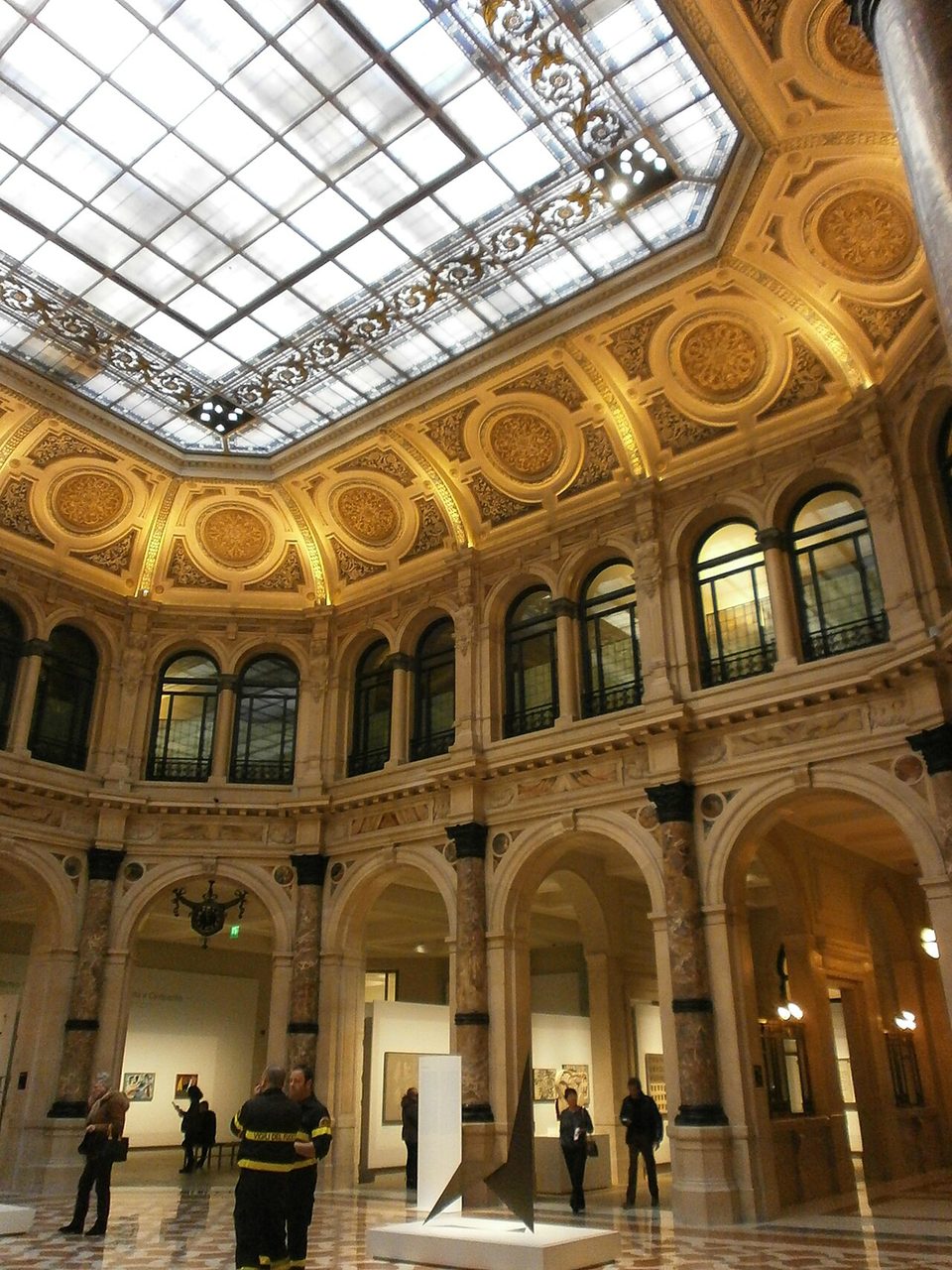
The banking hall and the Cantiere del '900
Where to stand
Inside the former bank, in the great hall and the rooms that open onto it
Where banking went on for a century you now find Italian art of the later twentieth century: Fontana, Burri, Vedova, Dorazio. It is called the Cantiere, the worksite, because it never stands still: the works rotate, picked from a collection of over three thousand.
Spot the detail
Find the grand staircase up to the second floor and look at the balustrade: what motif decorates it?
The full story
A century ago you came in here on business: loans, securities, safe-deposit boxes. Now you come in to look at paintings with no figures and sculptures that resemble nothing at all. The change of trade was radical, but the building has kept its solemn stride.
Before the art, look at the container. The interiors by Luca Beltrami, the building's architect, speak the same classical language as the facade. The showpiece is the grand staircase up to the second floor.
Why it is called a worksite
The rooms around the hall house the Cantiere del '900, the Twentieth-Century Worksite. The name tells the truth: it is a work in progress. Intesa Sanpaolo's collection of twentieth-century and present-day art runs to more than three thousand works, which arrived from the banks that merged into the group over the years.
Showing them all is impossible. So the museum rotates them, in displays that change theme. What you find today may be gone a year from now: don't look for a fixed list of masterpieces, look for an idea.
Italy after the war
The idea is this: Italian art from the 1950s to the 1980s. These are the decades when many painters stop depicting the world and start questioning the picture itself: what space is, what a mark is, how much the material matters.
The names are the ones that count. Lucio Fontana and Emilio Vedova reason about space, Alberto Burri and Afro work with traces and memory, Bruno Munari and Piero Dorazio play with geometry and color. In the hall, meanwhile, the sculptures take center stage.
If abstract art is not your thing, give it ten minutes anyway. Pick a single work, the one that annoys you most, and ask yourself what its maker was after. It usually works.
Then look up and remember where you are. Few collections of contemporary art have a 1911 bank for a backdrop.
Next stop
Look for the way down to the basement: the vault is below