Stop 3 of 8Must-see
The vault
Where to stand
In the basement of the former bank, at the entrance to the strongroom
The bank's strongroom, designed by Beltrami in the early 1900s, now holds about five hundred paintings instead of jewels and securities. It is a storeroom that lets itself be looked at.
Spot the detail
Look for the two big columns that hold up the room: which style do they belong to?
The full story
Every bank has a room its customers never see in full. This one belonged to the Banca Commerciale Italiana, and today it is part of the museum.
The , which Italians call by the French word caveau, is the strongroom: the place where valuables and documents were locked away. It was designed by Luca Beltrami, the building's architect, in the first years of the twentieth century. He could have made it a warehouse with a thick door. He made it a state room underground.
Look at how it is built. The plan is symmetrical and everything turns around two columns, massive ones. The staircase, the gallery railing and the details in cast and wrought iron pick up the plant motif of the grand staircase on the upper floors.
Few customers can have come down here to admire a railing. Beltrami designed it all the same.
How it looked in 1911
There are photographs of this place taken in 1911, when the building had just been finished, by Achille Ferrario and Luca Comerio. Today they are in the bank's historical archive.
They show a world tidy to the point of obsession. There was the for the Dossiers and the one for the Tesoro, the treasure, each with its own lobby. And there were the single booths, where a customer could withdraw to open a box away from other people's eyes.
Paintings instead of boxes
The safe-deposit boxes are gone. In their place are about five hundred paintings from the Intesa Sanpaolo collection, hung on mesh panels that slide like wardrobe doors.
It is a storage system, designed for conservation. But it leaves the works in view. This is where the paintings that find no room upstairs rest, waiting for their turn.
It is still a working storeroom, and you cannot always get in. If you find it closed, at least remember what lies under your feet.
A museum usually shows you the galleries and hides the storerooms. Here the storeroom is one of the finest things to see.
About this stop
Anecdote
The vault as seen by a film pioneer
At the Gallerie d'Italia, the museum on Piazza della Scala, the of the former Banca Commerciale Italiana was photographed in 1911, brand new. Several of those pictures are by Luca Comerio, a Milanese photographer whose life is worth a movie. Not yet twenty, he had photographed the 1898 Milan riots, among barricades and soldiers. He became court photographer, then switched to the movie camera and in 1907 founded Milan's first film production company. In 1911 he also filmed the war in Libya. It ended badly: jobless, poor and ill, he died in 1940 in the Mombello psychiatric hospital. He had filmed kings and battles. And, once, a safe.
Record
Five hundred paintings in a bank vault
At the Gallerie d'Italia, the museum born inside a bank on Piazza della Scala, the twentieth-century works rotate, and the numbers explain why. The collection of twentieth-century and present-day art of Intesa Sanpaolo, the bank behind the museum, alone runs to more than three thousand works. In 2011, when the museum opened, the group owned about ten thousand in all. There are never enough walls. That is why about five hundred paintings are kept in the , the strongroom in the basement, hung on sliding panels where the safe-deposit boxes used to be. It is a storeroom where, for once, you are allowed to peek.
Next stop
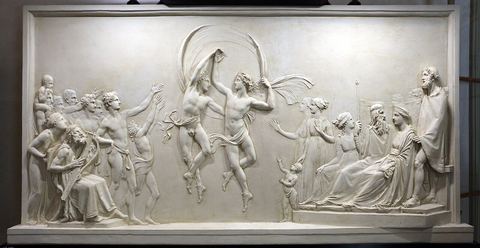
Go back up and follow the nineteenth-century route: it starts with Canova's white reliefs