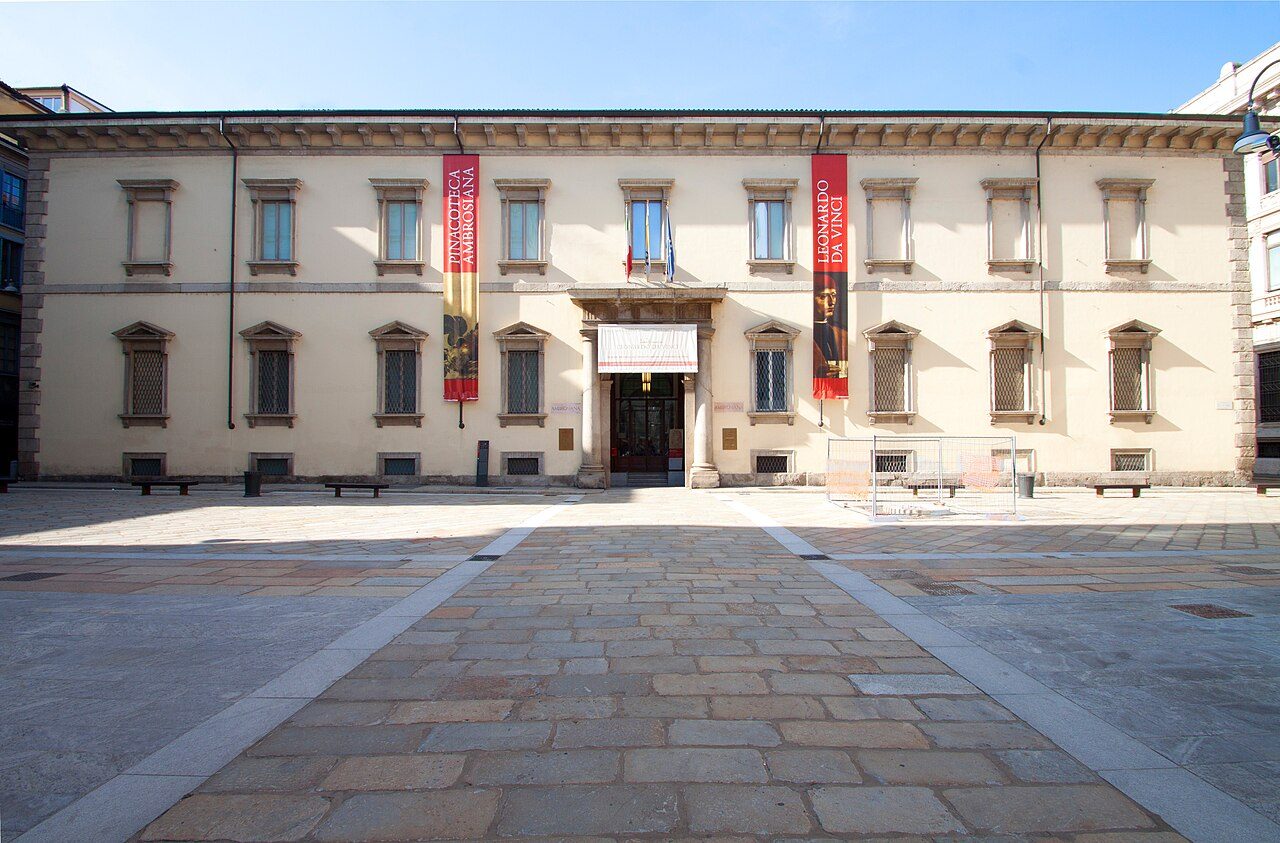
Museum · Historic Center · 1618
Pinacoteca Ambrosiana
Caravaggio, Raphael and Leonardo in Milan's oldest museum, founded as a school
In brief
The collection that Cardinal Federico Borromeo gave to his library in 1618, to serve people who were studying. A few sure things: Caravaggio's Basket of Fruit, the cartoon for the School of Athens, Leonardo's Musician and the sheets of the Codex Atlanticus.
Stories of this place
- Anecdote · The cardinal who wanted a schoolReadExcommunication for stealing a bookMany old libraries protected their volumes by chaining them to the desks. Federico Borromeo, the cardinal who founded the Ambrosiana, chose another system. In his library, opened in 1609, the books were available to anyone who could read and write, but whoever stole one would be excommunicated. The warning is carved on a marble plaque that still exists. For a seventeenth-century cardinal it was the most powerful anti-theft device imaginable.
- In culture · The cardinal who wanted a schoolReadThe cardinal of I promessi sposiIf you have read I promessi sposi, The Betrothed, the great Italian novel, you already know the founder of the Ambrosiana: Federico Borromeo, archbishop of Milan, is its Cardinal Federigo. The author, Alessandro Manzoni, gives him the twenty-second chapter, where he tells the story of his life and of his visits to the villages of the diocese. The character is not made up. The real Federico handed out alms during the famine, and in the plague of 1630 he stayed to care for the sick. And before ending up in a novel he had founded the Ambrosiana, library and museum.
- In culture · Caravaggio, the Canestra di fruttaReadCaravaggio's fruit on the 100,000-lire noteThe Ambrosiana holds Caravaggio's Basket of Fruit, a small painting of a wicker basket and nothing else. For almost twenty years Italians carried it in their wallets: it appeared on the back of the 100,000-lire banknote bearing the painter's portrait, issued from 1983 and in use until the euro arrived. A fine fate for a picture painted on a secondhand canvas, in the Roman years when the painter was short of money: his worm-eaten fruit became, quite literally, hard cash.
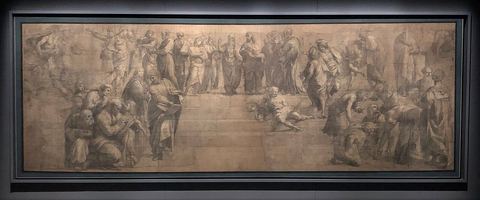
- Anecdote · Raphael, the cartoon for the School of AthensReadPlato has Leonardo's faceThe Ambrosiana holds the cartoon, the large drawing, that the painter Raphael made for the School of Athens, his fresco in the Vatican. In the center, find the bearded old man pointing at the sky: he is the philosopher Plato. A very widespread reading, which the museum shares, says Raphael gave him the face of Leonardo da Vinci, then still alive and thirty years his senior. The one left out is Raphael himself: in the fresco he portrayed himself in a corner, on the right, but here his self-portrait is missing. So at the Ambrosiana Leonardo appears twice: in his own works, and perhaps here, as a Greek philosopher.
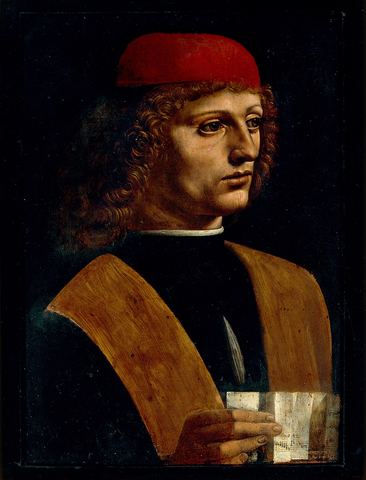
- Anecdote · Leonardo, the Ritratto di musicoReadLeonardo came to Milan as a musicianLeonardo da Vinci's Portrait of a Musician, at the Ambrosiana, may show one of his traveling companions. His first biographers say Leonardo did not present himself in Milan as a painter. Around 1482 Lorenzo de' Medici, ruler of Florence, sent him to Ludovico il Moro, who governed Milan, as a musician. He brought a lyre he had built himself, largely of silver, shaped like a horse's skull. And he brought a young pupil he had taught to sing to the lyre: Atalante Migliorotti. He is one of the names proposed for the boy in the portrait. If it really is him, that boy entered the court at Leonardo's side.
- Anecdote · The Codex Atlanticus in the Sala FedericianaReadThe Leonardo mistaken for ChineseThe Codex Atlanticus, the great collection of Leonardo da Vinci's papers shown at the Ambrosiana, nearly stayed in Paris, where Napoleon's commissioners had taken it. In 1815, with the emperor fallen, an Austrian commissioner went to take back the works carried off from Milan. The story goes that he was about to leave it where it was: that reversed handwriting, running from right to left, looked like Chinese to him. Still according to the story, it was the sculptor Antonio Canova who insisted the volume should come home. The other Leonardo manuscripts that had been at the Ambrosiana were not recovered, and they are still in Paris.
- Legend · The Codex Atlanticus in the Sala FedericianaReadThe bicycle Leonardo never drewThe Codex Atlanticus is the great collection of Leonardo da Vinci's papers kept at the Ambrosiana. In the 1960s, for its restoration, the sheets were detached from their old supports, and on the back of one appeared the sketch of a bicycle, chain and all. The scholar Augusto Marinoni attributed it to a pupil copying one of the master's ideas, and in the 1970s the affair broke out. But another expert, Carlo Pedretti, had held that sheet up to the light in 1961, when it was still glued down: only circles and a few lines. Today almost all scholars consider it a modern addition. Who drew it, nobody knows.
- Anecdote · The Codex Atlanticus in the Sala FedericianaReadThe Leonardo a king of England couldn't buyThe Codex Atlanticus, the largest collection of Leonardo da Vinci's papers, came to the Ambrosiana in 1637, a gift from the Milanese nobleman Galeazzo Arconati. A plaque records it and adds a detail worthy of a novel: a king of England had offered him a large sum for it, and he had refused. Which king is not clear. A document of the time names James I, but with a date when he was already dead, and many think it was Charles I instead.
- AnecdoteReadLucrezia Borgia's lock of blond hairAmong the curiosities of the Pinacoteca Ambrosiana, in Milan, is a lock of blond hair. It is attributed to Lucrezia Borgia, duchess of Ferrara, and has been here since at least 1685, kept with her letters to the poet Pietro Bembo. In the nineteenth century it became a Romantic myth. The English poet Lord Byron, visiting in 1816, called those letters the prettiest love letters in the world and told of taking away a single hair as a relic. In 1926 the writer Gabriele D'Annunzio came to be moved by it. Soon afterward the goldsmith Alfredo Ravasco enclosed the lock in the precious case where you see it today.
- In cultureReadMark Twain refuses to be impressedIn 1867 Mark Twain, the American writer, came through the Ambrosiana on a cruise around Europe and the Holy Land. He wrote about it in The Innocents Abroad, his best-selling book in his lifetime, and he would not be intimidated. Of the blond hair attributed to Lucrezia Borgia, the duchess of Ferrara, he noted: It awoke emotions, but we still live. Then he saw some drawings by Leonardo da Vinci, and stopped at the pronunciation: here they spell it Vinci and pronounce it Vinchy, because foreigners always spell better than they pronounce. As for the drawings, We reserve our opinion. Leonardo rarely gets a review that lukewarm.
Ready-made questions
After Sant'Ambrogio, Saint Ambrose, the patron saint of Milan. Federico Borromeo, who was the city's archbishop, named the library he opened in 1609 after him, and the name then passed to the picture gallery and to the whole building. In Milan, ambrosiano is almost a synonym for Milanese: the name tells you this collection was created for the city.
Because they come from the same project. Federico Borromeo opened the library first, then in 1618 gave it his paintings and drawings, and finally added an academy for young artists. Books and images were meant to serve the same purpose: educating people. To this day the library and the , the picture gallery, share the same building, and the visit ends right in the old reading room.
Go to stop: The cardinal who wanted a schoolNo, and nobody can. There are more than a thousand sheets, and light damages them. In the room you will find about a dozen, and they rotate: each sheet stays on display for three months and then rests in the dark for three years. Since 2019, though, every sheet can be browsed online, one by one.
Go to stop: The Codex Atlanticus in the Sala FedericianaToday almost all scholars say yes, at least for the face. But it was not always so: in the old Ambrosiana inventories the painting goes from Leonardo to Bernardino Luini and back, and in the twentieth century more than one scholar gave it to a painter of his circle. The doublet and the stole, left unfinished, could be by an assistant. The face and the curls, on the other hand, convince nearly everyone.
Go to stop: Leonardo, the Ritratto di musicoBecause it is as big as the figures in the fresco it prepared. A was used to fix the composition at full scale, one to one, and then transfer it to the wall. The one for the School of Athens measures about eight meters by almost three and includes only the figures: the architecture of the background is not there. It is the largest Renaissance cartoon to have survived.
Go to stop: Raphael, the cartoon for the School of AthensThe simplest explanation is that he was left-handed. Writing from right to left was his everyday habit, and he kept it up to the last papers of the Atlanticus. The result is handwriting that reads easily only in a mirror and that has confused more than one reader. The story goes that in 1815 an Austrian commissioner mistook it for Chinese.
Go to stop: The Codex Atlanticus in the Sala FedericianaThey are in Paris. In 1637 Galeazzo Arconati had given twelve of them to the Ambrosiana, including the Atlanticus. In 1796 Napoleon's commissioners took them all to France. After the emperor's fall only the Codex Atlanticus came back to Milan: the others stayed there, and today they belong to the Institut de France.
Go to stop: The Codex Atlanticus in the Sala FedericianaThe stops
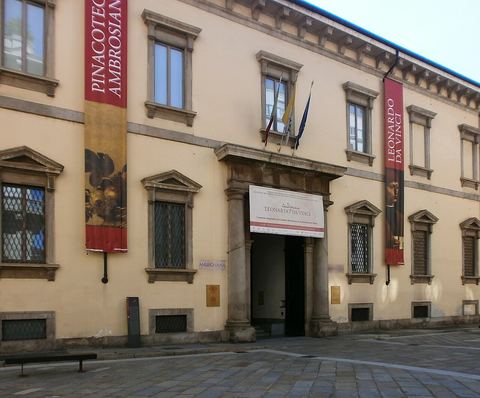
1 The cardinal who wanted a school
Before you go in, the key to everything: the Ambrosiana was not created to guard treasures but to teach. It was the idea of Cardinal Federico Borromeo, who brought together a library open to all, a picture gallery and an academy.
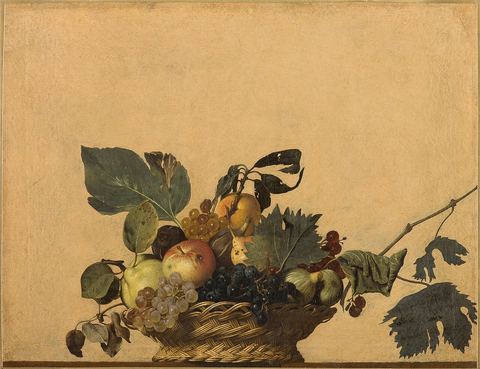
2 Caravaggio, the Canestra di frutta
A basket of fruit and nothing else, painted in Rome at the end of the sixteenth century. It is considered the prototype of the still life, and Cardinal Borromeo loved it so much that he could not find it a worthy companion.
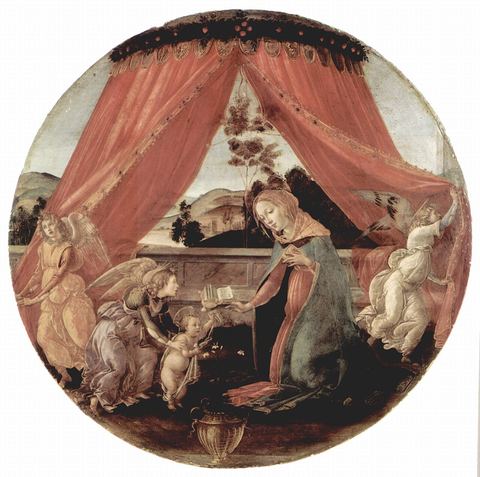
3 Botticelli, the Madonna del Padiglione
A tondo painted by Sandro Botticelli in the 1490s. Two angels pull back a curtain like a stage curtain and reveal a mother with her child. A tender scene, but one full of omens.
4 Raphael, the cartoon for the School of Athens
The full-size drawing Raphael made to prepare the most famous fresco in the Vatican's Raphael Rooms. Eight meters of charcoal, all by his own hand: it is the largest Renaissance cartoon to have come down to us.
5 Leonardo, the Ritratto di musico
The only male portrait painted by Leonardo da Vinci, and the only panel of his still in Milan. A young man in a red cap with a sheet of music in his hand. Who he is, after five centuries, nobody knows.
6 The Codex Atlanticus in the Sala Federiciana
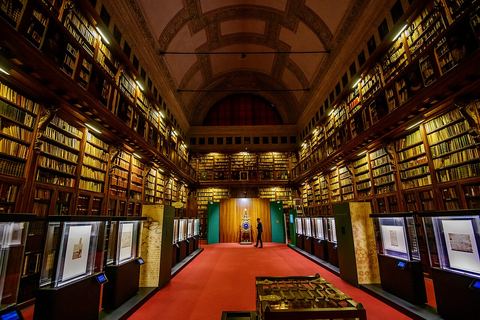
The world's largest collection of drawings and notes by Leonardo da Vinci: more than a thousand sheets, forty years of ideas. You see about a dozen at a time, in rotation, in the room where the library opened in 1609.
Timeline
- 1609Cardinal Federico Borromeo opens the Biblioteca Ambrosiana, his library, to the public.
- 1618Borromeo gives the library paintings, drawings and sculptures, including Caravaggio's Basket of Fruit: the Pinacoteca is born.
- 1626Raphael's cartoon for the School of Athens, on loan since 1610, is bought for six hundred imperial lire.
- 1637Galeazzo Arconati donates twelve manuscripts by Leonardo da Vinci, including the Codex Atlanticus.
- 1796Napoleon's commissioners take the Codex Atlanticus and the other Leonardo manuscripts to Paris.
- 1815With Napoleon fallen, the Codex Atlanticus and Raphael's cartoon are returned. The other manuscripts stay in France.
- 1905A cleaning of the Portrait of a Musician brings back the hand holding the sheet of music.
- 2019After four years of restoration Raphael's cartoon goes back on view in a redesigned room.
Who's who
Federico Borromeo
cardinal and archbishop of Milan, founder
Cousin of Saint Carlo Borromeo. He opened the library in 1609 and in 1618 gave it his art collection, to serve those who studied. He is Cardinal Federigo in I promessi sposi.
Caravaggio
painter
Michelangelo Merisi, born in Milan in 1571. In Rome, as a young man, he painted the Basket of Fruit, considered the prototype of the still life.
Raphael
painter
Raffaello Sanzio drew with his own hand the cartoon for the School of Athens, the fresco Pope Julius II wanted for the Raphael Rooms in the Vatican.
Leonardo da Vinci
painter, engineer and scientist
He lived in Milan for many years, at the court of Ludovico il Moro. He left the Ambrosiana the Portrait of a Musician and the more than a thousand sheets of the Codex Atlanticus.
Sandro Botticelli
Florentine painter
The painter of the Primavera. His Madonna del Padiglione, painted around 1493, belongs to his most severe phase, in the years of Savonarola's sermons.
Galeazzo Arconati
Milanese nobleman, donor
In 1637 he gave the Ambrosiana twelve Leonardo manuscripts, including the Codex Atlanticus. A plaque records that he refused to sell it to a king of England.
Words to know
Where it is
The neighborhood
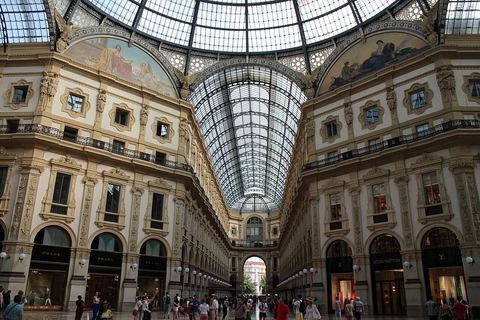
Historic Center
Related places
The story of the place
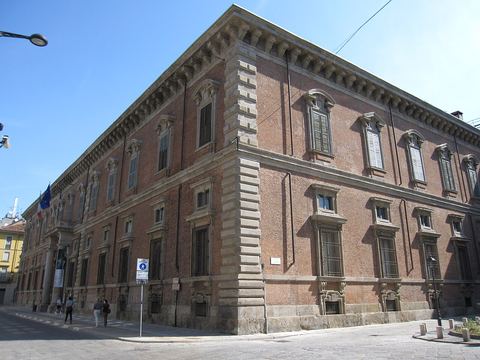
From the outside it does not promise much: a plain facade, a doorway between two columns, a quiet little square a few minutes from the Duomo, Milan's cathedral. Inside is the oldest museum in the city, and it grew up in an unusual place: inside a library.
The cardinal's project
The idea came from Federico Borromeo, cardinal and archbishop of Milan, cousin of Saint Carlo Borromeo. During his years in Rome he had set his heart on a project: a library that anyone who could read and write would be free to enter. He opened it in 1609 and dedicated it to Sant'Ambrogio, Saint Ambrose, the patron saint of the city. To fill it he sent his agents to buy manuscripts across half of Europe, in the Greek islands and in the Near East.
In 1618 he took the second step: he gave the library his collection of paintings, drawings and sculptures. A , meaning a picture gallery, was born. Soon afterward came the third piece, an academy where young people learned to paint and sculpt from the models the cardinal had gathered.
For him paintings were not furniture: they were textbooks. That is why he also wanted plaster casts, copies and preparatory drawings, things a vain collector would have turned his nose up at.
What happened next
The academy did not last. In the eighteenth century the Austrian government put its money on Brera, the new academy across town, and the Ambrosiana's school faded away. The collection, on the other hand, kept growing through gifts and bequests, and the building grew with it. Over the centuries it expanded, taking the place of a demolished church along the way, until it filled an entire block above the ancient Roman forum.
Not everything went smoothly. At the end of the eighteenth century Napoleon's commissioners carried the best pieces off to Paris, and not all of them came back. In 1943 bombs hit the building. Each time the Ambrosiana got back on its feet.
What to see today
Today the visit runs through four centuries of gifts, but the sure things are few and clear. On the upper floor are Caravaggio's Canestra di frutta, the Basket of Fruit, a Madonna by Botticelli and Raphael's gigantic for the School of Athens. At the end, on the ground floor, Leonardo da Vinci is waiting for you: with the only one of his panel paintings still in Milan and with the sheets of the Atlanticus, displayed in the old reading room.
Keep one thing in mind as you walk around. This museum was not created to put on a show: it was created so that someone, by looking, could learn the craft.
Sources
- Pinacoteca, Veneranda Biblioteca Ambrosiana (opens in a new tab)Official site
- Canestra di frutta, Veneranda Biblioteca Ambrosiana (opens in a new tab)Official site
- Codex Atlanticus, Veneranda Biblioteca Ambrosiana (opens in a new tab)Official site
- Palazzo dell'Ambrosiana, Lombardia Beni Culturali (opens in a new tab)Catalog
- Scuola di Atene, cartone di Raffaello, Lombardia Beni Culturali (opens in a new tab)Catalog
- Teca con i capelli di Lucrezia Borgia, Lombardia Beni Culturali (opens in a new tab)Catalog
- Borromeo, Federico, Dizionario Biografico degli Italiani, Treccani (opens in a new tab)Encyclopedia
- Torna a splendere il Raffaello dell'Ambrosiana, ARTE.it (opens in a new tab)Other source
- Cullen Murphy, La biblioteca Ambrosiana di Milano e Leonardo, Internazionale (opens in a new tab)Other source
- Cartone per la Scuola di Atene, Veneranda Biblioteca Ambrosiana (opens in a new tab)Official site
- Ritratto di musico, Veneranda Biblioteca Ambrosiana (opens in a new tab)Official site
- Migliorotti, Atalante, Dizionario Biografico degli Italiani, Treccani (opens in a new tab)Encyclopedia
- La bicicletta attribuita a Leonardo, mostra in rete del Museo Galileo (opens in a new tab)Institution
- Leonardo da Vinci ha inventato la prima bicicletta?, Geopop (opens in a new tab)Other source
- Mark Twain, The Innocents Abroad, capitolo 19, Wikisource in inglese (opens in a new tab)Other source
- Innocents Abroad, Mark Twain in His Times, University of Virginia (opens in a new tab)Institution
- Hans-Erhard Lessing, The Leonardo da Vinci Bicycle Hoax, Cycle Publishing (opens in a new tab)Other source
- Giorgio Vasari, Vita di Lionardo da Vinci (1568), Wikisource in italiano (opens in a new tab)Other source
- Scuola di Atene, Musei Vaticani (opens in a new tab)Institution
- Lucrezia Borgia, duchessa di Ferrara, Dizionario Biografico degli Italiani, Treccani (opens in a new tab)Encyclopedia
- Bicicletta di Leonardo da Vinci, Wikipedia in italiano (opens in a new tab)Wikipedia
- The Innocents Abroad, Wikipedia in inglese (opens in a new tab)Wikipedia
- Pinacoteca Ambrosiana, Wikipedia in italiano (opens in a new tab)Wikipedia
- Biblioteca Ambrosiana, Wikipedia in inglese (opens in a new tab)Wikipedia
- Canestra di frutta, Wikipedia in italiano (opens in a new tab)Wikipedia
- Madonna del Padiglione, Wikipedia in italiano (opens in a new tab)Wikipedia
- Scuola di Atene, Wikipedia in italiano (opens in a new tab)Wikipedia
- Ritratto di musico, Wikipedia in italiano (opens in a new tab)Wikipedia
- Portrait of a Musician, Wikipedia in inglese (opens in a new tab)Wikipedia
- Codice Atlantico, Wikipedia in italiano (opens in a new tab)Wikipedia
- Pinacoteca Ambrosiana, Wikidata (Q1085811), coordinate e indirizzo (opens in a new tab)Other source