Stop 5 of 6Must-see
Leonardo, the Ritratto di musico
Where to stand
On the ground floor, in the Aula Leonardi. The portrait is small: stand facing it and find the eyes first
The only male portrait painted by Leonardo da Vinci, and the only panel of his still in Milan. A young man in a red cap with a sheet of music in his hand. Who he is, after five centuries, nobody knows.
Spot the detail
Look for the hand holding the folded sheet: for a long time nobody could see it
The full story
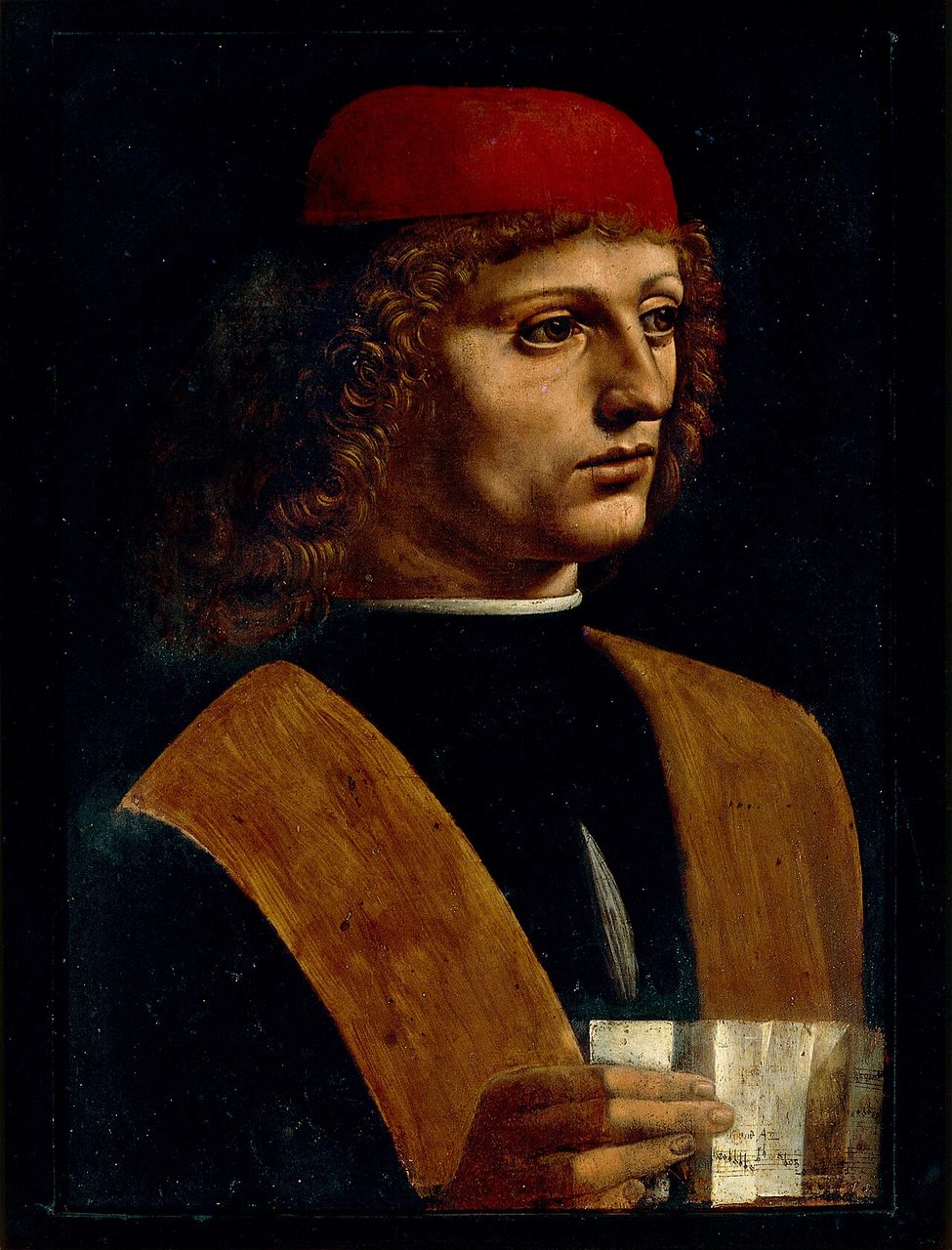
A boy with curls down to his shoulders and a red cap is looking at something you cannot see, outside the picture. He is not posing. He seems to be listening instead.
This is the Ritratto di musico, the Portrait of a Musician. As far as we know, it is the only portrait of a man that Leonardo da Vinci ever painted, and the only one of his panel paintings still in Milan. He made it around 1485, in his first years in the city at the court of Ludovico il Moro, ruler of Milan.
What to look at up close
Step closer and see where the painting is finished and where it is not. The face and hair are worked down to the last curl. The rest was left halfway: the dark doublet is barely blocked in, the orange stole is only a base of color. Many scholars think Leonardo painted the head and an assistant had a hand in the body.
Then go back to the eyes. The two pupils are not the same: one is much more dilated than the other, as if the light were striking it differently. In real life that does not happen. But in his notebooks Leonardo was studying exactly how the pupil reacts to light, and some think that here he pushed the effect to bring the gaze alive.
Who the musician is
And now the mystery. For centuries this was the portrait of a duke, perhaps Ludovico il Moro himself. Then, at the beginning of the twentieth century, restorers removed some old overpainting and at the bottom a hand appeared, holding a sheet of music. The duke suddenly became a musician.
Which one, though? The first candidate was Franchino Gaffurio, who in those years directed the choir of the Duomo, Milan's cathedral. But Gaffurio was a priest, and there is no trace of a priest's clothing here.
Today the favorite is Atalante Migliorotti, a young musician: in a note Leonardo mentions a portrait he made of Atalante with his face raised. A pity that this face is not raised at all. The name of the composer Josquin Desprez has come up as well. Nobody has won.
Even the painter has been in doubt. A seventeenth-century inventory assigns the picture to Bernardino Luini, a Lombard painter; then someone crosses it out and corrects it: or rather, by Leonardo.
While you are here, look around. The room gathers the painters who grew up in Leonardo's shadow, and the comparison helps you see what he had that they did not.
The painting, in any case, works perfectly well without answers. In front of you is a boy from five centuries ago, caught a moment before he sings. Or a moment after. You decide.
About this stop
Anecdote
Leonardo came to Milan as a musician
Leonardo da Vinci's Portrait of a Musician, at the Ambrosiana, may show one of his traveling companions. His first biographers say Leonardo did not present himself in Milan as a painter. Around 1482 Lorenzo de' Medici, ruler of Florence, sent him to Ludovico il Moro, who governed Milan, as a musician. He brought a lyre he had built himself, largely of silver, shaped like a horse's skull. And he brought a young pupil he had taught to sing to the lyre: Atalante Migliorotti. He is one of the names proposed for the boy in the portrait. If it really is him, that boy entered the court at Leonardo's side.
Today almost all scholars say yes, at least for the face. But it was not always so: in the old Ambrosiana inventories the painting goes from Leonardo to Bernardino Luini and back, and in the twentieth century more than one scholar gave it to a painter of his circle. The doublet and the stole, left unfinished, could be by an assistant. The face and the curls, on the other hand, convince nearly everyone.
Next stop
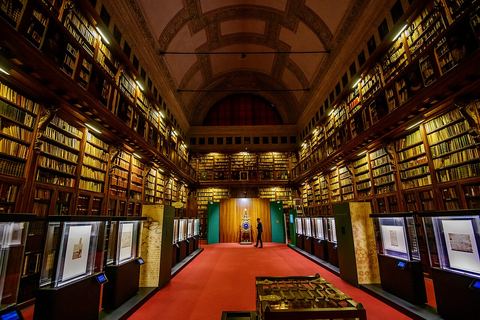
Look for the Sala Federiciana, the old reading room: the sheets of the Codex Atlanticus are displayed there