Stop 6 of 6Must-see
The Codex Atlanticus in the Sala Federiciana
Where to stand
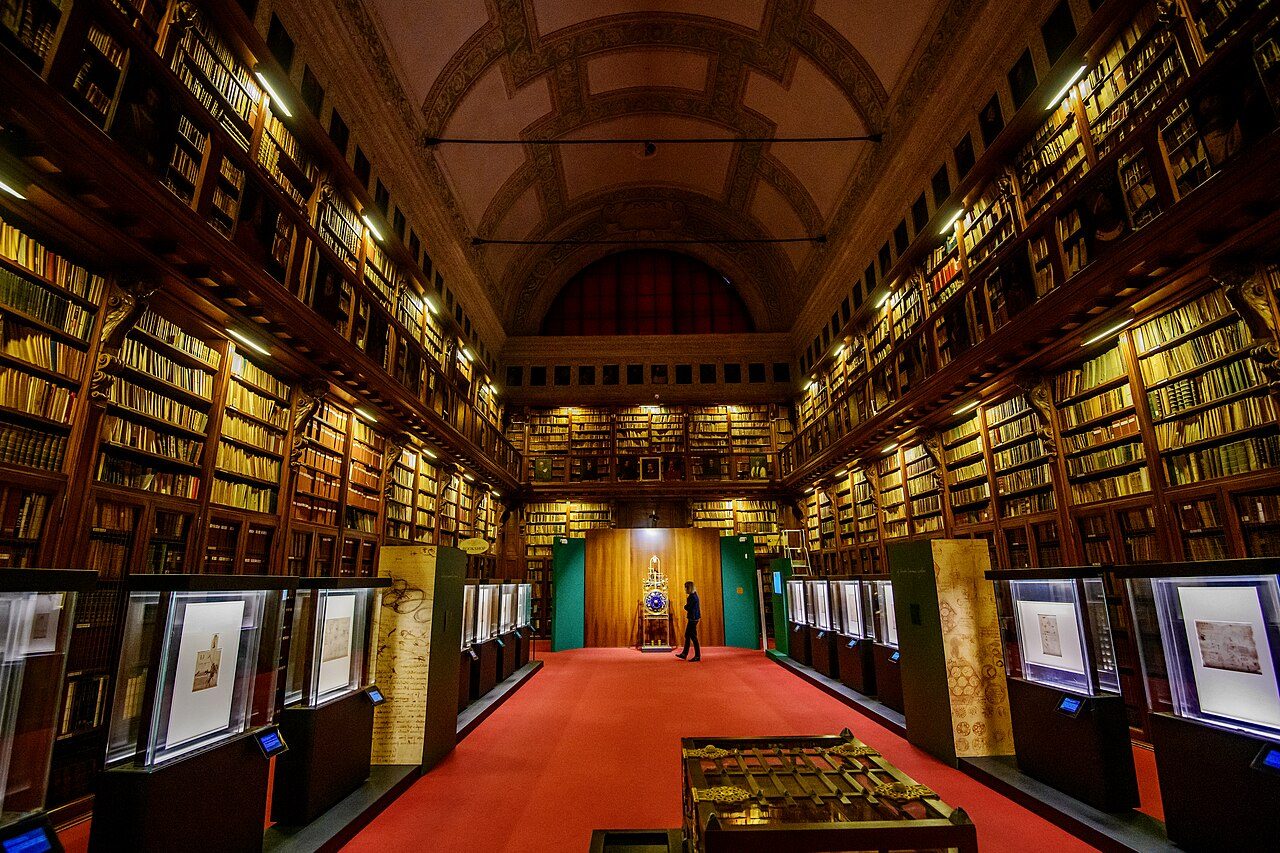
In the Sala Federiciana, the library's old reading room. Leonardo's sheets are in the display cases: pick one
The world's largest collection of drawings and notes by Leonardo da Vinci: more than a thousand sheets, forty years of ideas. You see about a dozen at a time, in rotation, in the room where the library opened in 1609.
Spot the detail
Pick a sheet and try to read one word. Which side does the line start from?
The full story
Look around before you bend over the cases. This is the Sala Federiciana, the original reading room of the Ambrosiana, named after its founder, Cardinal Federico Borromeo: here, from December 1609, anyone who could read and write was free to sit down and study. There was no better place to show the papers of the most curious man of the Renaissance.
What is in the codex
The Atlanticus, the Codice Atlantico in Italian, is the largest collection of writings and drawings by Leonardo da Vinci: more than a thousand sheets, forty years of work, from his youth to the last months of his life. There is a bit of everything in it. Machines for war and for building sites, mechanical wings, a parachute, studies in geometry, the plan of Milan, even a cart that moves by itself. The ocean has nothing to do with it: Atlanticus comes from the format of the pages, as large as those of an atlas.
From Leonardo to the Ambrosiana
It was not Leonardo who put it together. At his death the papers passed to his pupil Francesco Melzi, then they were scattered. At the end of the sixteenth century the sculptor Pompeo Leoni recovered many of them and pasted them into one huge book.
In 1637 the Milanese nobleman Galeazzo Arconati gave it to the Ambrosiana together with eleven other Leonardo manuscripts. A stone plaque tells how a king of England had offered him a fortune for it, and how he had said no.
Then came Napoleon. In 1796 his commissioners shipped everything to Paris. After his fall only the Atlanticus came back to Milan: the other manuscripts are still in France.
And it very nearly stayed there too. The story goes that the Austrian official in charge was about to discard it, and that it was the sculptor Antonio Canova who insisted it should come home.
Why you see few sheets
An honest warning: you will not see the whole . In the twentieth century a major restoration divided it into twelve volumes. More recently the sheets were unbound one by one, to preserve them better and to make it possible to show them.
There are about a dozen in the room, and they change. Each sheet stays in the light for three months, then goes back into the dark for three years. The ones in front of you today may not be there for someone who comes a few months from now.
So pick one and stay with it. Do not look for the masterpiece: look for the second thought, the note squeezed into the margin, the small drawing next to the large one. Leonardo's paintings are very few. Here, instead, you find him at work, at the exact moment an idea comes to him.
About this stop
Anecdote
The Leonardo mistaken for Chinese
The Atlanticus, the great collection of Leonardo da Vinci's papers shown at the Ambrosiana, nearly stayed in Paris, where Napoleon's commissioners had taken it. In 1815, with the emperor fallen, an Austrian commissioner went to take back the works carried off from Milan. The story goes that he was about to leave it where it was: that reversed handwriting, running from right to left, looked like Chinese to him. Still according to the story, it was the sculptor Antonio Canova who insisted the volume should come home. The other Leonardo manuscripts that had been at the Ambrosiana were not recovered, and they are still in Paris.
Legend
The bicycle Leonardo never drew
The Atlanticus is the great collection of Leonardo da Vinci's papers kept at the Ambrosiana. In the 1960s, for its restoration, the sheets were detached from their old supports, and on the back of one appeared the sketch of a bicycle, chain and all. The scholar Augusto Marinoni attributed it to a pupil copying one of the master's ideas, and in the 1970s the affair broke out. But another expert, Carlo Pedretti, had held that sheet up to the light in 1961, when it was still glued down: only circles and a few lines. Today almost all scholars consider it a modern addition. Who drew it, nobody knows.
Anecdote
The Leonardo a king of England couldn't buy
The Atlanticus, the largest collection of Leonardo da Vinci's papers, came to the Ambrosiana in 1637, a gift from the Milanese nobleman Galeazzo Arconati. A plaque records it and adds a detail worthy of a novel: a king of England had offered him a large sum for it, and he had refused. Which king is not clear. A document of the time names James I, but with a date when he was already dead, and many think it was Charles I instead.
No, and nobody can. There are more than a thousand sheets, and light damages them. In the room you will find about a dozen, and they rotate: each sheet stays on display for three months and then rests in the dark for three years. Since 2019, though, every sheet can be browsed online, one by one.
The simplest explanation is that he was left-handed. Writing from right to left was his everyday habit, and he kept it up to the last papers of the Atlanticus. The result is handwriting that reads easily only in a mirror and that has confused more than one reader. The story goes that in 1815 an Austrian commissioner mistook it for Chinese.
They are in Paris. In 1637 Galeazzo Arconati had given twelve of them to the Ambrosiana, including the Atlanticus. In 1796 Napoleon's commissioners took them all to France. After the emperor's fall only the Codex Atlanticus came back to Milan: the others stayed there, and today they belong to the Institut de France.