Stop 4 of 6Must-see
Raphael, the cartoon for the School of Athens
Where to stand
In the room devoted to the cartoon. Start from the back to take it in whole, then walk up to the glass
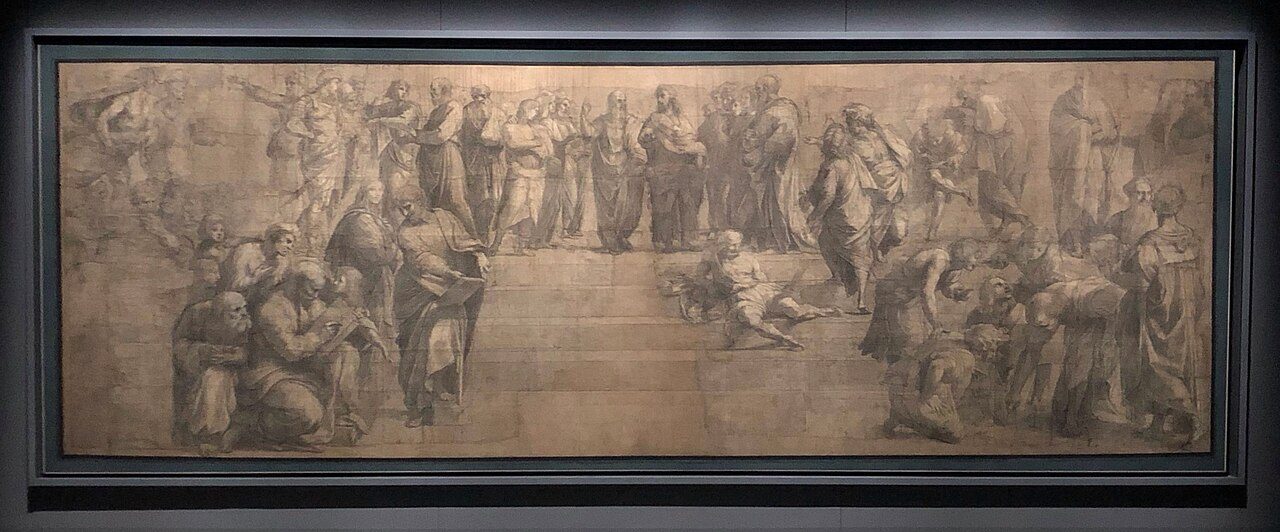
The full-size drawing Raphael made to prepare the most famous fresco in the Vatican's Raphael Rooms. Eight meters of charcoal, all by his own hand: it is the largest Renaissance to have come down to us.
Spot the detail
Look behind the philosophers for the great vaults that fill half the scene in the fresco
The full story
The wall in front of you is one single, enormous drawing: a crowd of life-size figures, in black and white. Raphael drew it with his own hand, when he was a little over twenty-five.
What a cartoon is
You need one word: . It has nothing to do with comics. It is the preparatory drawing as large as the finished work, made of many sheets of paper glued together, which painters used to carry their figures onto the wall.
This one prepared the School of Athens, the fresco that Pope Julius II wanted for his rooms in the Vatican and that Raphael painted around 1510. At the center Plato and Aristotle stride forward. Around them the wise men of antiquity argue, write, measure with a compass.
The beauty of it is that here you watch Raphael think. No color to distract you: only charcoal, with touches of for the highlights. The shadows are bolder than in the fresco, and every face has a character of its own.
Why it still exists
A usually died on the job. The outlines were pricked with a needle, the sheet was laid against the fresh plaster, and charcoal dust was dabbed over it, passing through the holes and leaving the drawing on the wall: this is the technique called . In the end there was little left to keep.
This one has pricked outlines too, but it was not used to carry the drawing onto the wall: it served instead to show the pope the effect of the whole. That is why it still exists, and it is the largest Renaissance to have come down to us: about eight meters by almost three, some 26 feet across.
The cartoon's travels
How did it end up in Milan? A century later, Count Fabio Visconti lent it to Cardinal Federico Borromeo, the founder of the Ambrosiana. It arrived in two pieces. When the count died, his widow sold it to the cardinal for six hundred imperial lire. For a museum born as a drawing school it was the perfect lesson.
After that it traveled more than a sheet of paper should. At the end of the eighteenth century Napoleon's French requisitioned it and took it to the Louvre; it came back after the emperor's fall. During the Second World War it was locked in a bank vault while bombs hit the building. The latest chapter is a restoration that lasted four years and ended in 2019, with the room redesigned and the great glass case you see in front of you.
Before you go, try something. Pick a single figure and follow its outline with your eyes, from head to foot. Raphael drew that line, and no brush has ever passed over it.
About this stop
Anecdote
Plato has Leonardo's face
The Ambrosiana holds the , the large drawing, that the painter Raphael made for the School of Athens, his fresco in the Vatican. In the center, find the bearded old man pointing at the sky: he is the philosopher Plato. A very widespread reading, which the museum shares, says Raphael gave him the face of Leonardo da Vinci, then still alive and thirty years his senior. The one left out is Raphael himself: in the fresco he portrayed himself in a corner, on the right, but here his self-portrait is missing. So at the Ambrosiana Leonardo appears twice: in his own works, and perhaps here, as a Greek philosopher.
Because it is as big as the figures in the fresco it prepared. A was used to fix the composition at full scale, one to one, and then transfer it to the wall. The one for the School of Athens measures about eight meters by almost three and includes only the figures: the architecture of the background is not there. It is the largest Renaissance cartoon to have survived.
Next stop
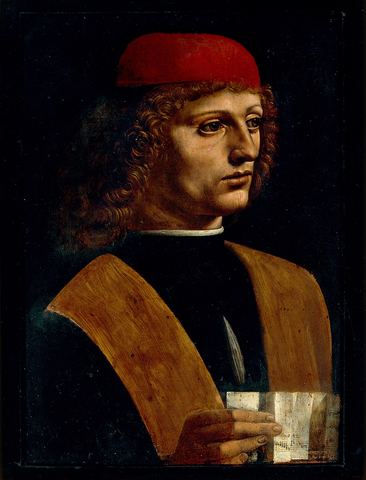
Follow the route down to the ground floor: in the Aula Leonardi a young man in a red cap is waiting for you