Stop 3 of 6
Botticelli, the Madonna del Padiglione
Where to stand
In the first rooms, in front of the round painting of the Madonna under a curtain. It is small: move in close
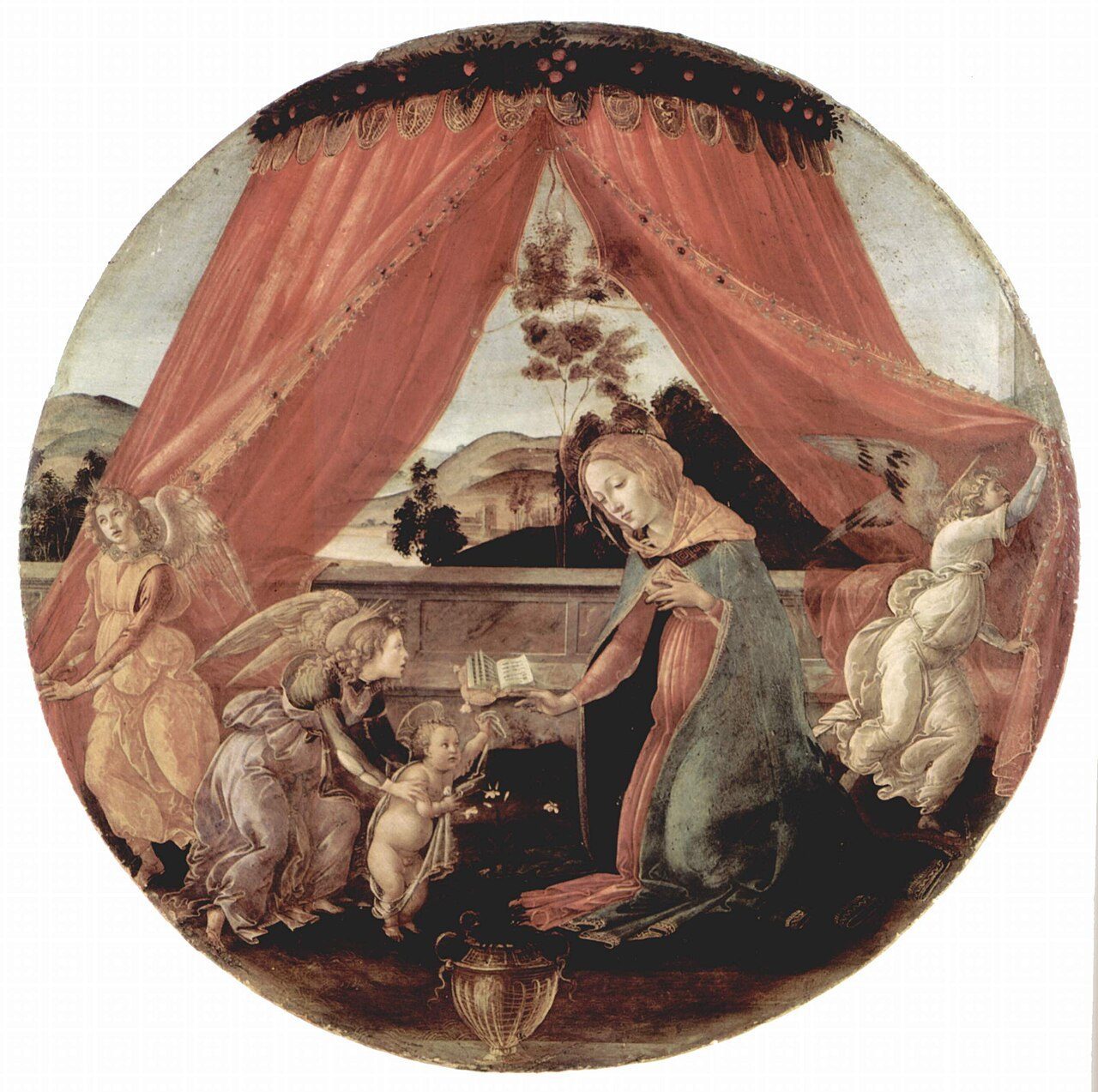
A painted by Sandro Botticelli in the 1490s. Two angels pull back a curtain like a stage curtain and reveal a mother with her child. A tender scene, but one full of omens.
Spot the detail
Raise your eyes to the garland above the curtain: what color are the fruits?
The full story
Here the scene begins as if in a theater. Two angels take hold of the edges of a curtain and draw it aside, and you are the audience. The padiglione of the title, the pavilion, is that very curtain: a canopy, the fabric covering set up over a throne or a ceremonial bed.
Beneath it is Mary, turned toward the Child. He can barely stand, and a third angel holds him up the way you would with someone learning to walk. With her left hand she uncovers her breast: she is about to nurse him. Behind them, beyond a parapet, a landscape of soft hills opens up.
A more severe Botticelli
The painter is Sandro Botticelli, the Florentine of the Primavera and the Birth of Venus. But this is not the lighthearted Botticelli you have in mind. The painting is dated to around 1493, and in Florence the mood is changing: these are the years of the sermons of Girolamo Savonarola, the friar who wanted to reform the city. Botticelli is marked by them, and his painting grows more severe.
Look at the angels: they are smaller than the Madonna, even though they are right beside her. It is not a mistake in perspective. It is a deliberate return to an old rule, the one that says whoever matters more is painted larger.
The objects and the format
Then there are the objects, and none of them is there by chance. The vase in the foreground is Mary herself, whom Christian tradition calls the mystical vessel. The book and the white flowers speak of purity. And up above, in the garland, are the fruits you are looking for.
The round format has a name: . This one is a little over half a meter across, about two feet, and a recent restoration has given it back its luminous, transparent colors, with the delicacy of a miniature. It is worth looking at up close, one face at a time: they all have that melancholy air that is Botticelli's signature.
An uncertain provenance
How it got to Milan is not entirely clear. It appears for the first time in an Ambrosiana inventory of 1837, as the gift of a Milanese marchioness, Fiorenza Talenti. Perhaps it is the small that Giorgio Vasari, the biographer of the Renaissance artists, recalls in the room of the prior of a monastery in Florence. Perhaps not.
What stays with you is the stroke of theater in that curtain. The angels open it for you, and what they show is a mother who already seems to know how it will end.
Next stop
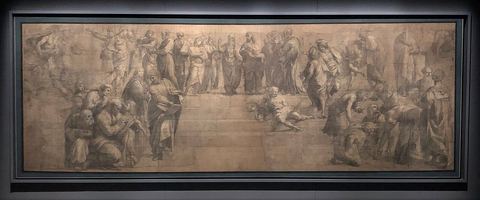
Keep going through the rooms until an entire wall turns into a drawing: that is Raphael's cartoon