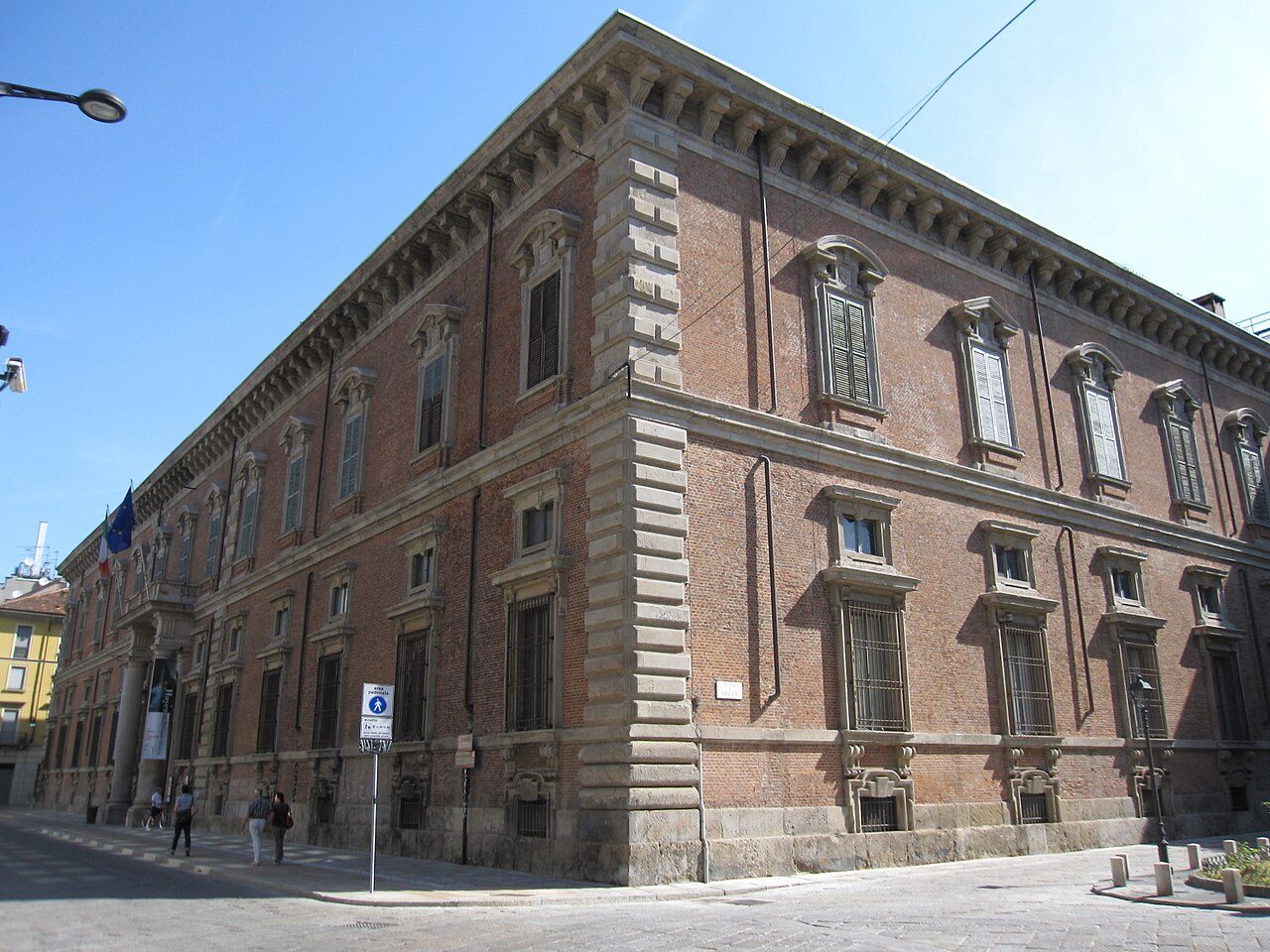
Museum · Brera · 1776–1809
Pinacoteca di Brera
The museum Napoleon filled by emptying the altars of half of Italy
In brief
Milan's great picture gallery, inside a former Jesuit college that still houses an art academy. Mantegna, Raphael, Caravaggio and Hayez hang a few rooms apart, and many of the paintings were made for a church and came here with Napoleon.
Stories of this place
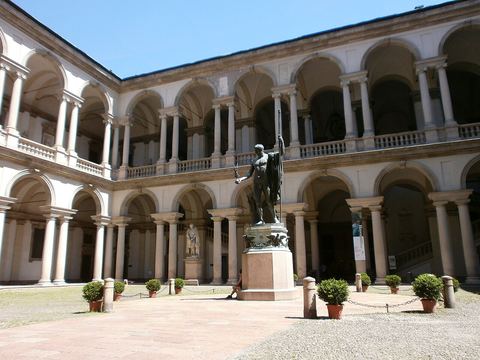
- Anecdote · The Courtyard of HonorReadThe Napoleon that ended up in the basementA bronze Napoleon by the sculptor Antonio Canova, naked as an ancient god, stands in the courtyard of Milan's Pinacoteca di Brera. Ordered in 1807, it was cast in Rome from cannons of Castel Sant'Angelo, the papal fortress. The first casting failed. By the time it reached Milan the empire was on its last legs, and after Napoleon's fall it ended up in the basement. In 1857 the emperor of Austria ordered it set up in the public gardens: nobody obeyed. It was unveiled in the courtyard only on August 14, 1859, after Napoleon III, nephew of the man portrayed, reached Milan. Almost half a century waiting for a pedestal.
- Anecdote · The Courtyard of HonorReadThe marble Napoleon in Wellington's houseThe bronze Napoleon in the courtyard of Brera, naked as an ancient god, has a marble twin, and the marble is the original. The sculptor Antonio Canova finished it in 1806. Napoleon saw it in Paris in 1811 and found it "too athletic": he had it removed from public view. In 1816 the British government bought it, and the Prince Regent gave it to the Duke of Wellington, the victor of Waterloo. It has stood in London ever since, at the foot of the staircase in his house, where the floor had to be reinforced. The loser, almost three and a half meters tall, in the winner's home.
- In culture · Mantegna, Cristo mortoReadPasolini and the dead man seen from the feetAt Brera, the Cristo morto, the Dead Christ, by the fifteenth-century painter Andrea Mantegna shows a corpse seen from the feet. In the 1962 film Mamma Roma, the death of young Ettore immediately reminded many of it. The director, Pier Paolo Pasolini, denied drawing directly on the painting and spoke instead of what he had learned from the art historian Roberto Longhi. The comparison stuck, though, and it is not the only one: critics have found the same shot in The Return, a 2003 film by the Russian director Andrey Zvyagintsev. And the photographer who photographed Che Guevara's body said he had been thinking of the image of Christ.
- Anecdote · Mantegna, Cristo mortoReadMantegna, 67 centimeters off the floorAt Brera, Andrea Mantegna's Cristo morto, the Dead Christ, shows a corpse seen from the feet. In 2013 the superintendent handed its display to a filmmaker, Ermanno Olmi. He isolated it in a small dark room, 67 centimeters from the floor: the height, he explained, where the body lay. "I drowned it in black," he said. Controversy was immediate. In the daily Corriere della Sera the archaeologist Andrea Carandini wrote that you had to kneel to see it, in a "dark space under the stairs." In 2016 the new director, James Bradburne, had it rehung among the fifteenth-century paintings. Five centuries on, people still argue over how to view it.
- Legend · Piero della Francesca, Pala MontefeltroReadThe cut nose of the Duke of UrbinoIn Piero della Francesca's altarpiece at Brera a man kneels in armor: Federico da Montefeltro, Duke of Urbino and a mercenary commander. At the root of the nose his profile has a sharp step, as if a piece were missing. For a long time the story went that he had a surgeon remove it: having lost his right eye in a joust, he could then see to that side with the other. The story is unproven, and many scholars doubt it. More likely the lance that pierced his visor took the eye and the top of the nose together. That famous profile is, first of all, a wound.
- Anecdote · Raphael, Sposalizio della VergineReadHammer blows for RaphaelRaphael's Sposalizio della Vergine, the Marriage of the Virgin, shows Mary and Joseph's wedding in front of a temple, and it is one of the most famous paintings in Milan's Pinacoteca di Brera. In June 1958 a man walked into the museum with a hammer and an awl. He broke the glass protecting the painting and struck the panel twice: on Mary's elbow and on the steps of the temple. The glass cushioned the blows and the damage stayed limited. The painting was restored in the 1960s. The attacker spent a year in a psychiatric hospital and was then released.
- In culture · Hayez, Il bacioReadHayez's Kiss, from painting to chocolatesIl bacio, the Kiss, painted by Francesco Hayez in 1859 and now in Milan's Pinacoteca di Brera, left the museum almost at once. By 1862 the painter Gerolamo Induno put it, as a print, in the room of a girl thinking of her sweetheart gone to war: that painting, Triste presentimento, Sad Presentiment, is at Brera too. In 1922 Federico Seneca, head of advertising at Perugina, designed the image for Baci, the chocolates: two lovers embracing, commonly traced back to the painting. In 1954 the director Luchino Visconti re-created the scene in Senso, his film set during the Risorgimento. Few Italian paintings have been quoted so much.
- AnecdoteReadThe director who ended up in prisonFernanda Wittgens won the competition to direct Milan's Pinacoteca di Brera in 1940: the first woman in Italy to run a major museum. During the war she moved the paintings out of reach of the bombing, and meanwhile helped Jews and other persecuted people flee the country. Betrayed by an informer, she was arrested in July 1944 and sentenced to four years. She left prison in 1945 and went back to work: the Pinacoteca, wrecked by the bombs of 1943 and rebuilt, opened on June 9, 1950. In 2014 Milan dedicated a tree to her in the Giardino dei Giusti, the city's Garden of the Righteous.
- RecordReadThe oldest complete tarot deck in the worldMilan's Pinacoteca di Brera holds more than paintings: it also has the Sola Busca tarot, seventy-eight cards printed from engravings, then colored in tempera and gold in Venice in 1491. The museum calls it the oldest complete deck in the world. The Italian state bought it for Brera in 2009. Forget fortune-telling, which caught on only in the eighteenth century: back then tarot was a court game. Here, instead of the usual figures, there are warriors of ancient Rome and heroes of the Bible, and symbols that scholars link to alchemy. The cards are fragile, and you may not find them on display. But they are here, all seventy-eight.
- AnecdoteReadA church cut in twoInside the Brera palace in Milan, home of the Pinacoteca, there was a church: Santa Maria di Brera, built in the Middle Ages by the Umiliati, a religious order. By 1808, under Napoleon, so many paintings had arrived from suppressed churches and convents that nobody knew where to put them. The solution was drastic: the church was divided into two floors, one above the other, and that is how the great halls known ever since as the Napoleonic rooms were born. To make space for paintings taken from churches, a church was sacrificed.
Ready-made questions
It comes from braida, a medieval word for a patch of uncultivated land. In the Middle Ages this is where Milan ended and the meadows began. The Umiliati, a religious order of wool workers, settled here, and the name of the land passed to their convent, then to the Jesuit college, the building, the museum and finally the whole neighborhood. The same word gives us Braidense, the name of the library housed in this building.
Because Brera was not born from a king's collection, but from a political decision. In the Napoleonic years many churches and convents were suppressed, and their paintings were sent to Milan, capital of the Kingdom of Italy. That is why the rooms hold mostly large . The Raphael comes from a church in Città di Castello, the Piero della Francesca from a church in Urbino. As you look at them, try to picture them where they used to be: high up, above an altar.
Because Canova did not make the portrait of a general, but the image of a god. The statue is called Napoleon as Mars the Peacemaker: Mars is the Roman god of war, and ancient sculptors showed gods and heroes without clothes. So no uniform and no hat, but an ideal body and a small winged Victory in his hand. The bronze was ordered in 1807 for Eugène de Beauharnais, viceroy of Italy, when Milan was the capital of the Napoleonic kingdom.
Go to stop: The Courtyard of HonorBecause Mantegna did not follow perspective to the letter, and he did it on purpose. In a body seen from the feet, a rigorous construction would enlarge what is near and shrink what is far. Here the opposite happens: the feet and legs are smaller than normal, the chest is very broad, the arms look too long. That way the face stays clearly visible, and the viewer is drawn into the scene instead of stopping at a display of skill.
Go to stop: Mantegna, Cristo mortoIt is an ostrich egg, and it is no whim. According to the museum it recalls the Virgin's miraculous motherhood and is also an emblem of the Montefeltro, the family of the duke who commissioned the painting. Other scholars have seen in it divine perfection, life, even a pearl. There is no single explanation. What is certain is that Piero della Francesca placed it in the most conspicuous spot, in line with Mary's oval face, which repeats its shape.
Go to stop: Piero della Francesca, Pala MontefeltroHe took the layout, not the result. Perugino was painting a Marriage of the Virgin with the same arrangement, now kept in Caen, in France, and Raphael may have seen it in progress. The difference lies in the space. In Perugino the temple is a backdrop. In Raphael it is the center toward which all the lines run, and the figures arrange themselves in a semicircle to follow its curve. More than a copy, it is a correction.
Go to stop: Raphael, Sposalizio della VergineYes, and the public of 1859 understood that at once. The painting was shown at Brera a few months after Vittorio Emanuele II and Napoleon III entered Milan, in the year of the Second War of Independence. The young man with the dagger who says goodbye and leaves was read as a volunteer. The colors of the clothes, blue, white, red and green, recalled the flags of Italy and France, the allies. The medieval costume was only the outfit: the subject was the present.
Go to stop: Hayez, Il bacioThe stops
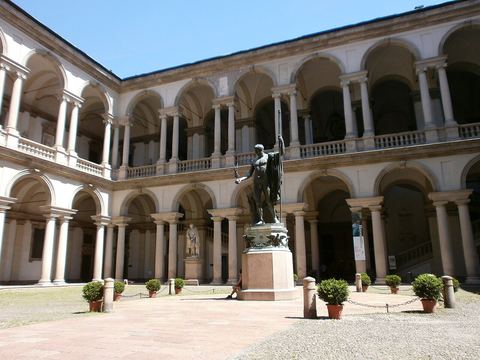
1 The Courtyard of Honor
The seventeenth-century courtyard of a Jesuit college, with a bronze Napoleon at its center, naked as an ancient god. The statue is by Canova, and before it got here it spent almost half a century in the basement.
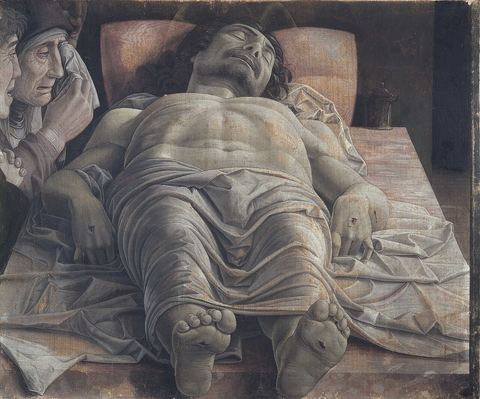
2 Mantegna, Cristo morto
A body laid out and seen from the feet, on a canvas barely eighty centimeters wide. It is one of the most famous feats of foreshortening in the Renaissance. Mantegna most likely painted it for himself: when he died it was still in his studio.
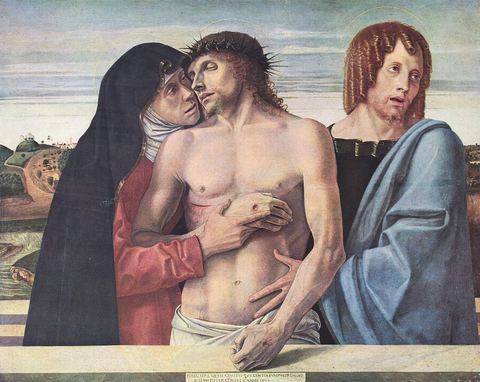
3 Giovanni Bellini, Pietà
Three half-length figures behind a parapet: the Madonna and Saint John hold up the dead Christ. Bellini, Mantegna's brother-in-law, answers the other man's harshness with the cold light of a dawn and a grief without gestures.
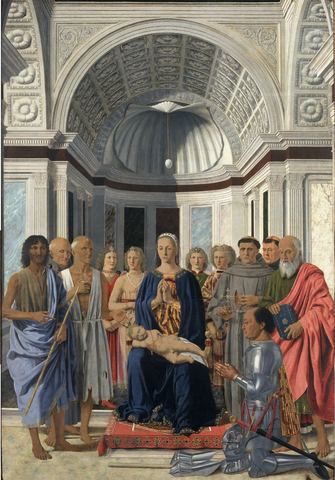
4 Piero della Francesca, Pala Montefeltro
A Madonna with the sleeping Child, saints, angels and a duke in armor, motionless beneath a marble apse. Piero della Francesca painted it for Federico da Montefeltro, lord of Urbino. Everything here is calculated, even the egg.
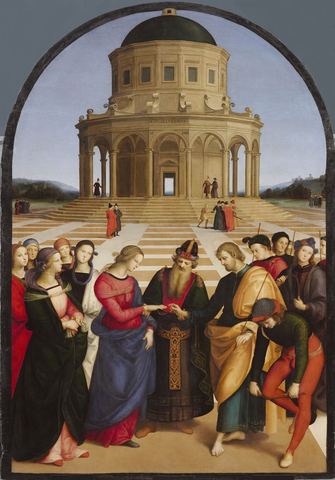
5 Raphael, Sposalizio della Vergine
The wedding of Mary and Joseph in front of a perfect temple. Raphael is just over twenty. He takes the layout of a painting by his master Perugino and does it better. Then he signs in plain sight, on the temple.
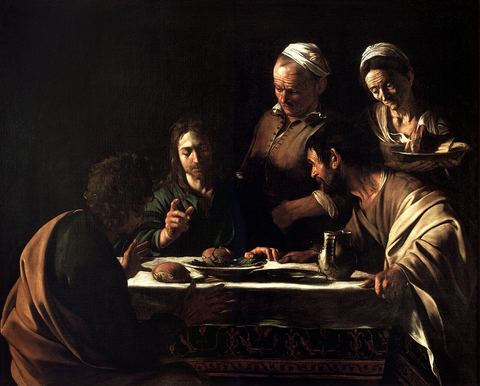
6 Caravaggio, Cena in Emmaus
Five figures around a humble table, in almost total darkness. Caravaggio painted it around 1606, as a fugitive, after killing a man in Rome. It is the stripped-down version of a scene he had already painted five years earlier.
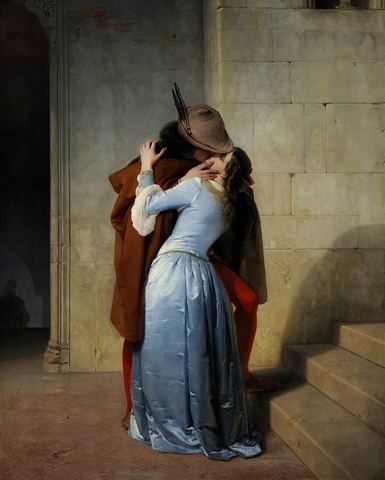
7 Hayez, Il bacio
A young man in a cloak kisses a girl dressed in blue in a medieval entrance hall. It looks like a love scene and nothing more. It was shown at Brera in 1859, a few months after Austrian rule over Milan ended, and everyone understood it was about Italy.
Timeline
- 13th–14th centuryThe Umiliati, a religious order of wool workers, build their convent and church at Brera.
- 1571The pope dissolves the Umiliati. The complex passes to the Jesuits, who want to turn it into a grand college.
- 1627Work begins on the new building, to a design by the architect Francesco Maria Richini.
- 1776With the Jesuits dissolved too, under Maria Theresa of Austria the building becomes the home of the Accademia di Belle Arti.
- 1809On August 15, Napoleon's birthday, the first rooms of the Pinacoteca open, with paintings taken from churches and convents.
- 1859Canova's Napoleon is unveiled in the center of the courtyard. In September Hayez exhibits Il bacio at Brera.
- 1943Bombs bring down the vaults of twenty-six rooms out of thirty-four. The paintings had already been moved to safety.
- 1950The rebuilt Pinacoteca reopens, under the leadership of Fernanda Wittgens.
Who's who
Francesco Maria Richini
architect of the building
In the seventeenth century he designed the Jesuit college, with its great courtyard and two stories of arcades. He died in 1658, with the building site still open.
Maria Theresa of Austria
empress, ruler of Milan in the eighteenth century
After the Jesuits were dissolved she turned the college into a center of learning. From 1776 Brera was the home of the Accademia di Belle Arti.
Giuseppe Bossi
painter, secretary of the academy from 1801
As secretary of the academy he looked after the art collections. In 1806 he tried to buy Mantegna's Cristo morto, with Canova's help.
Eugène de Beauharnais
viceroy of Italy, Napoleon's adopted son
He had the bronze Napoleon in the courtyard ordered, bought Raphael's Sposalizio for Brera and donated Giovanni Bellini's Pietà.
Antonio Canova
sculptor
He sculpted Napoleon as Mars the Peacemaker, of which the bronze in the courtyard is a copy. The Pinacoteca also keeps a large plaster of the same statue.
Fernanda Wittgens
director of the Pinacoteca from 1940
The first woman in Italy to direct a major museum. She saved the paintings from the war, went to prison for helping persecuted people, and led the rebuilding of Brera.
Words to know
Where it is
The neighborhood
Brera
Related places
The story of the place
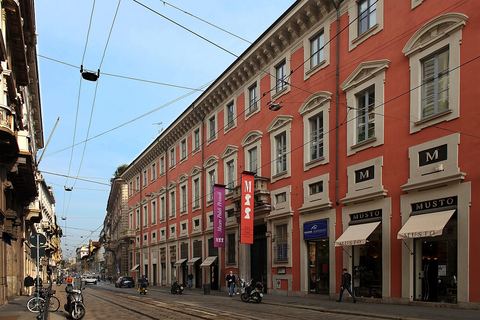
Brera comes from braida, a medieval word for a patch of uncultivated land. In the Middle Ages this is where the city ended and the meadows began. The Umiliati, a religious order famous for its wool working, settled here with a convent and a church.
In 1571 the pope dissolved the Umiliati and the complex passed to the Jesuits, who wanted a grand college. The building you are about to enter is theirs, designed in the seventeenth century by the architect Francesco Maria Richini and built in no hurry at all. The eighteenth century added an observatory for watching the stars, a library and a botanical garden. All three are still here.
Then the Jesuits were dissolved too. In 1776 Maria Theresa, empress of Austria and ruler of Milan at the time, made the college the home of the Accademia di Belle Arti, the fine arts academy. That is why the first paintings arrived: the students needed them to study.
The museum Napoleon made
The real museum was Napoleon's doing. Milan was the capital of his Kingdom of Italy, churches and convents were being shut down one after another, and the paintings they held ended up here in enormous numbers. To make room, the old church of the Umiliati was even cut into two floors. The first rooms of the , the picture gallery, opened on August 15, 1809, the emperor's birthday.
Keep that in mind as you walk through the rooms, because it explains what you see. Brera is not the collection of a king or a great family, full of portraits and drawing-room pictures. It is made up mostly of : large, solemn panels painted to stand at the far end of a church and removed from their place by decree.
The bombs of 1943
In August 1943 bombs brought down the vaults of twenty-six rooms out of thirty-four. The paintings were no longer there. Fernanda Wittgens, the director and the first woman in Italy to run a major museum, had already moved them to safety. She was the one who led the rebuilding, and in 1950 Brera reopened.
The visit in seven stops
Today the , the academy with its students, the library, the observatory and the botanical garden all live under the same roof. The visit we suggest has seven stops: the courtyard and six paintings, in chronological order, from the fifteenth century to the nineteenth. If you are in a hurry, keep four: Mantegna, Raphael, Caravaggio and Hayez. If a painting is not in its place, because it is being restored or is out on loan, move on to the next one: every stop stands on its own.
Sources
- Pinacoteca di Brera, sito ufficiale: capolavori (opens in a new tab)Official site
- Pinacoteca di Brera, sito ufficiale: Palazzo Brera (opens in a new tab)Official site
- Pinacoteca di Brera, scheda: Triste presentimento di Gerolamo Induno (opens in a new tab)Official site
- Seneca, Federico, Dizionario Biografico degli Italiani, Treccani (opens in a new tab)Encyclopedia
- Biblioteca Nazionale Braidense: storia del palazzo (opens in a new tab)Institution
- Palazzo di Brera, Lombardia Beni Culturali (opens in a new tab)Catalog
- Pinacoteca di Brera (Q150066), Wikidata: coordinate (opens in a new tab)Other source
- Pinacoteca di Brera, scheda: Cristo morto nel sepolcro e tre dolenti (opens in a new tab)Official site
- Pinacoteca di Brera, scheda: Pietà di Giovanni Bellini (opens in a new tab)Official site
- Pinacoteca di Brera, scheda: Pala di San Bernardino (opens in a new tab)Official site
- Pinacoteca di Brera, scheda: Sposalizio della Vergine (opens in a new tab)Official site
- Pinacoteca di Brera, scheda: Cena in Emmaus (opens in a new tab)Official site
- Pinacoteca di Brera, scheda: Il bacio (opens in a new tab)Official site
- Pinacoteca di Brera, Wikipedia in italiano (opens in a new tab)Wikipedia
- Napoleone Bonaparte come Marte pacificatore (Milano), Wikipedia in italiano (opens in a new tab)Wikipedia
- Cristo morto (Mantegna), Wikipedia in italiano (opens in a new tab)Wikipedia
- Pala di Brera, Wikipedia in italiano (opens in a new tab)Wikipedia
- Sposalizio della Vergine (Raffaello), Wikipedia in italiano (opens in a new tab)Wikipedia
- Il bacio (Hayez), Wikipedia in italiano (opens in a new tab)Wikipedia
- Fernanda Wittgens, Wikipedia in italiano (opens in a new tab)Wikipedia
- Napoleone Bonaparte come Marte pacificatore, Wikipedia in italiano (opens in a new tab)Wikipedia
- Napoleon as Mars the Peacemaker, Wikipedia in inglese (opens in a new tab)Wikipedia
- English Heritage: descrizione di Apsley House (opens in a new tab)Institution
- Federico da Montefeltro, duca di Urbino, Dizionario Biografico degli Italiani, Treccani (opens in a new tab)Encyclopedia
- Federico da Montefeltro, Wikipedia in italiano (opens in a new tab)Wikipedia
- Federico da Montefeltro, Wikipedia in inglese (opens in a new tab)Wikipedia
- Finestre sull'Arte: Il Cristo morto di Mantegna, capolavoro alla Pinacoteca di Brera (opens in a new tab)Other source
- Blitz quotidiano: Andrea Carandini sul Cristo morto di Mantegna a Brera (opens in a new tab)Other source
- Pinacoteca di Brera: Il segreto dei segreti, i tarocchi Sola Busca, guida alla mostra (opens in a new tab)Official site
- Finestre sull'Arte: I tarocchi Sola Busca, il mazzo completo più antico al mondo (opens in a new tab)Other source
- Waterloo 200, Age of Revolution: Napoleon as Mars the Peacemaker (opens in a new tab)Institution
- Museo Gypsotheca Antonio Canova: Napoleone come Marte pacificatore (opens in a new tab)Institution
- The Victorian Web: Canova, Napoleon as Mars the Peacemaker (opens in a new tab)Other source
- Schwartz e altri, The Monocular Duke of Urbino, Ophthalmology and Eye Diseases, 2016 (opens in a new tab)Other source
- Artribune: Dialoghi tra opere d'arte a Brera, Mantegna a confronto con Borgianni e Carracci (2016) (opens in a new tab)Other source
- Arte.it: La Pinacoteca si rinnova, Mantegna e Bellini visti da Ermanno Olmi (opens in a new tab)Other source