Stop 3 of 7
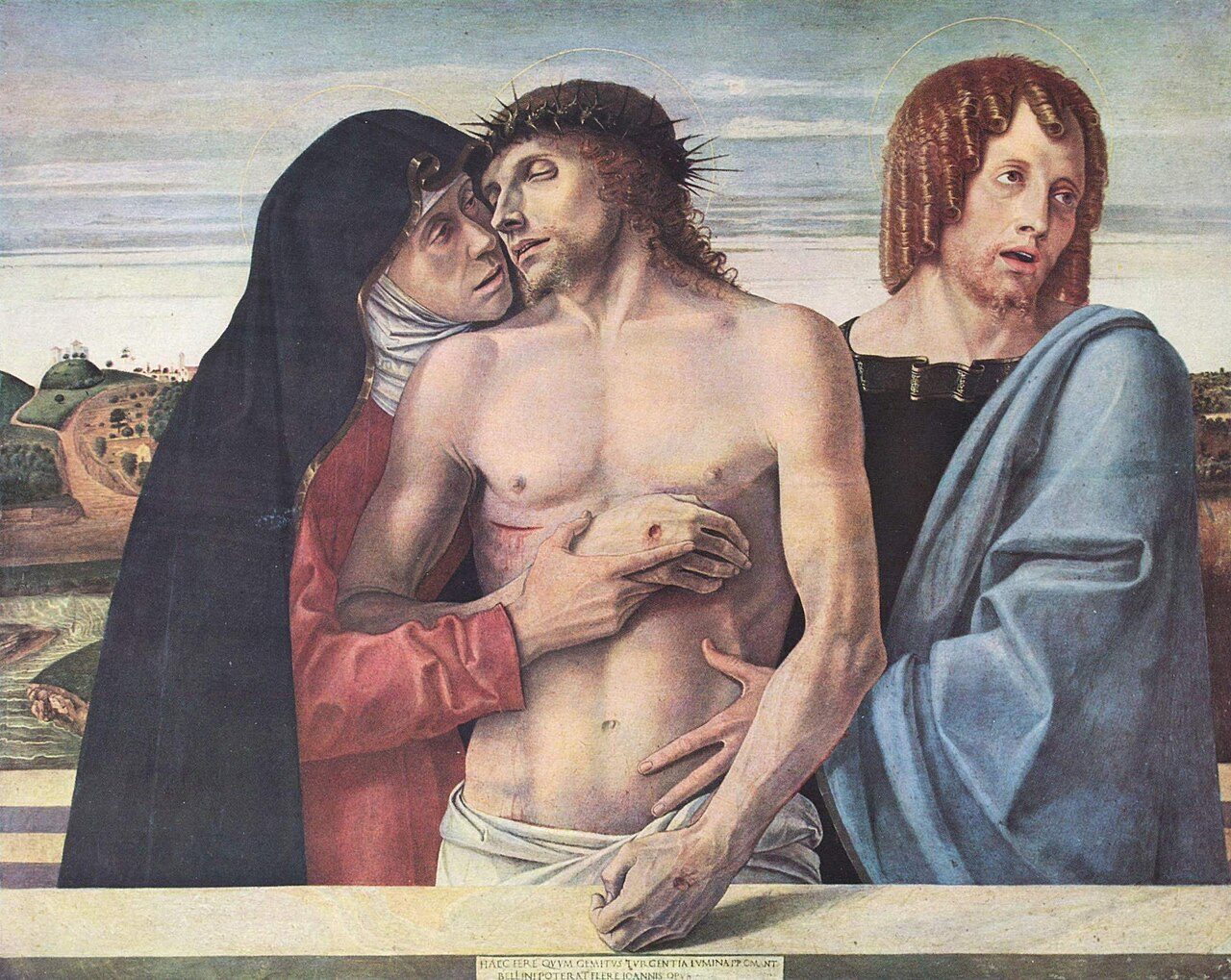
Giovanni Bellini, Pietà
Where to stand
In the same room as Mantegna's Cristo morto. Stand facing it, up close, level with the three faces
Three half-length figures behind a parapet: the Madonna and Saint John hold up the dead Christ. Bellini, Mantegna's brother-in-law, answers the other man's harshness with the cold light of a dawn and a grief without gestures.
Spot the detail
The little sheet of paper painted on the marble parapet, at the bottom: what does it say?
The full story
Mantegna's Christ is still in your eyes. Now look at what his brother-in-law does with the same subject.
Giovanni Bellini was Venetian, and Mantegna was family. The two knew each other well, and it shows. The crisp outlines and the solidity of the figures are lessons learned from the other man.
Everything else, though, is another world. There is no feat of perspective here. There is a marble parapet, and behind it three figures cut off at the waist, as if leaning at a window.
On the left the Madonna brings her face close to her son's, so close that you notice how alike they look. On the right Saint John has the stricken gaze of someone about to groan. In the middle is Christ, upright only because they are holding him. He seems to weigh nothing.
The hands and the light
Look at the hands. Those of the living have the color of circulating blood, those of Christ the pallor of death. One rests on the marble and juts out past the edge, toward you. It is an effective device: the parapet separates your world from theirs, and that hand crosses it.
Then raise your eyes to the sky behind the heads. It is clear and cold, like at dawn. Mantegna built space with lines; Bellini fills it with natural light, and with that light he sets the tone of the whole scene.
No cries, no gestures. The grief travels through the faces and the interlocking hands.
According to the museum, this is the painting in which Bellini breaks free of his brother-in-law's lesson. The soft tones and the attention to the humanity of his figures would become his hallmark.
From Bologna to Brera
The date is uncertain: around 1460 according to the museum, a few years later according to others. The journey here, on the other hand, is well known.
The painting was in Bologna, in the collection of the Sampieri family. In 1811 it was given to Brera by Eugène de Beauharnais, viceroy of Italy and Napoleon's adopted son. For once, a painting that arrived as a gift rather than being taken from an altar.
Mantegna puts you in front of a corpse. Bellini puts you in front of a mother.
They hang a few steps apart, and you would do well to look at them together. If you then have to choose which one to linger beside, we choose this one.
Next stop
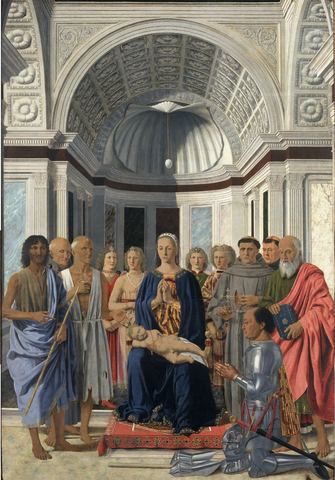
Follow the route to the large altarpiece by Piero della Francesca, with the Madonna beneath a marble apse