Stop 7 of 7Must-see
Hayez, Il bacio
Where to stand
In front of the painting, among the nineteenth-century painters. Look at it first from a few steps back, then up close
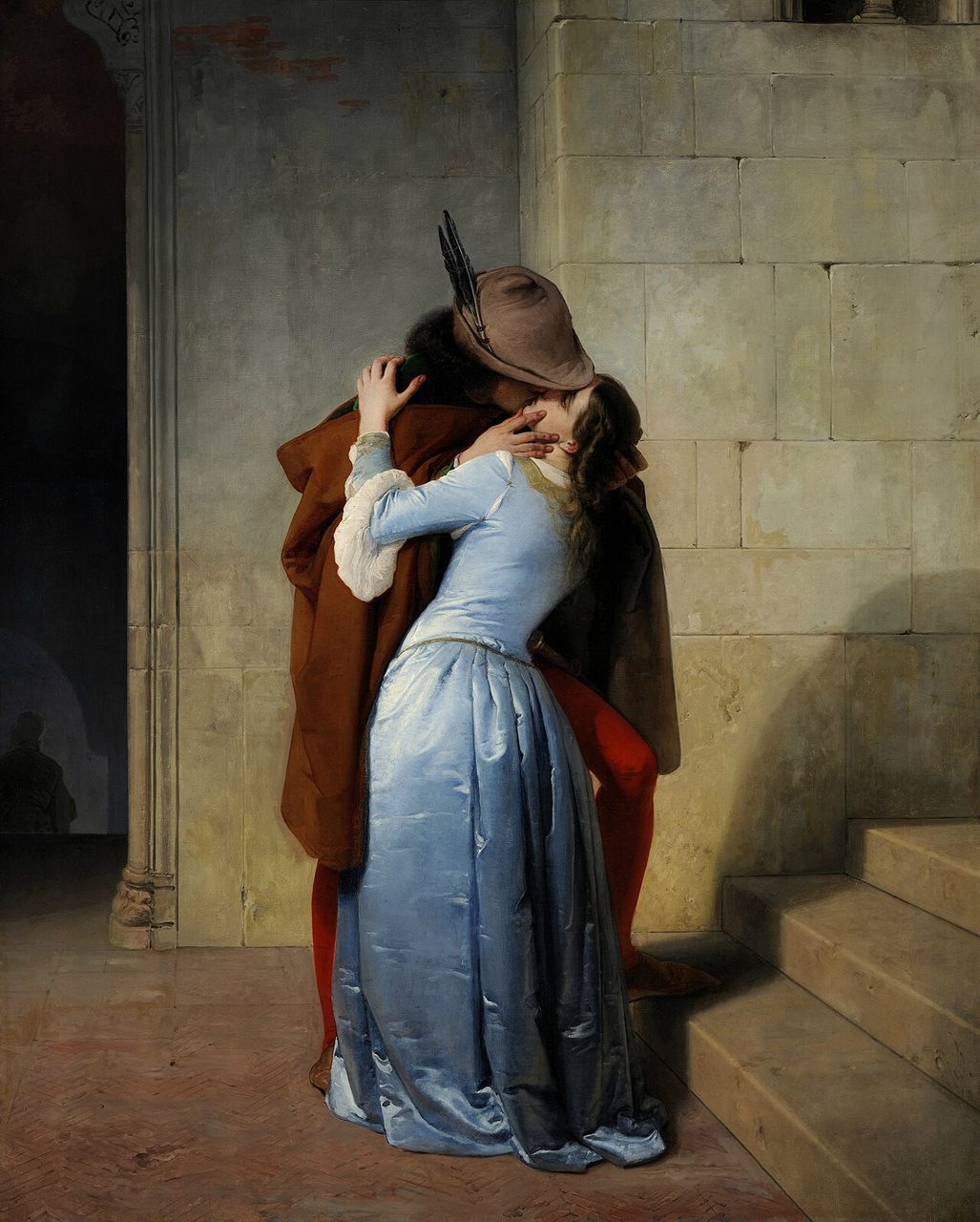
A young man in a cloak kisses a girl dressed in blue in a medieval entrance hall. It looks like a love scene and nothing more. It was shown at Brera in 1859, a few months after Austrian rule over Milan ended, and everyone understood it was about Italy.
Spot the detail
Under his cloak, at hip level: what is sticking out?
The full story
Chances are you knew this painting before you walked in. Il bacio, the Kiss, is among the most reproduced Italian paintings of the nineteenth century. In real life it is a little over a meter tall, about three and a half feet, and more restless than you remembered.
Look at how the two of them stand. They are kissing, but his body is already elsewhere: he has one foot on the step, ready to go. Under his cloak he hides a weapon.
At the back of the hall, in the shadows, there is a third figure. A spy? A fellow conspirator? Perhaps just a maid. But the doubt is part of the painting.
A painting from 1859
Francesco Hayez painted it in 1859 for a Milanese count, Alfonso Maria Visconti di Saliceto. The full title speaks of fourteenth-century costumes: a medieval scene, the kind Romantic taste loved.
But what matters is the date. The painting was exhibited right here, at Brera, in September of that year. A few months earlier Vittorio Emanuele II, king of Sardinia, and Napoleon III, emperor of the French and his ally in the war against Austria, had entered Milan.
Those who saw it then had no doubts. The young man who kisses and runs was the volunteer leaving to fight, and that kiss was the farewell of a generation.
Even the clothes were speaking. Look at the colors: the blue and white of her dress, the red of his tights, the green peeking out from the lining of his cloak. Put together, they make the flags of Italy and France, the two allies.
It was an instant success, and not only out of patriotism. The public also admired its boldness: a kiss like this, a real one, filling the whole canvas, made an impression. Hayez painted other versions of it, now scattered across various collections. This one stayed for more than twenty-five years in the home of the count, who left it to Brera in 1886.
Outside the museum
Then the Kiss walked out of the museum and never quite came back in. Within a few years other painters were already quoting it in their pictures of the Risorgimento, the movement that unified Italy. In the twentieth century it ended up in a celebrated movie scene, and the image on a famous box of chocolates is commonly traced back to it. It has become so familiar that you risk no longer looking at it.
Look at it anyway. You started with a bronze emperor and Mantegna's Christ, and you finish here, with two young people in an entrance hall. In between lie four centuries of painting, and one thing in common: almost none of these pictures was made to hang in a museum. They got here because someone, each time, decided they should belong to everyone.
About this stop
In culture
Hayez's Kiss, from painting to chocolates
Il bacio, the Kiss, painted by Francesco Hayez in 1859 and now in Milan's di Brera, left the museum almost at once. By 1862 the painter Gerolamo Induno put it, as a print, in the room of a girl thinking of her sweetheart gone to war: that painting, Triste presentimento, Sad Presentiment, is at Brera too. In 1922 Federico Seneca, head of advertising at Perugina, designed the image for Baci, the chocolates: two lovers embracing, commonly traced back to the painting. In 1954 the director Luchino Visconti re-created the scene in Senso, his film set during the Risorgimento. Few Italian paintings have been quoted so much.
Yes, and the public of 1859 understood that at once. The painting was shown at Brera a few months after Vittorio Emanuele II and Napoleon III entered Milan, in the year of the Second War of Independence. The young man with the dagger who says goodbye and leaves was read as a volunteer. The colors of the clothes, blue, white, red and green, recalled the flags of Italy and France, the allies. The medieval costume was only the outfit: the subject was the present.