Stop 5 of 7Must-see
Raphael, Sposalizio della Vergine
Where to stand
In front of Raphael's panel, in the same room as Piero della Francesca. Stand in the center, three or four steps back
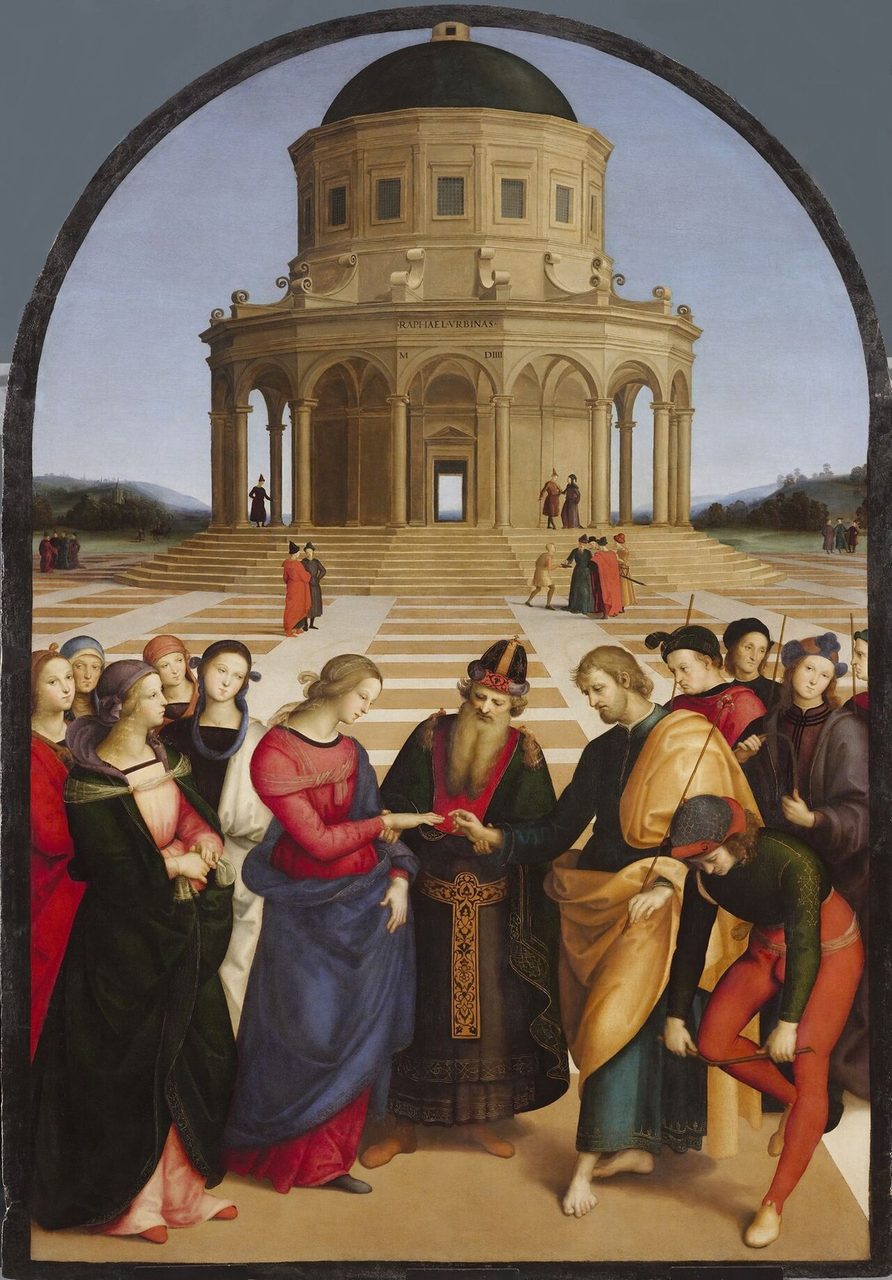
The wedding of Mary and Joseph in front of a perfect temple. Raphael is just over twenty. He takes the layout of a painting by his master Perugino and does it better. Then he signs in plain sight, on the temple.
Spot the detail
The inscription above the central arch of the temple, in line with the door
The full story
Start from the back. Even before the figures, what pulls you into the Sposalizio della Vergine, the Marriage of the Virgin, is the temple: sixteen sides, a portico all the way around, a dome, and an open door through which you can see the sky on the other side. The lines of the pavement all run there.
The story in the foreground comes from the . According to this tradition Mary had grown up in the Temple of Jerusalem, and when the time came to find her a husband, each suitor was given a dry branch. The winner would be the one whose branch flowered. Joseph's branch flowered.
In the center a priest performs the wedding, with the women on one side and the men on the other. Among the men, look for the disappointed suitor: he is snapping his branch against his leg.
The master's layout
Raphael painted the panel in 1504, at just over twenty, for a family's chapel in Città di Castello, a town in Umbria. And the idea was not his.
His master, Perugino, was working on the same subject with the same layout: the bride and groom in front, the square, the temple at the back. Raphael may have seen that painting while it was still in progress. Today it is in France, in the museum of Caen.
The comparison is merciless. In Perugino the temple is a backdrop, propped up behind the figures like a stage set. In Raphael it is the center of everything.
The figures arrange themselves in a semicircle to answer the curve of the building, and the space between them and the temple looks as if you could really walk across it. The architecture is so exact that some scholars have suggested he used a small wooden model.
It is the painting of a pupil overtaking his master. And the signature is right there, writ large, on the temple.
The journey to Milan
The journey to Milan is a story of elegant bullying. In 1798 one of Napoleon's generals, Giuseppe Lechi, had the panel presented to him as a gift by the town of Città di Castello, which was in no position to refuse.
He then sold it to a Milanese count, who bequeathed it to the city's hospital. A few years later Eugène de Beauharnais, viceroy of Italy, bought it for Brera. In the chapel in Città di Castello there is now a reproduction.
Before you go, look once more at the open door at the back. None of the figures turns toward it. And yet the whole painting is headed there.
About this stop
Anecdote
Hammer blows for Raphael
Raphael's Sposalizio della Vergine, the Marriage of the Virgin, shows Mary and Joseph's wedding in front of a temple, and it is one of the most famous paintings in Milan's di Brera. In June 1958 a man walked into the museum with a hammer and an awl. He broke the glass protecting the painting and struck the panel twice: on Mary's elbow and on the steps of the temple. The glass cushioned the blows and the damage stayed limited. The painting was restored in the 1960s. The attacker spent a year in a psychiatric hospital and was then released.
He took the layout, not the result. Perugino was painting a Marriage of the Virgin with the same arrangement, now kept in Caen, in France, and Raphael may have seen it in progress. The difference lies in the space. In Perugino the temple is a backdrop. In Raphael it is the center toward which all the lines run, and the figures arrange themselves in a semicircle to follow its curve. More than a copy, it is a correction.
Next stop
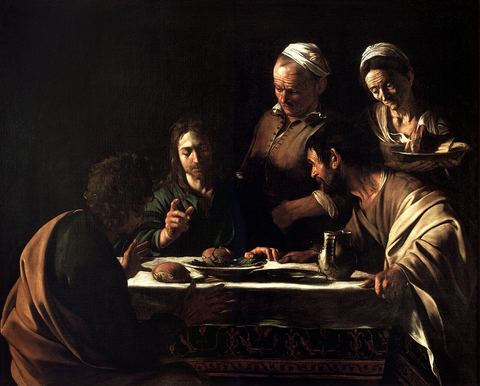
Carry on toward the seventeenth-century painting and look for Caravaggio's Cena in Emmaus, a very dark canvas