Stop 1 of 7
The Courtyard of Honor
Where to stand
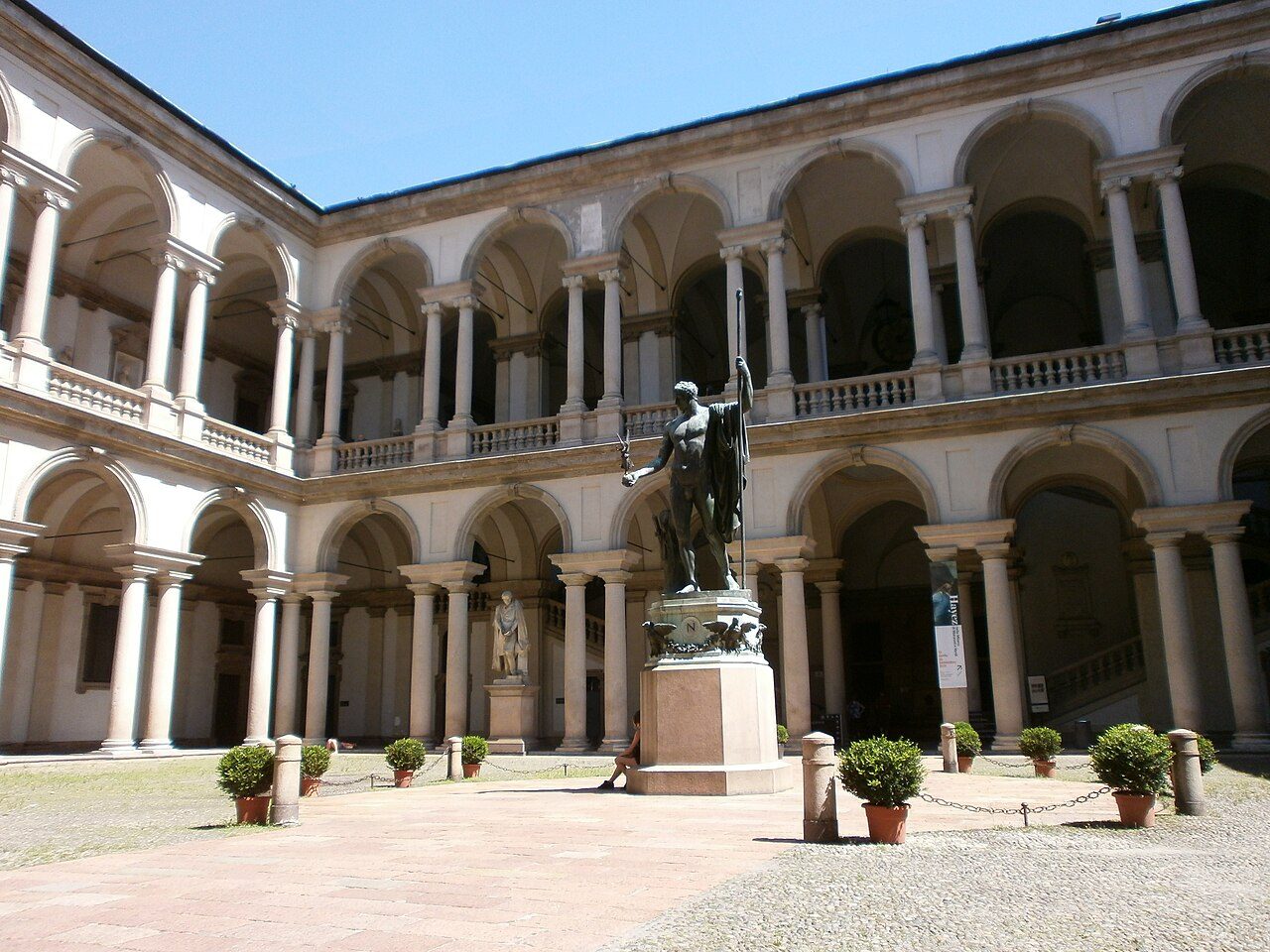
In the middle of the courtyard, facing the bronze statue, with two stories of arcades all around you
The seventeenth-century courtyard of a Jesuit college, with a bronze Napoleon at its center, naked as an ancient god. The statue is by Canova, and before it got here it spent almost half a century in the basement.
Spot the detail
The small winged figure Napoleon holds in his hand: is it the one cast in Canova's day?
The full story
Before the paintings, stop here for a moment. You are standing in the courtyard of a school, and it still is one: the same building houses the Accademia di Belle Arti, the fine arts academy, and its students walk through here every day.
Look around. Two stories of arcades, one on top of the other, run all the way around the courtyard. The architect Francesco Maria Richini designed them in the seventeenth century for the Jesuits, who wanted a grand college here. Construction dragged on for a long time, and Richini never saw it finished.
The Napoleon by Canova
Then there is him. In the center, on a pedestal, stands a completely naked man in bronze, holding a small winged figure in his hand. It is Napoleon.
The sculptor Antonio Canova turned him into Mars the Peacemaker: the Roman god of war who, having won everything, brings peace. He is naked because that is how the ancients sculpted gods and heroes.
A statue in the basement
The statue's story is less glorious than its subject. It was ordered in 1807 on behalf of Eugène de Beauharnais, viceroy of Italy and Napoleon's adopted son. The bronze came from a few cannons of Castel Sant'Angelo, the papal fortress in Rome, melted down for the purpose. The first casting failed, the second succeeded.
But by the time the colossus reached Milan, the empire was already collapsing. Nobody put it on a pedestal, and after Napoleon's fall it ended up in the basement of the building.
It stayed there for decades. At one point the emperor of Austria even ordered it set up in the public gardens, but nothing came of it. It only saw daylight again in 1859, when Vittorio Emanuele II, king of Sardinia, entered Milan as a victor alongside his ally Napoleon III, emperor of the French and nephew of the man in bronze. It was the right moment to dust off the uncle.
He has not moved since. In 1943, when bombs devastated the museum, he was shut inside a wooden crate and covered with sandbags. He came out unharmed.
A walk under the porticoes
Now take a walk under the porticoes. The building tells you right away what it wants to be: not just a museum, but a place where people study. A library, an astronomical observatory and a botanical garden are still at work under this roof.
A naked emperor in the middle of a school. That is how Brera begins.
About this stop
Anecdote
The Napoleon that ended up in the basement
A bronze Napoleon by the sculptor Antonio Canova, naked as an ancient god, stands in the courtyard of Milan's di Brera. Ordered in 1807, it was cast in Rome from cannons of Castel Sant'Angelo, the papal fortress. The first casting failed. By the time it reached Milan the empire was on its last legs, and after Napoleon's fall it ended up in the basement. In 1857 the emperor of Austria ordered it set up in the public gardens: nobody obeyed. It was unveiled in the courtyard only on August 14, 1859, after Napoleon III, nephew of the man portrayed, reached Milan. Almost half a century waiting for a pedestal.
Anecdote
The marble Napoleon in Wellington's house
The bronze Napoleon in the courtyard of Brera, naked as an ancient god, has a marble twin, and the marble is the original. The sculptor Antonio Canova finished it in 1806. Napoleon saw it in Paris in 1811 and found it "too athletic": he had it removed from public view. In 1816 the British government bought it, and the Prince Regent gave it to the Duke of Wellington, the victor of Waterloo. It has stood in London ever since, at the foot of the staircase in his house, where the floor had to be reinforced. The loser, almost three and a half meters tall, in the winner's home.
Because Canova did not make the portrait of a general, but the image of a god. The statue is called Napoleon as Mars the Peacemaker: Mars is the Roman god of war, and ancient sculptors showed gods and heroes without clothes. So no uniform and no hat, but an ideal body and a small winged Victory in his hand. The bronze was ordered in 1807 for Eugène de Beauharnais, viceroy of Italy, when Milan was the capital of the Napoleonic kingdom.
This stop on the map
Next stop
Climb the grand staircase and enter the Pinacoteca: the next stop is among the fifteenth-century painters