Stop 6 of 7Must-see
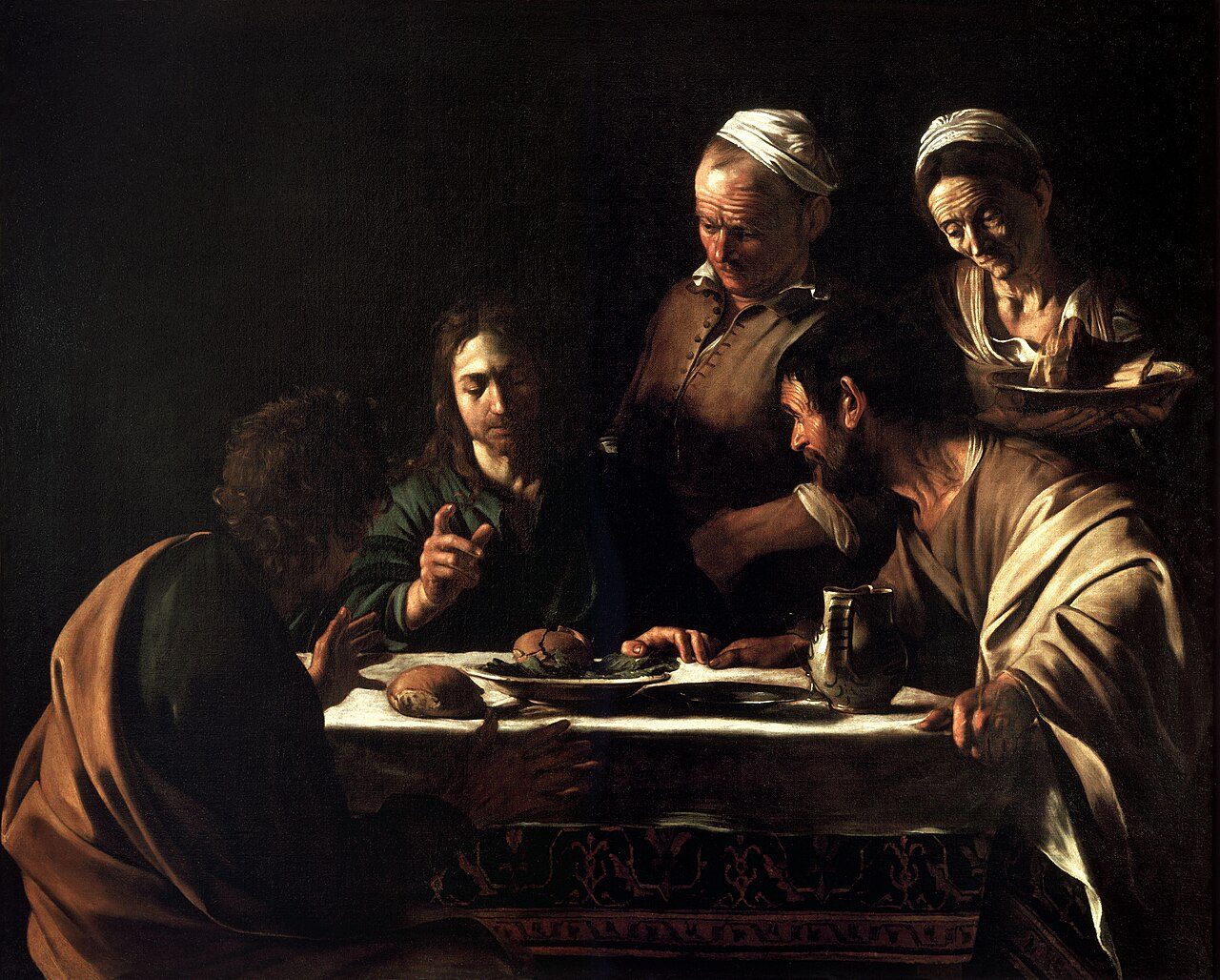
Caravaggio, Cena in Emmaus
Where to stand
In front of Caravaggio's canvas, among the seventeenth-century painters. Stand in the center, level with the painted table
Five figures around a humble table, in almost total darkness. Caravaggio painted it around 1606, as a fugitive, after killing a man in Rome. It is the stripped-down version of a scene he had already painted five years earlier.
Spot the detail
Christ's right hand: what is it doing?
The full story
After so much light, darkness. It takes a few seconds for your eyes to adjust. Take them.
The scene of the Cena in Emmaus, the Supper at Emmaus, comes from the Gospel of Luke. After the crucifixion two disciples are walking toward Emmaus, a village, and a stranger joins them.
In the evening they stop for supper together. When he blesses the bread and breaks it, they understand: he is the risen Christ. A moment later he is gone.
Look at how Caravaggio tells it. Christ is seated at the table with the two disciples. Standing by are an innkeeper and an old serving woman, who have understood nothing.
On the table there is almost nothing. All around, black.
The first version, in London
Five years earlier Caravaggio had already painted this supper. That painting is now in London, at the National Gallery, and it is the complete opposite: more light, a more complex composition, a basket of fruit on the table, a young Christ with delicate features.
Here Christ is an older man, tired and worn. The colors have shrunk to a few dark shades. The brushwork is faster, sketchier. All that matters is what happens on the faces.
On the run from Rome
Between the two paintings lies 1606. In Rome Caravaggio kills a man, Ranuccio Tomassoni. A sentence awaits him, and he flees.
He hides on the lands of the Colonna, a great Roman family that protects him. There, probably in the town of Paliano, he paints this canvas. He will never return to Rome.
It comes naturally to read the painting with that story in mind: a fugitive, an inn, a presence about to dissolve into the dark. But that is our reading, not a document. What is certain is that the painter, at this point, takes away instead of adding.
How it came to Brera
The canvas was sold to a Roman marquis, Patrizi, and stayed in his family's palace for more than three centuries. In 1939 it was bought by the Amici di Brera, an association of friends founded to support the museum, who brought it here. X-rays later revealed, beneath the surface, a first version different from the final one. That is the proof it is not a copy: it is a painting Caravaggio thought and rethought as he made it.
The London Caravaggio astonishes you. This one silences you.
Next stop
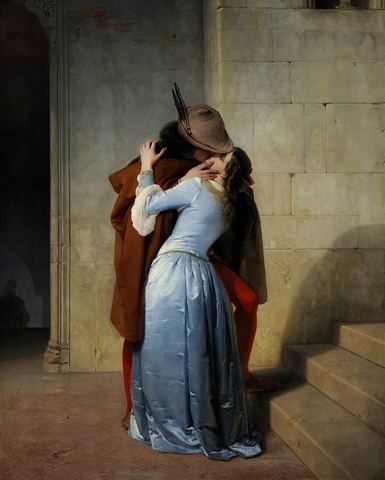
Head toward the end of the route, among the nineteenth-century painters, and look for Il bacio, the Kiss, by Hayez