Stop 2 of 7Must-see
Mantegna, Cristo morto
Where to stand
In front of the painting, among the fifteenth-century painters. It is small: move in to within a couple of meters
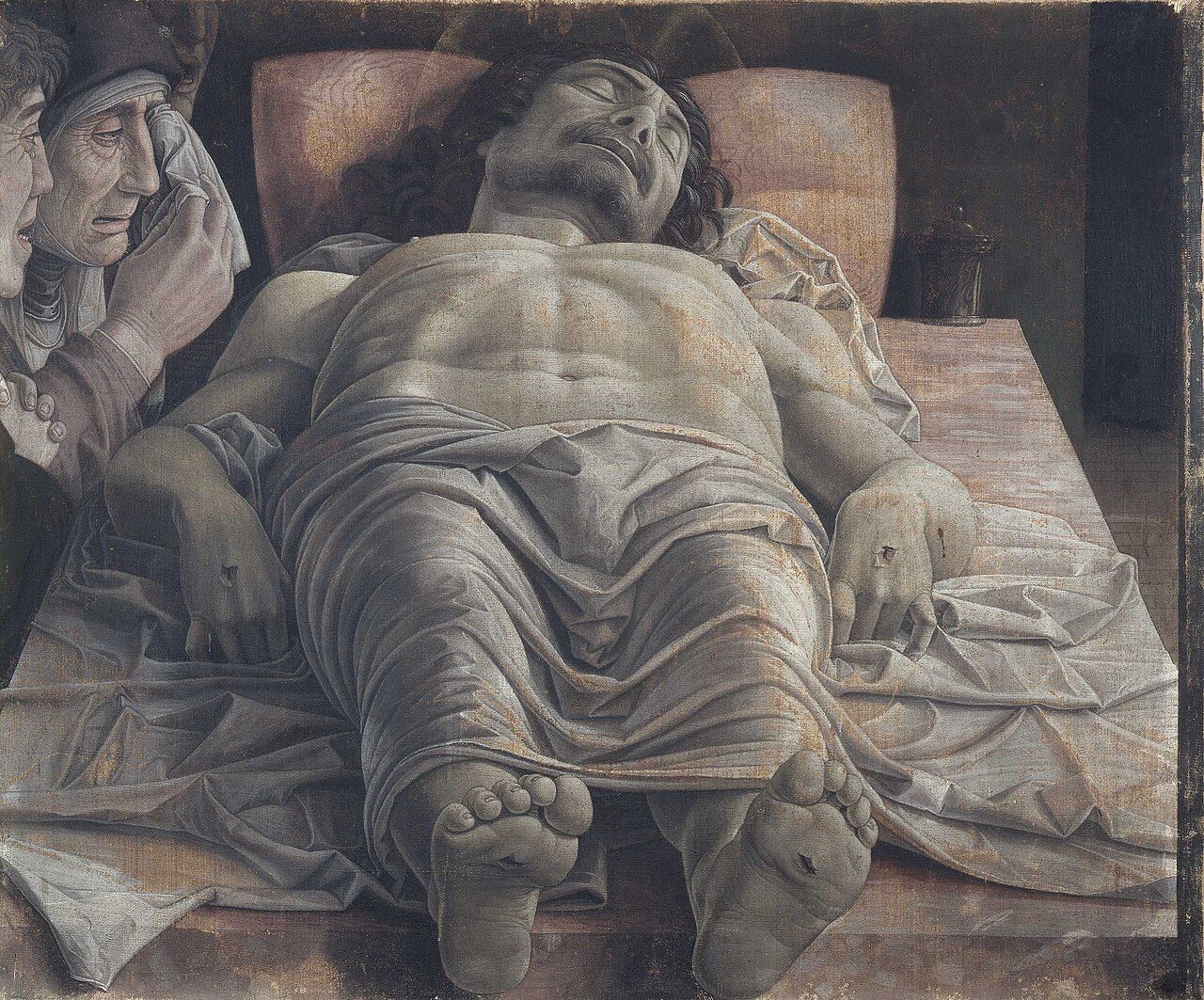
A body laid out and seen from the feet, on a canvas barely eighty centimeters wide. It is one of the most famous feats of in the Renaissance. Mantegna most likely painted it for himself: when he died it was still in his studio.
Spot the detail
Top right, at the edge of the scene: a small object
The full story
This painting will not let you look at it from a distance. It is eighty centimeters wide, a little over two and a half feet, and it forces you to come closer, until you find yourself standing at a dead man's feet.
Andrea Mantegna, court painter to the Gonzaga family in Mantua, painted it in on canvas in the second half of the fifteenth century. Scholars have always argued over the exact date.
This is his Cristo morto, the Dead Christ, and the subject is a traditional one: the mourning over Christ's body. The treatment is not.
The body lies on a stone slab and you see it from the far end, drastically shortened, with the soles of the feet in the foreground and the face way back there. The technique is called , and here it is pushed to the limit.
Mantegna spares you nothing. The nail wounds, in the hands and feet, are set right before your eyes. The limbs are stiff.
The sheet looks wet and clings to the legs like the drapery of a statue. There is no landscape, no sky, no way out.
Perspective adjusted on purpose
And yet the painter cheats. Under perspective applied to the letter, feet this close would be enormous and the head tiny. Instead the feet and legs are smaller than they should be, the chest is very broad, the arms too long.
Mantegna corrected the geometry so that you could look Christ in the face. The result is false, and it looks truer than the truth.
Now shift your eyes to the left. Squeezed against the edge are three faces. The Madonna wipes away her tears. Saint John weeps with his hands clasped.
Behind them, almost swallowed by shadow, is a woman: most likely Mary Magdalene. They have so little room that some scholars think they were added at a later stage.
Who it was painted for
Who was such a harsh image for? Probably no client at all. When Mantegna died, in 1506, there was still a "Cristo in scurto" in his studio, as the documents call it: a Christ.
The most widely accepted theory is that it was this one, painted for his own devotion and never sold. His son handed it over to a Gonzaga cardinal. Later the painting vanished, and for more than a century nothing was heard of it.
It resurfaced in the early nineteenth century. In 1806 Giuseppe Bossi, secretary of the Brera academy, asked an exceptional go-between for help in buying it: the sculptor Antonio Canova, the same man behind the Napoleon in the courtyard. It took a while. The Cristo morto entered the , the picture gallery, in 1824.
Since then that camera angle has never stopped coming back. Painters, film directors and photographers have laid out many bodies this way, seen from the feet. The model is right here in front of you.
About this stop
In culture
Pasolini and the dead man seen from the feet
At Brera, the Cristo morto, the Dead Christ, by the fifteenth-century painter Andrea Mantegna shows a corpse seen from the feet. In the 1962 film Mamma Roma, the death of young Ettore immediately reminded many of it. The director, Pier Paolo Pasolini, denied drawing directly on the painting and spoke instead of what he had learned from the art historian Roberto Longhi. The comparison stuck, though, and it is not the only one: critics have found the same shot in The Return, a 2003 film by the Russian director Andrey Zvyagintsev. And the photographer who photographed Che Guevara's body said he had been thinking of the image of Christ.
Anecdote
Mantegna, 67 centimeters off the floor
At Brera, Andrea Mantegna's Cristo morto, the Dead Christ, shows a corpse seen from the feet. In 2013 the superintendent handed its display to a filmmaker, Ermanno Olmi. He isolated it in a small dark room, 67 centimeters from the floor: the height, he explained, where the body lay. "I drowned it in black," he said. Controversy was immediate. In the daily Corriere della Sera the archaeologist Andrea Carandini wrote that you had to kneel to see it, in a "dark space under the stairs." In 2016 the new director, James Bradburne, had it rehung among the fifteenth-century paintings. Five centuries on, people still argue over how to view it.
Because Mantegna did not follow perspective to the letter, and he did it on purpose. In a body seen from the feet, a rigorous construction would enlarge what is near and shrink what is far. Here the opposite happens: the feet and legs are smaller than normal, the chest is very broad, the arms look too long. That way the face stays clearly visible, and the viewer is drawn into the scene instead of stopping at a display of skill.
Next stop
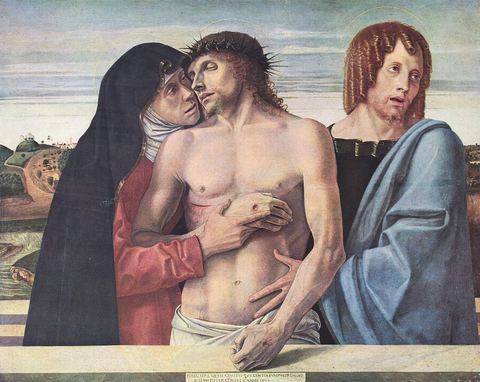
Stay in the same room and look for Giovanni Bellini's Pietà: same subject, a completely different temperament