Church · Historic Center · IX secolo–1871
Santa Maria presso San Satiro
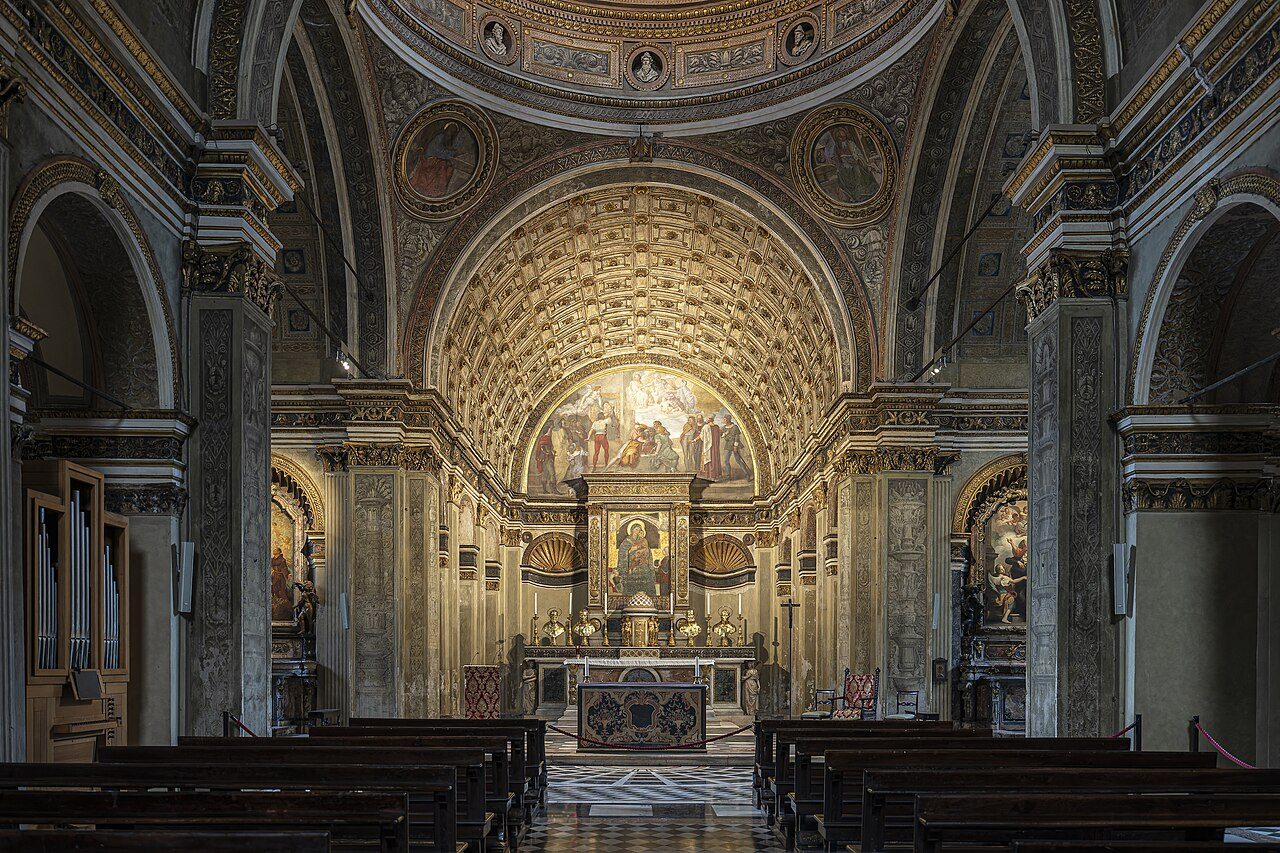
The choir that isn't there: ten meters of depth in one meter of wall
In brief
A fifteenth-century church half hidden on Via Torino, built to house an image believed to be miraculous. Inside is Bramante's most famous trick: a choir that looks about ten meters deep and measures about one. Next to it stands a chapel more than a thousand years old.
Stories of this place
- Legend · The facade on Via TorinoReadThe Madonna that bledSanta Maria presso San Satiro, in Milan, was born from a stabbing. According to tradition, one evening in 1242 a certain Massazio da Vigolzone stormed out of a game of dice gone wrong. Passing the old chapel of San Satiro, he struck the Madonna painted on its outer wall with a dagger. Blood, the legend says, came out of the image. The man repented, people came running, and a cult was born that two centuries later led to the building of the church, next to the chapel. The wounded image is now on the high altar. Accounts differ: for some Massazio was a gambler, for others an unbalanced young man.
- Anecdote · The choir that isn't thereReadBramante's fake choir, measured by laserIn Santa Maria presso San Satiro the architect Bramante used perspective to fake a choir that looks about ten meters deep and measures about one. Where should you stand? Some put the ideal viewpoint over two meters off the ground, too high for anybody. In 2019 researchers at the Politecnico di Milano, the city's technical university, surveyed the church by laser and redid the math: the right spot is about seventeen meters from the choir and a meter and a half above the floor, at eye level. The survey also found that the choir is slightly off axis from the nave. The decoration hides it well: nobody notices.
- In culture · The choir that isn't thereReadThe fake choir, from Masaccio to the stageThe choir of Santa Maria presso San Satiro in Milan is a fake: a relief about one meter deep, which the architect Bramante makes look like ten. It has illustrious ancestors. The model is the Trinity painted by Masaccio, with its coffered vault in perspective. Then the stiacciato of the sculptor Donatello, the very shallow relief that suggests depth: Bramante takes it to full scale. The choir has descendants too. Scholars see here the first model for modern stage design, where a few meters of stage must look like a whole street. Later, in Rome, the architect Borromini took up the idea in the perspective gallery of Palazzo Spada.
- Anecdote · Under the domeReadThe miracle Madonna, retouched over the centuriesOn the high altar of Santa Maria presso San Satiro, in Milan, is a thirteenth-century Madonna and Child. According to tradition, this is the image that bled in 1242 when struck with a knife. What you see, though, is largely more recent. The blue mantle with the gold inscriptions Maria and Virgo, the angels above and the gilded background are later additions. So are the two figures at the sides, perhaps the donors: some see Duke Gian Galeazzo Sforza and his mother Bona di Savoia, who wanted the church built. Red marks remain on the Madonna's throat and hand. To the faithful, it is the miracle's blood.
- Anecdote · The sacello of San SatiroReadAnsperto, the founder deposed by the popeThe sacello of San Satiro, the oldest chapel of Santa Maria presso San Satiro in Milan, was founded in the ninth century by Ansperto, an archbishop the pope ended up excommunicating. In 879 Pope John VIII summoned him to Rome, and he did not show up. He was excommunicated, and he would not let the pope's envoys into the city. In October he was declared deposed. Ansperto stayed in office, backed by much of the Milanese clergy, and later the two made peace. His epitaph, in the basilica of Sant'Ambrogio, records that he dedicated a church and a house to San Satiro, with property to support monks.
- Anecdote · The sacello of San SatiroReadSan Satiro, the brother who survived a shipwreckThe oldest chapel of Santa Maria presso San Satiro is dedicated to San Satiro, or Satyrus, the middle child between Saint Marcellina and Saint Ambrose. When Ambrose became bishop of Milan, in 374, Satiro left his public career to manage the family estate and help him. All we know about him is what Ambrose said in his funeral orations. Among other things, that he survived a shipwreck returning from Africa, and credited his rescue to a fragment of Eucharistic bread given by his fellow travelers and kept in a handkerchief. He died in 378. Ambrose buried him beside a martyr, in what is now the basilica of Sant'Ambrogio.
- Anecdote · The back on Via FalconeReadThe Roman epitaph in San Satiro's bell towerThe bell tower of Santa Maria presso San Satiro, in Milan, is partly built from stones older than itself. The Lombardy Region's heritage catalog calls it the oldest in the city after Sant'Ambrogio's, and its base, on the Via Speronari side, holds Roman and early Christian pieces. One is a Roman tombstone, at head height, set sideways and cut down: the name is lost. According to a 2019 reading in the newspaper Il Foglio, it is a dedication from a slave in the emperor's service to his wife, with whom he lived sine ulla macula, without a single blemish. Smog is wearing it away: find it while you still can.
- AnecdoteReadThe pieces of San Satiro that ended up elsewhereSanta Maria presso San Satiro has lost a lot along the way. The frescoes by the painter Bergognone were detached and assigned in 1868 to the Pinacoteca di Brera, Milan's great picture gallery. A Saint Barbara by the painter Giovanni Antonio Boltraffio is in the Gemäldegalerie in Berlin. What remains of the facade begun by the architect Giovanni Antonio Amadeo is in the collections of the Castello Sforzesco, the city's castle. After French troops arrived, at the end of the eighteenth century, the church's twenty-six tombstones were removed. The thirty-six terracotta figures the sculptor Agostino Fonduli modeled for the tiburio of the dome were lost in an eighteenth-century restoration.
Ready-made questions
Because there are two churches. The older one is the , the little chapel dedicated to San Satiro, founded in the ninth century by Archbishop Ansperto. The second is the large church, built at the end of the fifteenth century to house an image of the Madonna believed to be miraculous, and so dedicated to Mary. It was put up right against the old chapel, which is what presso means: next to San Satiro. The saint's name has not taken second place, though: the parish too is called San Satiro.
Go to stop: The facade on Via TorinoThe brother of Saint Ambrose, bishop of Milan, and of Saint Marcellina. Known in English as Satyrus and born around 340, he made a career in the Roman administration and rose to govern a province. When Ambrose was elected bishop he left everything to look after the family estate and help his brother. He died in Milan in 378, and Ambrose devoted two funeral orations to him, which are the only source for his life. The sacristans of the diocese of Milan regard him as their patron.
Go to stop: The sacello of San SatiroAbout one meter. The figure you read most often is 97 centimeters. Other sources say 90, and a recent survey speaks of three Milanese feet, which is slightly more. The depth the eye thinks it sees, on the other hand, is ten meters or so, the same as the arms of the . The ratio is roughly one to ten: every real centimeter fakes ten.
Go to stop: The choir that isn't thereBecause there was no room. Behind the ran the contrada del Falcone, a busy street, and the church could not grow any longer. The plan stayed T-shaped. Without a , though, the building would have looked cut short, and the miraculous image on the altar would have been left against a bare wall. Perspective solved both problems: it gave the church the look of a cross and the Madonna a solemn frame.
Go to stop: The choir that isn't thereIt is not certain. His name first appears in the building records on December 4, 1482, as witness to a deed, but he may have been working there earlier. A contract of 1483 leaves the decoration of the sacristy, which was already built, to his judgment. Some scholars, on the basis of other documents, give greater weight to Giovanni Antonio Amadeo, who was commissioned to build the facade. The fake remains tied to the name of Bramante, who was known as a master of perspective.
Go to stop: Under the domeYes. The Madonna and Child that according to tradition bled in 1242 was originally on the outer wall of the . With the new church it was brought inside, and today it is kept on the high altar, right in the middle of the fake . The whole architecture, when you think about it, is its frame. Above, in the lunette, a fresco added in the nineteenth century tells the episode of the stabbing.
Go to stop: Under the domeNo, it is a nineteenth-century imitation. At the end of the fifteenth century the facade was entrusted to Giovanni Antonio Amadeo, who built only the base. The church stayed unfinished until 1871, when the architect Giuseppe Vandoni built the present facade in Renaissance Revival style. From the original design it keeps only the rose window and the frame of the doorway. For real fifteenth-century work on the outside, go around the back, to Via Falcone.
Go to stop: The facade on Via TorinoThe stops
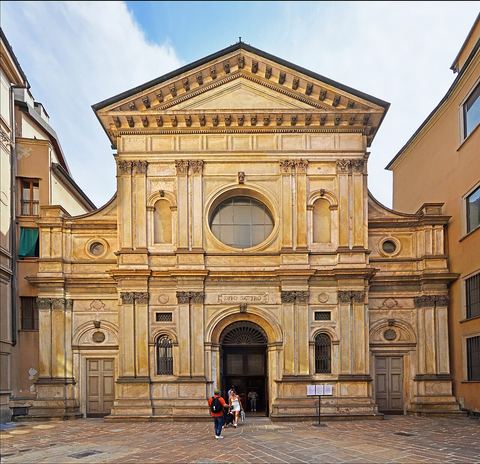
1 The facade on Via Torino
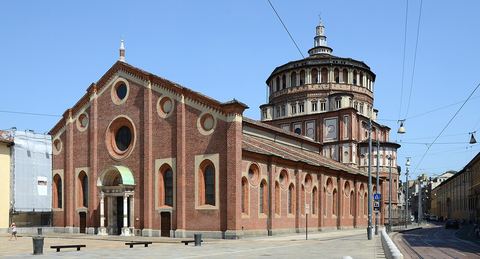
A nineteenth-century facade for a fifteenth-century church, born from a story of knives and blood. The name says it all: a church of Mary built next to the much older one of San Satiro.
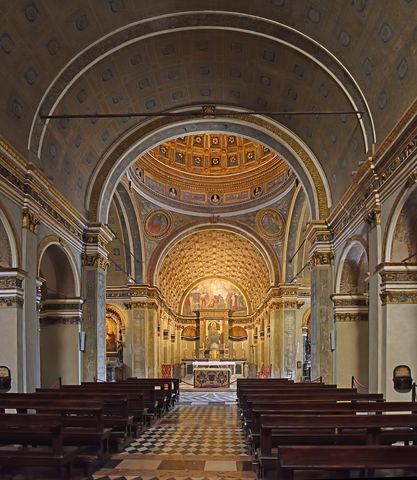
2 The choir that isn't there
At the far end of the church you see a deep choir with a coffered vault. It is a trick: the real space is about one meter deep. Bramante invented it because a street ran behind the wall and the church could not grow any longer.
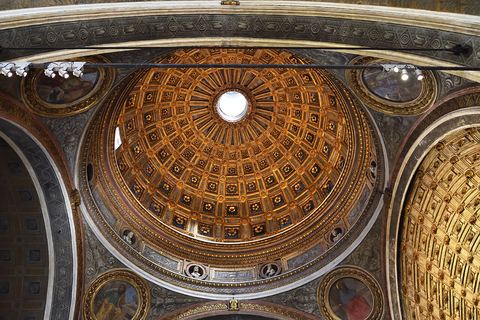
3 Under the dome
From here the choir's trick falls apart and you see the real architecture: a great barrel vault, a coffered dome, a transept. It is the first building Bramante completed in Milan.
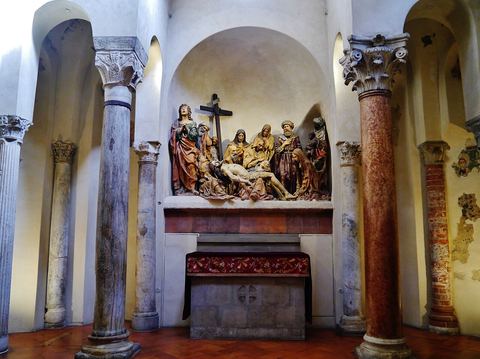
4 The sacello of San Satiro
The oldest part: a ninth-century chapel, founded by Archbishop Ansperto and dedicated to the brother of Saint Ambrose. Inside, fourteen terracotta figures mourn the dead Christ.
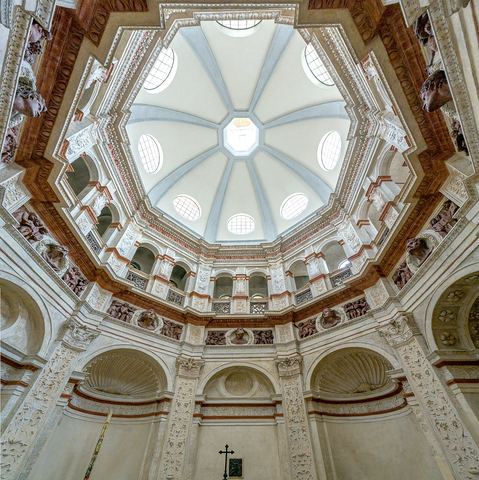
5 The octagonal sacristy
An octagon on two levels, closed by a segmented dome. Bramante designed it as a sacristy, taking his cue from ancient baptisteries. The terracotta frieze of putti and heads is by Agostino Fonduli.
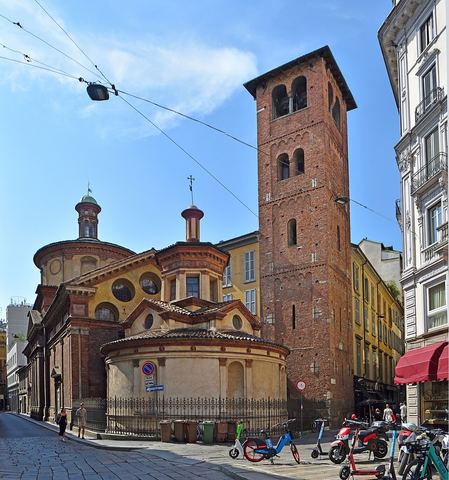
6 The back on Via Falcone
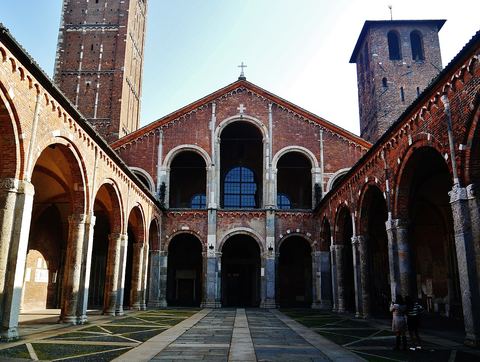
Here you see the trick from outside: behind the choir that looked so deep there is only a wall, flush with the street. Beside it rise the old chapel, re-clad in the fifteenth century, and a bell tower about a thousand years old.
Timeline
- 9th centuryArchbishop Ansperto founds a small church dedicated to San Satiro. It certainly exists before 879.
- 1242According to tradition, a Madonna painted on the outer wall of the sacello bleeds after being stabbed.
- 1478Construction of the new church begins, at the wish of Duke Gian Galeazzo Sforza and his mother Bona di Savoia.
- 1482Bramante appears for the first time in the building records.
- 1483Agostino Fonduli is commissioned to make the terracottas, to be done according to Bramante's judgment. The sacristy is already built.
- 1486The facade is entrusted to Giovanni Antonio Amadeo, who gets no further than the base.
- 1871Giuseppe Vandoni builds the present facade, in Renaissance Revival style.
- 1939–1942A restoration gives the sacello back its original form and brings medieval frescoes to light.
Who's who
Ansperto
archbishop of Milan in the ninth century
He founded the sacello before 879, the year of his will, and dedicated it to Saints Satiro, Sylvester and Ambrose.
San Satiro
Saint Satyrus, brother of Saint Ambrose
A Roman official, he left his career to help his brother the bishop. He died in Milan in 378 and is buried in the basilica of Sant'Ambrogio.
Donato Bramante
painter and architect
Born near Urbino around 1444, documented in Milan from 1481. San Satiro is his first Milanese building. From 1499 he is in Rome, where he designs the new St. Peter's. He dies in 1514.
Agostino Fonduli
sculptor in terracotta
Also called de Fondulis, from a Crema family that moved to Padua. From 1483 he models the Pietà in the sacello and the sacristy frieze for San Satiro. He later worked as an architect too.
Giovanni Antonio Amadeo
sculptor and architect
In 1486 he was commissioned to build the facade, with marbles in colors chosen by Bramante. He built only the base. Some scholars give him a larger role on the building site.
Bona di Savoia
duchess regent of Milan
Mother of Duke Gian Galeazzo Sforza, she was ruling in his name when work on the new church began in 1478.
Words to know
Where it is
The neighborhood
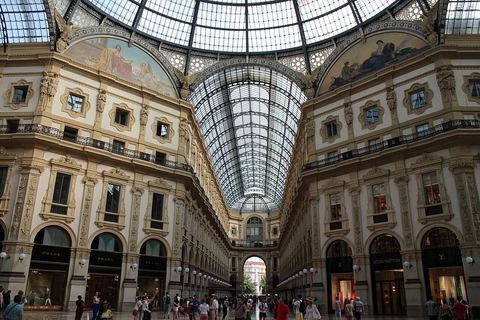
Historic Center
Related places
The story of the place
From Via Torino, a busy street in the center of Milan, you barely notice it: the facade sits back from the road. Yet inside is one of the boldest inventions of the Renaissance. At the end of the nave a solemn opens up, with a vault. It doesn't exist: it is a relief about one meter deep.
A thousand-year-old chapel
The story begins in the ninth century. Ansperto, archbishop of Milan, has a small church built and dedicates it to San Satiro, Saint Satyrus in English, the brother of Saint Ambrose. It is the , the little chapel that still exists, attached to the larger church.
On its outer wall was a painted image of the Madonna and Child. According to tradition, in 1242 a furious man struck it with a knife, and blood came out of the image. From then on it was venerated as miraculous.
A shrine for the Madonna
Two centuries later comes the decision to give it a worthy home. Work starts in 1478, at the wish of Duke Gian Galeazzo Sforza and his mother Bona di Savoia, who ruled for him. That explains the name: Santa Maria, built presso, meaning next to, San Satiro.
On the building site appears Donato Bramante, a painter and architect from the Urbino area. It is the first building he completes in Milan. But the plot is small, and behind it runs a street that cannot be touched: there is no room for a . Bramante fakes one, with perspective.
Working with him is Agostino Fonduli, a sculptor in terracotta. The frieze in the octagonal sacristy and the Pietà group in the are his.
A facade that came late
The facade, begun at the end of the fifteenth century, never got past its base. The one you see dates from 1871. Inside, meanwhile, much of the decoration has been lost, and the frescoes by the painter Bergognone have ended up in the Pinacoteca di Brera, Milan's great picture gallery.
The church is small and quick to walk around. But take your time: the fun here is working out where the real ends and the fake begins.
Sources
- Buratti, Mele, Rossi, Sperimentazioni prospettiche per la manipolazione dello spazio. Il finto coro di Bramante in Santa Maria presso San Satiro, rivista diségno 4/2019, Unione Italiana per il Disegno (opens in a new tab)Institution
- Bramante, Donato, Dizionario Biografico degli Italiani, Treccani (opens in a new tab)Encyclopedia
- Fonduli (de Fondulis), Agostino, Dizionario Biografico degli Italiani, Treccani (opens in a new tab)Encyclopedia
- Bramante, Donato, Enciclopedia on line, Treccani (opens in a new tab)Encyclopedia
- Chiesa di Santa Maria presso San Satiro, Lombardia Cristiana (opens in a new tab)Institution
- Chiesa di Santa Maria presso San Satiro, Wikipedia in italiano (opens in a new tab)Wikipedia
- Santa Maria presso San Satiro, Wikipedia in inglese (opens in a new tab)Wikipedia
- Agostino Fonduli, Wikipedia in italiano (opens in a new tab)Wikipedia
- Satiro di Milano, Wikipedia in italiano (opens in a new tab)Wikipedia
- Chiesa di Santa Maria presso San Satiro, Wikidata Q589462 (opens in a new tab)Other source
- Chiesa di Santa Maria presso San Satiro (Milano), Cathopedia (opens in a new tab)Other source
- Santa Maria presso San Satiro: il finto coro di Bramante a Milano, MilanoFree (opens in a new tab)Other source
- La rabbia, il miracolo, il dipinto e la chiesa, L'Unione Sarda (opens in a new tab)Other source
- Chiesa di S. Maria presso S. Satiro, complesso. Lombardia Beni Culturali, scheda LMD80-00013 (opens in a new tab)Catalog
- Chiesa di S. Maria presso S. Satiro. Lombardia Beni Culturali, scheda LMD80-00170 (opens in a new tab)Catalog
- Campanile della Chiesa di S. Maria presso S. Satiro. Lombardia Beni Culturali, scheda LMD80-00172 (opens in a new tab)Catalog
- Altare maggiore, affresco della Vergine con il Bambino. Lombardia Beni Culturali, scheda 1j560-00067 (opens in a new tab)Catalog
- Ansperto, Dizionario Biografico degli Italiani, Treccani (opens in a new tab)Encyclopedia
- Ansperto, Wikipedia in italiano (opens in a new tab)Wikipedia
- Sergio Garufi, All'amante ignoto, Il Foglio, 22 agosto 2019 (opens in a new tab)Other source