Stop 3 of 6
Under the dome
Where to stand
At the point where the nave crosses the transept, under the dome, looking first up and then toward the altar
From here the 's trick falls apart and you see the real architecture: a great barrel vault, a dome, a . It is the first building Bramante completed in Milan.
Spot the detail
On the high altar is the image the whole church was built for. Can you find it?
The full story
Here you are at the spot where the illusion gives up. From here, side on, the is what it is: a carved wall, little more than a stride deep. Good. Now forget it and look at what is actually real, because it deserves it.
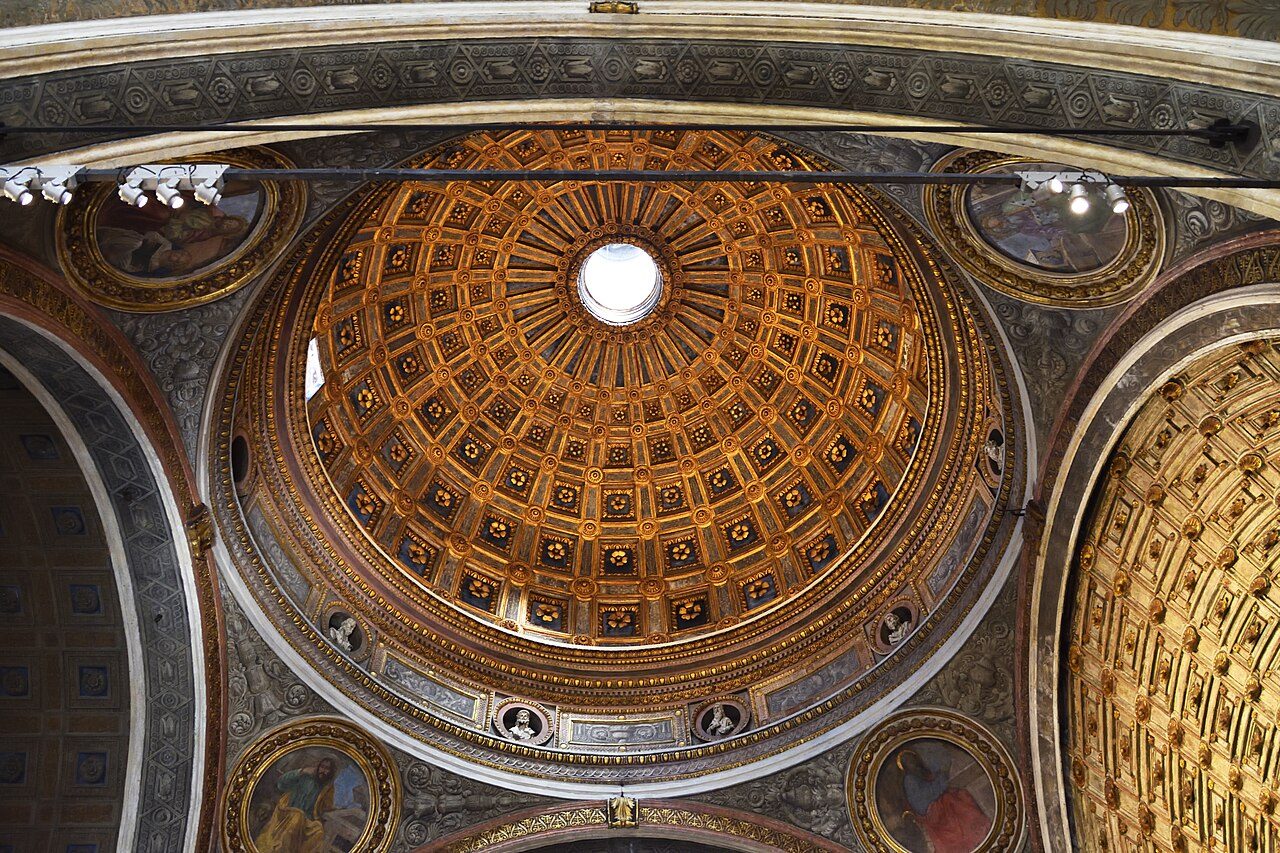
Look up. You are under a hemispherical dome, lined with painted in gold and blue, with a lantern on top. In the four corners that hold it up, inside four roundels, are frescoes of the four Evangelists.
Then turn toward the nave you came from. It is covered by a great barrel vault, one continuous half cylinder. The model is the basilica of Sant'Andrea in Mantua, designed by Leon Battista Alberti, a fifteenth-century architect and theorist. In a Milanese church of those years it was something new.
The painter who becomes an architect
The author is Donato Bramante. Born near Urbino around 1444, he arrives in Lombardy as a painter. His name appears in this church's records in 1482, and scholars consider it the first building he completed in Milan.
You can already see how he thinks. Space is not a sum of parts: it is a whole to be seen from one precise point, like a painting. Later his name will be tied to the tribune of Santa Maria delle Grazie, the church of Leonardo's Last Supper. Then he will go to Rome, where he will design the new St. Peter's Basilica.
Not everything is clear, though. Some documents suggest that Giovanni Antonio Amadeo, architect and sculptor, also counted for a lot on the building site, and some scholars play down Bramante's part. For the sacristy, in any case, a contract of the time names him outright. And the fake is still considered his idea.
White, blue and gold
One last thing, to imagine. Originally the interior was decorated all over in white, blue and gold, and on the walls were frescoes by Bergognone, a Lombard painter, now in the Pinacoteca di Brera, Milan's great picture gallery.
The floor has changed too. The two-tone marble one you are walking on dates from the sixteenth century, and lies almost twenty centimeters above the original, which was terracotta tile.
The church you see is less colorful than the one Bramante saw. The skeleton, though, is still his.
About this stop
Anecdote
The miracle Madonna, retouched over the centuries
On the high altar of Santa Maria presso San Satiro, in Milan, is a thirteenth-century Madonna and Child. According to tradition, this is the image that bled in 1242 when struck with a knife. What you see, though, is largely more recent. The blue mantle with the gold inscriptions Maria and Virgo, the angels above and the gilded background are later additions. So are the two figures at the sides, perhaps the donors: some see Duke Gian Galeazzo Sforza and his mother Bona di Savoia, who wanted the church built. Red marks remain on the Madonna's throat and hand. To the faithful, it is the miracle's blood.
It is not certain. His name first appears in the building records on December 4, 1482, as witness to a deed, but he may have been working there earlier. A contract of 1483 leaves the decoration of the sacristy, which was already built, to his judgment. Some scholars, on the basis of other documents, give greater weight to Giovanni Antonio Amadeo, who was commissioned to build the facade. The fake remains tied to the name of Bramante, who was known as a master of perspective.
Yes. The Madonna and Child that according to tradition bled in 1242 was originally on the outer wall of the . With the new church it was brought inside, and today it is kept on the high altar, right in the middle of the fake . The whole architecture, when you think about it, is its frame. Above, in the lunette, a fresco added in the nineteenth century tells the episode of the stabbing.
Next stop
Go to the end of the left arm of the transept: the oldest chapel opens there