Stop 5 of 6Must-see
The octagonal sacristy
Where to stand
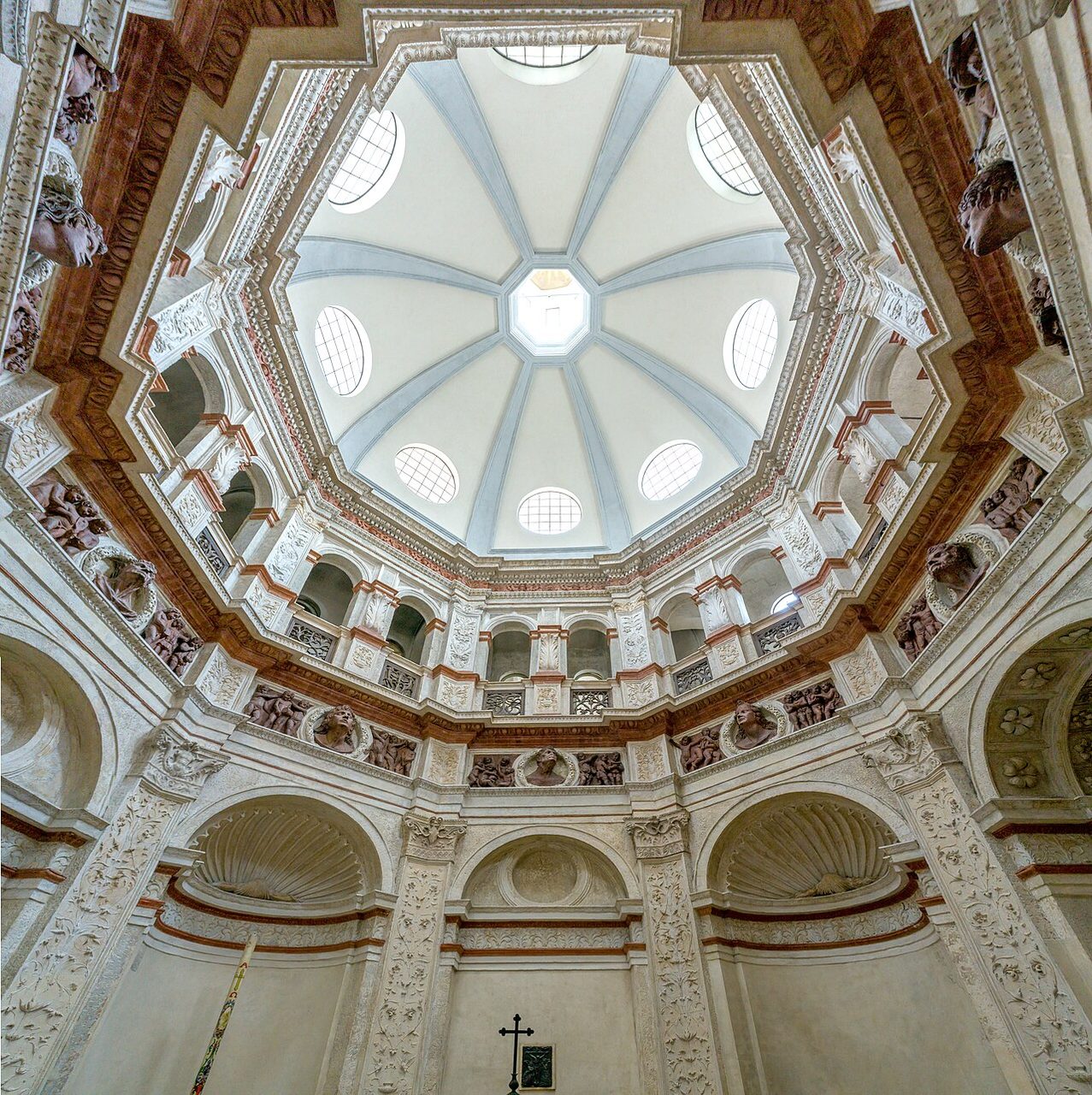
At the start of the right side aisle, at the entrance to the octagonal sacristy, looking up
An octagon on two levels, closed by a segmented dome. Bramante designed it as a sacristy, taking his cue from ancient baptisteries. The terracotta frieze of putti and heads is by Agostino Fonduli.
Spot the detail
Count the sides of the room, then the segments of the dome. And what is there in each segment?
The full story
After the fake , here is a space that is entirely real, and perhaps the most beautiful in the church. It is small, but everything pushes upward: an octagon on two levels, ending in a dome.
Look at it from the bottom up. On the ground level the walls are hollowed into niches, one flat and one curved, alternating, with in the corners. Above runs a gallery of . At the top, the dome in eight segments, each with its own oculus.
The shape of a baptistery
The shape comes from far back. The octagon was the plan of the baptisteries of the first Christian centuries, and Bramante borrows it for a service room: the place where priests get ready for mass. It is his way of saying that antiquity can be done again. Not by chance, in the nineteenth century the room was adapted as an actual baptistery, and some people still call it that.
We know that in 1483 it was already standing. That comes from the contract in which the sculptor Agostino Fonduli undertakes to decorate it: the work was to be done according to the judgment of Master Donato, known as Bramante, of Urbino.
Putti, heads and a fitting saint
Fonduli's work is the terracotta frieze that runs all the way around the room. The contract speaks of eight large heads and sixteen panels with putti. It is the most cheerful part of the building.
Giorgio Vasari, painter and the first great historian of Italian art, remembered it in the sixteenth century as a bellissima sagrestia, a most beautiful sacristy, full of statues. And the idea caught on. The same plan returns in the sanctuary of the Incoronata in Lodi and, in Milan, in the Trivulzio chapel of San Nazaro in Brolo.
Finally, there is a happy coincidence. San Satiro, the saint of this church, is regarded by the sacristans of the diocese of Milan as their patron. It would be hard to find him a better sacristy.
Next stop
Leave the church and walk around the block to Via Falcone, the street that runs behind it