Church · Historic Center · 1210–1776
San Bernardino alle Ossa
A chapel with walls lined in bones and a painted sky overhead
In brief
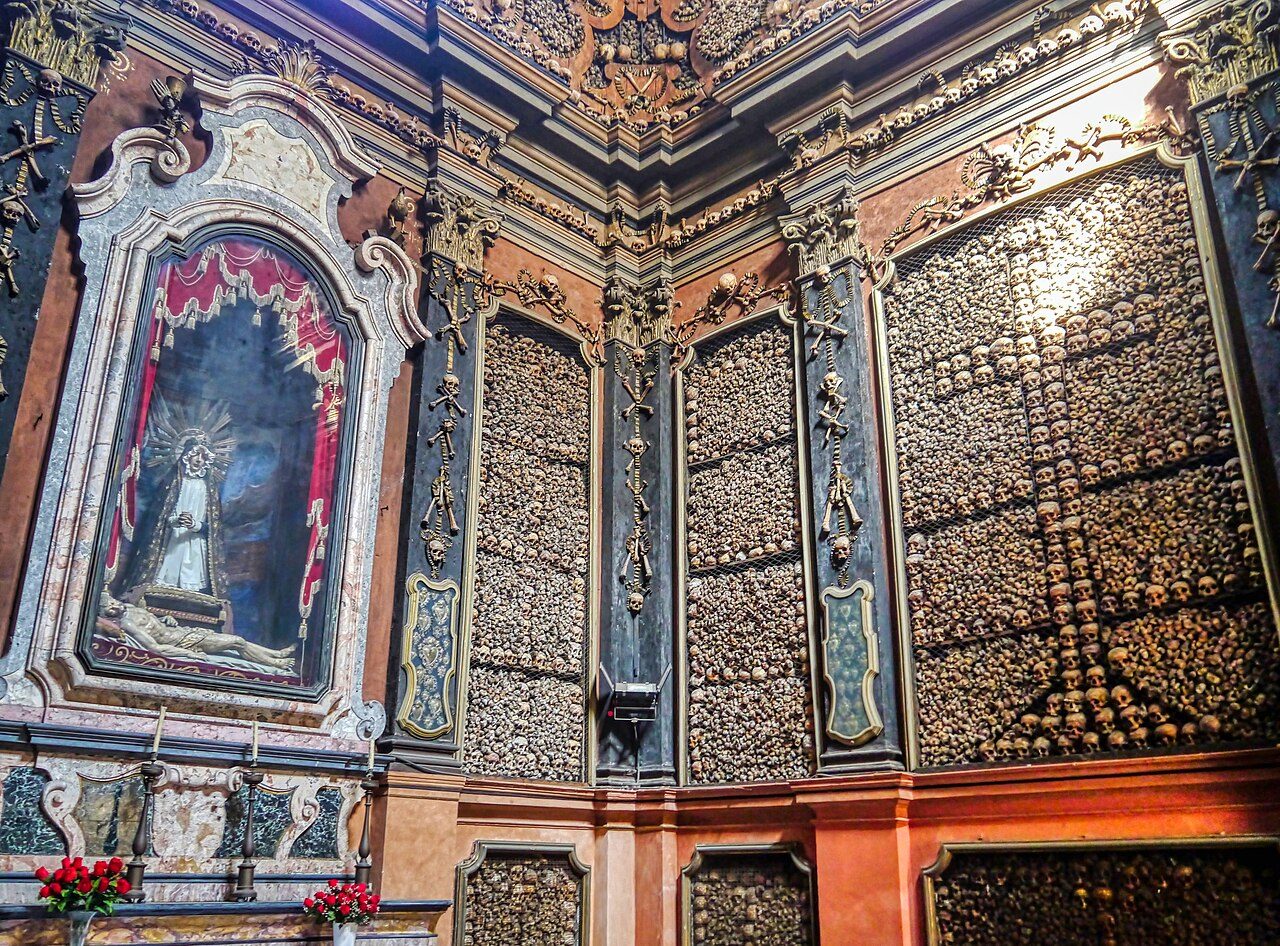
Next to an eighteenth-century church, a chapel where skulls and bones cover the walls, arranged like decoration. They come from a medieval hospital and cemetery. Overhead, the Venetian painter Sebastiano Ricci painted souls rising to heaven.
Stories of this place
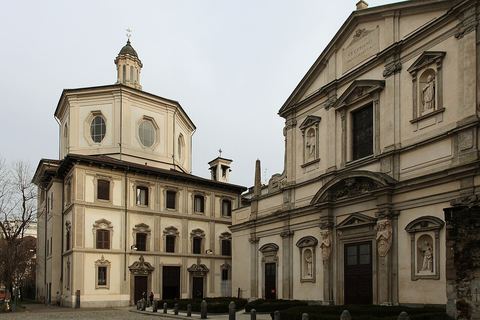
- Anecdote · The square and the facadeReadA duke murdered and a painter baptizedSan Bernardino alle Ossa has a bigger neighbor, attached to its side: the basilica of Santo Stefano. It has two stories that make it worth lingering in the square. On December 26, 1476, the feast of Saint Stephen, Galeazzo Maria Sforza, duke of Milan, was assassinated at its entrance by a group of aristocratic conspirators. And on September 30, 1571, Michelangelo Merisi, the future Caravaggio, was baptized there. The baptismal record was found only in 2007 in the Diocesan Archive of Milan, and it has convinced scholars that the painter was born in Milan and not in the town whose name he bears.
- In culture · The square and the facadeReadThe alley in a painting from 1912In 1912 the Milanese painter Arturo Ferrari painted Nella vecchia via, In the Old Street, a view of the alley of San Bernardino alle Ossa. A narrow street, the shops, and an elderly lady making her hesitant way toward a junk dealer with a painting under her arm. The picture won a gold medal at the Brera National Exhibition and was loved as a fond memory of a Milan that was disappearing. Today it belongs to the Fondazione Cariplo and is kept at the Gallerie d'Italia, the museum in Piazza della Scala.
- Legend · The altar and the legendsReadThe martyrs' bones that never wereSan Bernardino alle Ossa has an ossuary, a chapel with walls lined with skulls and bones. For centuries Milan believed they belonged to Christian martyrs, killed by the Arians in the days of Saint Ambrose. In the seventeenth century the claim also turns up in Carlo Torre, a chronicler of the city. Historians have taken it apart: the legend does not hold up. The bones are those of the sick from the hospital of the Brolo, of the priors and brothers who ran it, of prisoners, of the condemned, of nobles and canons buried nearby. An ordinary crowd, promoted to sainthood by popular devotion.
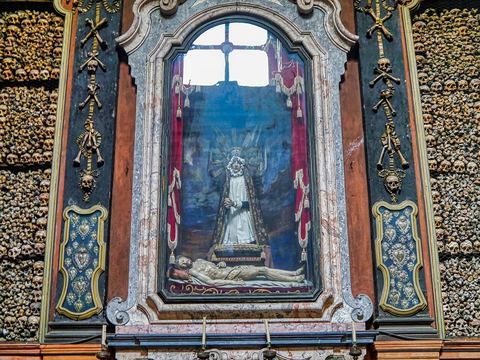
- Legend · The altar and the legendsReadThe girl who makes the skeletons danceThe ossuary of San Bernardino alle Ossa, the chapel with walls lined with skulls, has a folk legend with neither author nor date. Beside its only altar are said to lie the bones of a little girl. On the night of November 2, All Souls' Day, the girl is said to come back to life and draw the other skeletons into a dance that fills the chapel. No document mentions it. But the tale says something true about the place: people who walk in here have always tried to imagine the persons behind the bones.
- Legend · The altar and the legendsReadThe king who wanted to copy the ossuaryAt San Bernardino alle Ossa one chapel has walls lined with skulls and bones: the ossuary. According to the sanctuary, in 1738 John V, king of Portugal, was so struck by it that he had it faithfully copied in Évora. Évora does have its Capela dos Ossos, the Chapel of Bones, and over the entrance it warns visitors: we bones that are here are waiting for yours. Portuguese accounts, however, date it to the seventeenth century, the work of three Franciscan friars, and mention neither the king nor Milan. It is a tradition the Milanese are fond of, not a proven fact.
- Anecdote · The eight-sided church and the cryptReadThe cheesemakers' churchSan Bernardino alle Ossa is known for its chapel lined with skulls, but it has had room for a very down-to-earth trade as well. The church has been home to the confraternity of the cheesemakers, who venerated their protector here, Saint Lucius the martyr. The church owns a large painting of the saint, a reminder of their presence. It is a detail that brings the place back down to scale: a neighborhood church, a short walk from the Verziere, the old fruit and vegetable market.
Ready-made questions
Ordinary people's, for the most part. The sources point to the sick poor who died in the hospital of the , which stood next door, along with the priors and brothers who ran it. Then prisoners who died in jail, people condemned to beheading, some nobles buried in the nearby churches, and the canons of Santo Stefano. The bones come from the old medieval and from the cemeteries closed after the hospital was shut down in 1652. The tradition of martyrs killed in the days of Saint Ambrose is a legend.
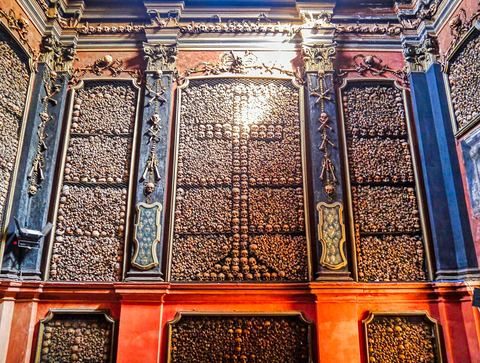
Go to stop: The ossuaryBecause after the collapse of 1642 the was rebuilt not as a storeroom but as a chapel. The that looked after it wanted a place to pray for the dead, and had the bones arranged on the walls in the taste of the time: panels, symmetries, crosses of skulls. To us it may look macabre. Back then it was a way of keeping the dead within the prayers of the living. The dome confirms it, with its souls rising to Paradise.
Go to stop: The ossuaryThe , and by a good margin. The first room for the bones dates from 1210, at the far end of the hospital cemetery. The small church next to it comes some sixty years later. What you see today is more recent. The ossuary was rebuilt from the foundations after the collapse of 1642 and finished in 1695. The eight-sided church is from the eighteenth century, consecrated in 1776. So here it is the church that grew up around the bones, not the other way around.
Because of the of the , which looked after the place from the end of the Middle Ages. The little thirteenth-century church was dedicated to Mary, Saint Ambrose, and Saint Sebastian. When Bernardino of Siena was proclaimed a saint in 1450, the brothers added him to the patrons, and his name ended up winning out. Ordinary people did the rest: to tell it apart from other churches they started calling it San Bernardino dei Morti, of the Dead, or alle Ossa, of the Bones.
A of laypeople, meaning ordinary people rather than priests or friars, bound together by prayer and by penance, which they also practiced by whipping themselves. They wore a habit like that of the Franciscans. They were behind the rebuilding of the after 1642 and then the church you see today. Under the floor, in front of the high altar, they had their . The confraternity was suppressed in 1786 and its property passed to the state. The complex went back to the Church in 1929.
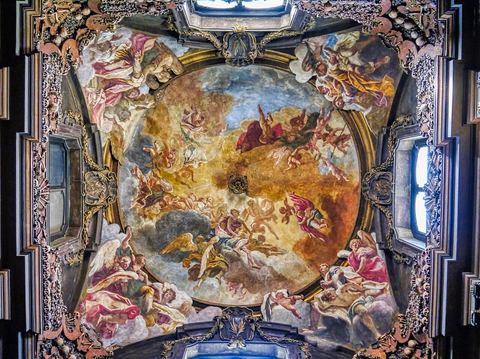
Go to stop: The eight-sided church and the cryptIt is the second half of the message. The walls say that death comes to everyone. The dome by Sebastiano Ricci answers with the souls of Purgatory rising to Paradise among the angels, watched over by the four patron saints. Anyone praying here for the dead could see, up above, what their prayer was for. That is why it pays to look at the room in two steps, first around you and then upward: one half without the other tells the wrong story.
Go to stop: Sebastiano Ricci's skyThe stops
1 The square and the facade
Two churches side by side, and the one you want is the less showy of the two. Its facade could belong to a palazzo. The story starts with a hospital, an overcrowded cemetery, and a fallen bell tower.
2 The ossuary
A square room with walls lined in skulls and bones, arranged in panels and crosses. These are the dead of a hospital, a cemetery, and the prisons: ordinary people, not the martyrs of legend.
3 The altar and the legends
A marble altar and a Madonna in black and white, kneeling beside the dead Christ. This is the spot where the legends of the ossuary have settled: good stories to tell, as long as you call them what they are.
4 Sebastiano Ricci's sky
Above the bones, a sky full of figures in flight: the souls of Purgatory rising among the angels. It was painted around 1695 by the Venetian Sebastiano Ricci, during the few years he spent in Milan.
5 The eight-sided church and the crypt
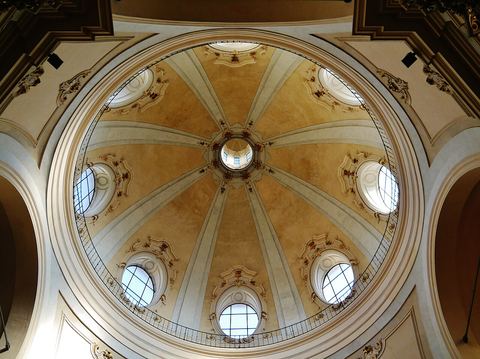
After the half-light of the ossuary, a bright eight-sided church, designed in the eighteenth century by Carlo Giuseppe Merlo. In front of the high altar a grate covers the crypt where the brothers waited to become bones.
Timeline
- mid-12th centuryGotifredo da Bussero founds a hospital next to the basilica of Santo Stefano. A cemetery grows up in front of it.
- 1210The cemetery is full: a room is built at the far end to hold the bones. It is the first ossuary.
- around 1269A small church goes up next to the ossuary, dedicated to Mary, Saint Ambrose, and Saint Sebastian.
- 1642The bell tower of Santo Stefano collapses and badly damages the ossuary and the little church.
- 1695The new ossuary is finished, with the bones arranged on the walls and the dome frescoed by Sebastiano Ricci.
- 1712A fire destroys the church. A few years later Carlo Giuseppe Merlo designs the new one, with eight sides.
- 1776Consecration of the present church, where work had started around 1750.
- 1931During restoration work, on October 8, the crypt of the Disciplini is found under the floor.
Who's who
Gotifredo da Bussero
founder of the hospital of the Brolo
Lived in the twelfth century. Next to Santo Stefano he founds the hospital that gives rise to the cemetery and then the ossuary. Without him there would be neither bones nor church here.
Sebastiano Ricci
Venetian painter of the ossuary dome
Born in Belluno in 1659, died in Venice in 1734. In Milan from 1694 to 1696, he paints the ossuary dome here. He will later work in London and Vienna as well.
Carlo Giuseppe Merlo
architect of the present church
Milanese, 1690–1760. He designs the central-plan church in 1717 but sees work begin only around 1750. He also worked for years with the Fabbrica del Duomo, the cathedral works.
Andrea Biffi
architect of the facade
He is credited with the late seventeenth-century design of the facade on the square, which looks more civic than religious.
Carlo Torre
seventeenth-century Milanese chronicler
In his pages on Milan he reports the tradition that the bones belong to martyrs killed by the Arians. It is the version historians later discarded.
Words to know
Where it is
The neighborhood
Historic Center
Related places
The story of the place
From outside it looks like a palazzo. Inside, a few steps from the door, there is a room whose walls are covered in skulls and bones, laid out as neatly as wallpaper. It was not built to frighten anyone. It is how seventeenth-century Milan chose to keep its dead close.
A hospital and a cemetery
It all begins in the middle of the twelfth century. This was the , a large stretch of green land belonging to the archbishop. A man named Gotifredo da Bussero founds a hospital next to the basilica of Santo Stefano, and a cemetery grows up in front of the hospital.
It fills quickly. In 1210 a room is built to hold the bones cleared out of the graves: the first . Some sixty years later a small church goes up beside it.
Later the place passes to the , a of laypeople devoted to penance. When Bernardino of Siena is proclaimed a saint in 1450, they add him to their patrons. That is where the church gets its name.
The collapse that changed everything
In 1642 the bell tower of Santo Stefano collapses and comes crashing down on the and the little church. Rebuilding becomes a chance to rethink the whole thing.
The is rebuilt from the foundations and finished in 1695. The bones are no longer heaped up: they are arranged on the walls. On the dome the Venetian painter Sebastiano Ricci paints souls rising to heaven.
The church you see today
The big church comes later. In 1712 a fire destroys the old one. The Milanese architect Carlo Giuseppe Merlo designs an eight-sided hall with a dome, but work only starts around 1750. The consecration comes in 1776.
Ever since, the Milanese have called it San Bernardino dei Morti, of the Dead, or alle Ossa, of the Bones. Legends have grown up around it: the martyrs, the dancing little girl, the king who came from Portugal. You will meet them along the visit, each time with the warning it needs: this is legend, this is not.
It is a small place, and twenty minutes or so is enough. But the room of bones is like nothing else in the city.
Sources
- Storia del Santuario e dell'Ossario, sito ufficiale del Santuario di San Bernardino alle Ossa (opens in a new tab)Official site
- History of the Sanctuary and of the Ossuary, sito ufficiale del Santuario di San Bernardino alle Ossa (opens in a new tab)Official site
- Ricci, Sebastiano, Dizionario Biografico degli Italiani, Treccani (opens in a new tab)Encyclopedia
- Merlo, Carlo Giuseppe, Dizionario Biografico degli Italiani, Treccani (opens in a new tab)Encyclopedia
- Church of San Bernardino alle Ossa, in-Lombardia, portale turistico della Regione Lombardia (opens in a new tab)Institution
- Arturo Ferrari, Nella vecchia via (Vicolo San Bernardino alle Ossa a Milano), Fondazione Cariplo su Google Arts & Culture (opens in a new tab)Institution
- San Bernardino alle Ossa, Wikidata Q734371 (coordinate da SIRBeC) (opens in a new tab)Other source
- Davida Pertena, San Bernardino alle Ossa, Meer, 5 maggio 2024 (opens in a new tab)Other source
- San Bernardino alle Ossa, dark-tourism.com (opens in a new tab)Other source
- San Bernardino alle Ossa a Milano, MilanoFree (opens in a new tab)Other source
- Chiesa di San Bernardino alle Ossa, Wikipedia in italiano (opens in a new tab)Wikipedia
- San Bernardino alle Ossa, Wikipedia in inglese (opens in a new tab)Wikipedia
- Basilica di Santo Stefano Maggiore, Wikipedia in italiano (opens in a new tab)Wikipedia
- Capela dos Ossos, Wikipedia in portoghese (opens in a new tab)Wikipedia
- Capela dos Ossos, Wikipedia in inglese (opens in a new tab)Wikipedia