Stop 3 of 5
The altar and the legends
Where to stand
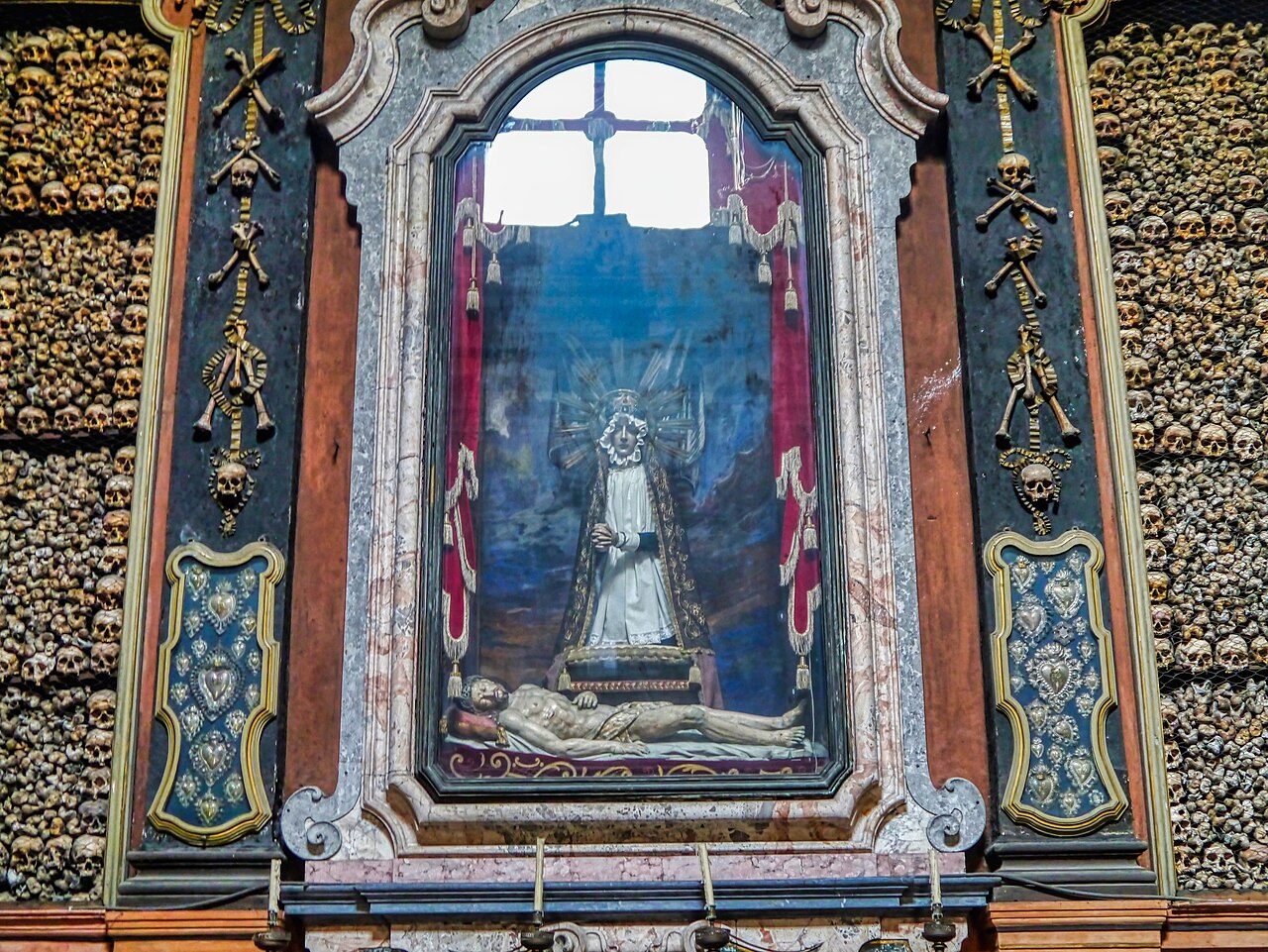
In the ossuary, in front of its only altar, with the statue of the Madonna in the niche above
A marble altar and a Madonna in black and white, kneeling beside the dead Christ. This is the spot where the legends of the have settled: good stories to tell, as long as you call them what they are.
Spot the detail
On the marble altar, look for the symbols of the Passion of Christ
The full story
There is only one altar in the whole room. It is marble and carries the symbols of the Passion. Above it, in a niche, is the figure that sets the tone of the place: a Madonna Addolorata, Our Lady of Sorrows, kneeling beside the dead Christ, in a white robe and a black mantle embroidered with gold.
The name she goes by is half Spanish, Dolorosa de Soledad. The sanctuary says she was carved by Gerolamo Cattaneo in the years when Milan was ruled by Spain, and compares her to the Madonnas in the churches of Seville and Toledo. On the exact date the sources disagree: some say seventeenth century, some eighteenth.
The legend of the martyrs
For centuries people said these were the bones of martyrs: Christians killed by the Arians, followers of a doctrine condemned as heresy, in the days of Saint Ambrose. In the seventeenth century Carlo Torre, a chronicler of the city, wrote it down too.
It is a legend, and historians say so without beating around the bush: it does not hold up. The bones are those of a hospital, a cemetery, the prisons. But you can see why it was so popular. Martyrs are easier to venerate than the sick poor and the condemned.
The little girl of November 2
The second legend is a folk tale with no author. It says that beside the altar lie the bones of a little girl. On the night of November 2, All Souls' Day, the girl is said to come back to life and draw all the skeletons into a dance.
There is no document, no name, no date. It is a tale, the kind that places like this have always attracted. Take it for what it is.
The king of Portugal
The third story sits halfway between. The sanctuary says that in 1738 John V, king of Portugal, was so struck by the that he wanted a faithful copy of it in Évora.
Évora really does have a chapel of bones, and a famous one. But those who tell its story in Portugal date it to the seventeenth century and credit it to three Franciscan friars, with no mention of the king or of Milan. The two versions do not fit together. Take it as a Milanese tradition, not as an established fact.
Three stories, three different degrees of truth. The statue, meanwhile, says one thing only, and it is certain: every skull around you was once someone, and someone wept for them.
About this stop
Legend
The martyrs' bones that never were
San Bernardino alle Ossa has an , a chapel with walls lined with skulls and bones. For centuries Milan believed they belonged to Christian martyrs, killed by the Arians in the days of Saint Ambrose. In the seventeenth century the claim also turns up in Carlo Torre, a chronicler of the city. Historians have taken it apart: the legend does not hold up. The bones are those of the sick from the hospital of the , of the priors and brothers who ran it, of prisoners, of the condemned, of nobles and canons buried nearby. An ordinary crowd, promoted to sainthood by popular devotion.
Legend
The girl who makes the skeletons dance
The of San Bernardino alle Ossa, the chapel with walls lined with skulls, has a folk legend with neither author nor date. Beside its only altar are said to lie the bones of a little girl. On the night of November 2, All Souls' Day, the girl is said to come back to life and draw the other skeletons into a dance that fills the chapel. No document mentions it. But the tale says something true about the place: people who walk in here have always tried to imagine the persons behind the bones.
Legend
The king who wanted to copy the ossuary
At San Bernardino alle Ossa one chapel has walls lined with skulls and bones: the . According to the sanctuary, in 1738 John V, king of Portugal, was so struck by it that he had it faithfully copied in Évora. Évora does have its Capela dos Ossos, the Chapel of Bones, and over the entrance it warns visitors: we bones that are here are waiting for yours. Portuguese accounts, however, date it to the seventeenth century, the work of three Franciscan friars, and mention neither the king nor Milan. It is a tradition the Milanese are fond of, not a proven fact.
Next stop
Without moving, look up at the painted dome