Stop 1 of 5
The square and the facade
Where to stand
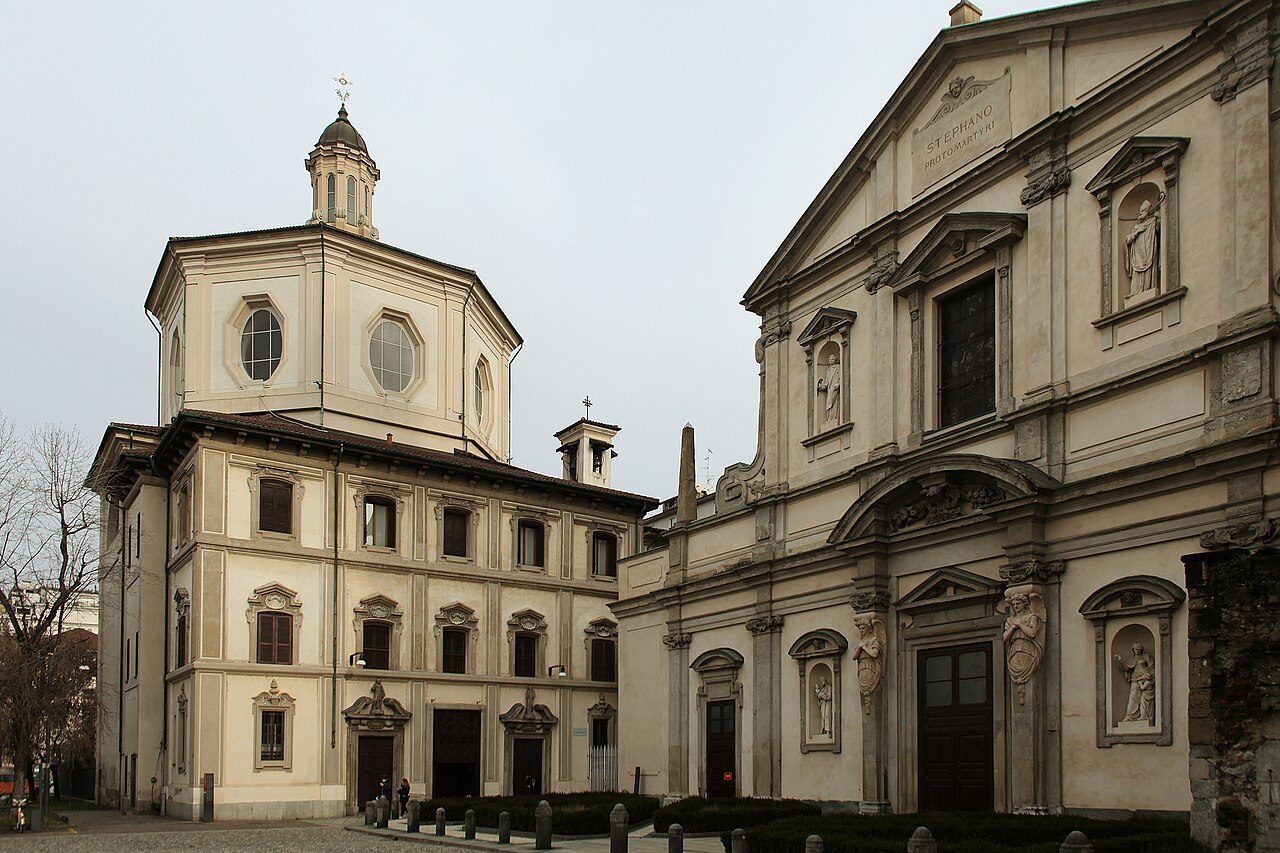
In Piazza Santo Stefano, facing the two churches standing side by side: look at the one on the left
Two churches side by side, and the one you want is the less showy of the two. Its facade could belong to a palazzo. The story starts with a hospital, an overcrowded cemetery, and a fallen bell tower.
Spot the detail
On the facade, above the two doorways, look for two statues of saints
The full story
Stop in the middle of the square. In front of you are two churches, one right up against the other. The one on the right is the basilica of Santo Stefano. The one you want is the other, on the left, and it is easy to miss.
The facade is laid out in three tiers, one above the other, with framed windows and two doorways. It looks more civic than religious: you could take it for a palazzo. The design dates from the late seventeenth century and is by the architect Andrea Biffi.
Why here, of all places
Eight centuries ago this was not a square. It was the , the archbishop's large stretch of green land, part of it set aside for hunting. In the middle of the twelfth century a man named Gotifredo da Bussero founded a hospital here next to the basilica. A cemetery opened in front of the hospital.
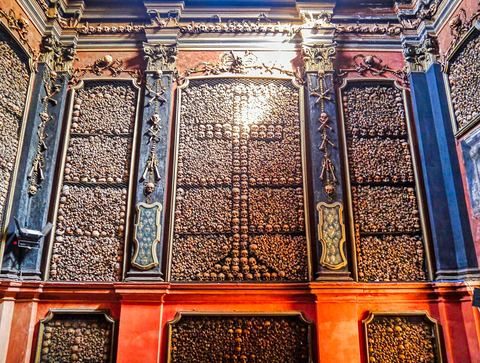
The dead were many and the space was small. In 1210, at the far end of the cemetery, a room was built to hold the bones taken out of the graves, to make way for new burials. That room is the ancestor of the you are about to see.
Some sixty years later, next to the room of bones, the prior and the brothers of the hospital had a small church built. Then came a , the , and with them the name of Saint Bernardino.
The fallen bell tower
The two churches have shared their bad luck too. In 1642 the bell tower of Santo Stefano, which rose directly opposite the , collapsed. It came down on the room of bones and the little church beside it.
The bell tower was rebuilt. So was the , but from the foundations up and in a different way. From a storeroom it became a chapel, with the bones arranged on the walls and a painted sky overhead.
Without that collapse, there might still be a plain storeroom here, and nobody would come looking for it. It took an accident to give Milan one of its strangest places.
Now go in. The door is like that of any other church. What lies behind it is not.
About this stop
Anecdote
A duke murdered and a painter baptized
San Bernardino alle Ossa has a bigger neighbor, attached to its side: the basilica of Santo Stefano. It has two stories that make it worth lingering in the square. On December 26, 1476, the feast of Saint Stephen, Galeazzo Maria Sforza, duke of Milan, was assassinated at its entrance by a group of aristocratic conspirators. And on September 30, 1571, Michelangelo Merisi, the future Caravaggio, was baptized there. The baptismal record was found only in 2007 in the Diocesan Archive of Milan, and it has convinced scholars that the painter was born in Milan and not in the town whose name he bears.
In culture
The alley in a painting from 1912
In 1912 the Milanese painter Arturo Ferrari painted Nella vecchia via, In the Old Street, a view of the alley of San Bernardino alle Ossa. A narrow street, the shops, and an elderly lady making her hesitant way toward a junk dealer with a painting under her arm. The picture won a gold medal at the Brera National Exhibition and was loved as a fond memory of a Milan that was disappearing. Today it belongs to the Fondazione Cariplo and is kept at the Gallerie d'Italia, the museum in Piazza della Scala.
This stop on the map
Next stop
Go in through the doorway: from the church, a narrow corridor on the right leads to the ossuary