Stop 4 of 5Must-see
Sebastiano Ricci's sky
Where to stand
At the center of the ossuary, head tilted back toward the painted dome
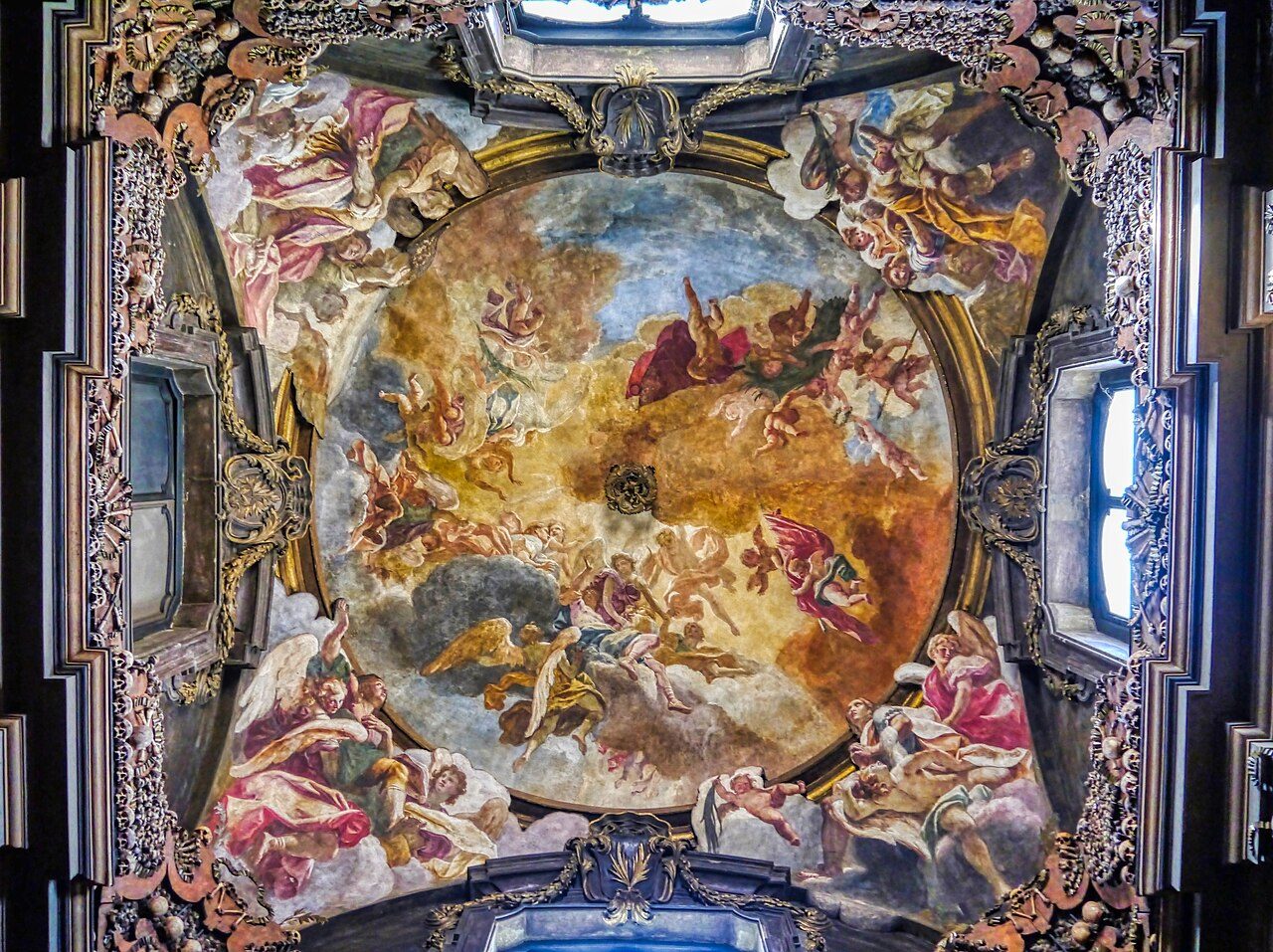
Above the bones, a sky full of figures in flight: the souls of Purgatory rising among the angels. It was painted around 1695 by the Venetian Sebastiano Ricci, during the few years he spent in Milan.
Spot the detail
At the four corners of the dome, in the curved triangles, four figures are carried up in glory. Who are they?
The full story
So far you have been looking at the walls. Now tip your head back, because this room is designed in two acts: death down below, and what comes after up above.
The dome is an open sky. Figures in flight rise upward, escorted by angels: they are the souls of Purgatory entering Paradise. The sources give the fresco two titles, Triumph of Souls in a Flight of Angels and Ascent to Heaven of the Souls in Purgatory. They say the same thing.
At the corners, in the four , four saints are carried up in glory.
A Venetian in Milan
The painter is Sebastiano Ricci, born in Belluno in 1659. He comes to Milan in 1694, summoned by the marquis Cesare Pagani, who had come to know his work in Parma. He stays less than three years. In the city his painting and that of another gifted painter, Alessandro Magnasco, influence each other.
The fresco, painted around 1695, comes out of that stay. It brings Venetian painting to the city, with its colors and its love of figures hanging in midair.
For three of the saints at the corners the survive, the small painted trials made before the fresco. One, the Saint Sebastian, has stayed in Milan, at the Castello Sforzesco, the city's castle. Another has ended up in Cleveland, in the United States.
Then Ricci moves on. He goes back to Venice, and from there he will work across half of Europe, as far as London and Vienna. Some see him as a forerunner of Tiepolo.
Why a sky above the bones
Try putting yourself in the shoes of someone walking in here at the end of the seventeenth century. They looked at the walls and read the first half of the message: we all end up like this. Then they looked up and found the second: but it does not end here.
In this chapel people prayed for the dead. And the dome showed what that prayer was for: souls leaving Purgatory and rising.
It is the contrast that makes the place. Without the dome it would be a gloomy room. Without the walls, one fine fresco among many. Together they make a complete thought, expressed with the tools of the baroque: real bones and a painted sky.
About this stop
It is the second half of the message. The walls say that death comes to everyone. The dome by Sebastiano Ricci answers with the souls of Purgatory rising to Paradise among the angels, watched over by the four patron saints. Anyone praying here for the dead could see, up above, what their prayer was for. That is why it pays to look at the room in two steps, first around you and then upward: one half without the other tells the wrong story.
Next stop
Go back along the corridor and step into the main hall of the church