Stop 1 of 8Must-see
The facade
Where to stand
In the square, in the middle, far enough back from the main portal to take in the whole facade
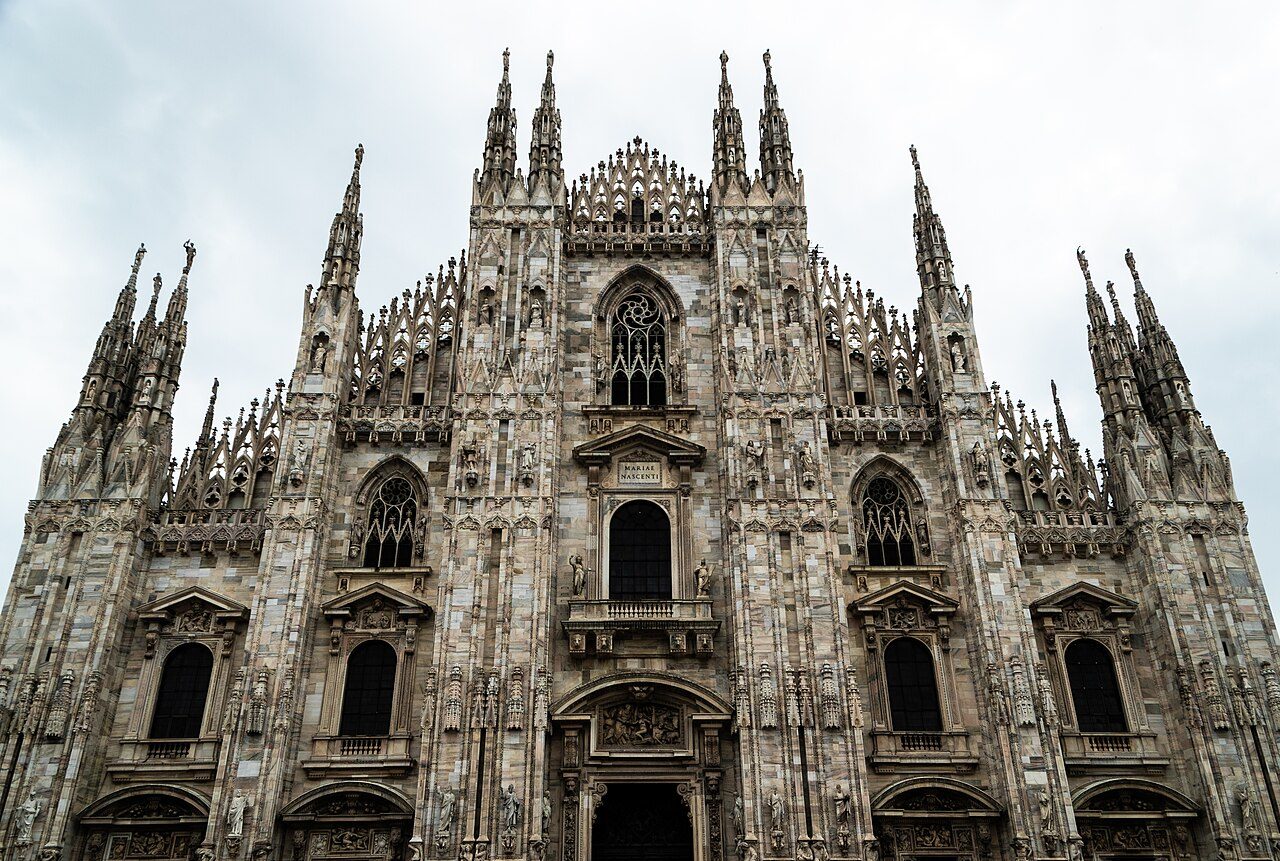
The last part of the Duomo to be finished. Napoleon wanted it done, and in 1805 he had himself crowned king of Italy here. The lower half is classical, the upper half Gothic, and the bronze doors all date from the twentieth century.
Spot the detail
On the balcony above the central portal, a statue of a woman with a crown of rays and one arm raised
The full story
Stand in the middle of the square and give yourself a minute. What you have in front of you looks like the oldest part of the Duomo, Milan's cathedral. It is the newest.
Work began in 1386 and started at the far end, with the . The facade was meant to come last, and for four centuries it did not come at all.
At the end of the sixteenth century the architect Pellegrino Tibaldi designed one in the classical taste of the day, and building started from the bottom. Then everything slowed down, between redrawn plans and endless arguments. The Milanese got used to a cathedral with its front left half done.
The order from Napoleon
The man who settled the matter was Napoleon. In 1805 he had decided to be crowned king of Italy right here, and a cathedral without a facade was not up to the occasion. He ordered it finished, and fast. Within a few years it was done.
The hurry shows, and that is the charm of it. Look at the doors and windows lower down: frames, pediments, regular shapes. They belong to the sixteenth-century design, and nobody took them away.
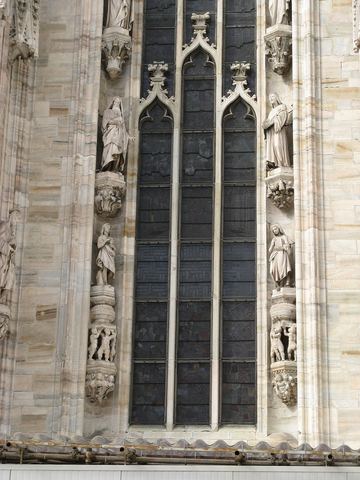
Now look up. From halfway up it is all , pointed arches and statues: Gothic remade in the nineteenth century to get along with the rest of the church. Two eras, one on top of the other, stitched together by the same marble.
Five bronze doors
Now the doors. There are five, one for each inside, all of them bronze. And they are very young.
The central one dates from the early twentieth century and is the work of the sculptor Lodovico Pogliaghi. The others arrived after the Second World War, and the last was unveiled in 1965. That is the date usually taken as the end of the works, almost six hundred years after they began.
The result has always divided people. Mark Twain, the American writer, came through in the nineteenth century and left thrilled: a wonder, he wrote, grand, solemn, vast. Not every visitor agrees with him, though: some find all this embroidered marble too much. You decide which side you are on.
Before you move, think of how many people, for centuries, crossed this square in front of an unfinished wall. You are among those who get to see the facade complete. That is not something to take for granted.
About this stop
Anecdote
The Duomo facade you will never see
The facade of the Duomo di Milano was meant to disappear. In 1886 the Fabbrica, the cathedral's works office, launched an international competition to rebuild it entirely in Gothic style. Two years later a twenty-six-year-old from Milan won, Giuseppe Brentano. The marble was already on order when, at the end of 1889, Brentano died. He was twenty-seven. The project stalled, and protests against demolishing the old portals did the rest. One piece of it survives: the central bronze door, designed for the new facade and then adapted to the old one. Inside, in the right , a plaque shows the Duomo that never existed.
In culture
Mark Twain in front of the Duomo
The Duomo has always gotten travelers talking. Mark Twain, the American writer, visited in the summer of 1867 and wrote about it in his travel book The Innocents Abroad. What a wonder it is, he wrote: so grand, so solemn, so vast. He was an American used to young buildings, and in front of a cathedral that had been growing for almost five centuries he did not hold back on the adjectives. If you want to understand what he felt, stop in the square and look up.
Next stop
Walk up to the Duomo and along one of its two sides, keeping close to the wall