Stop 4 of 8
The sundial
Where to stand
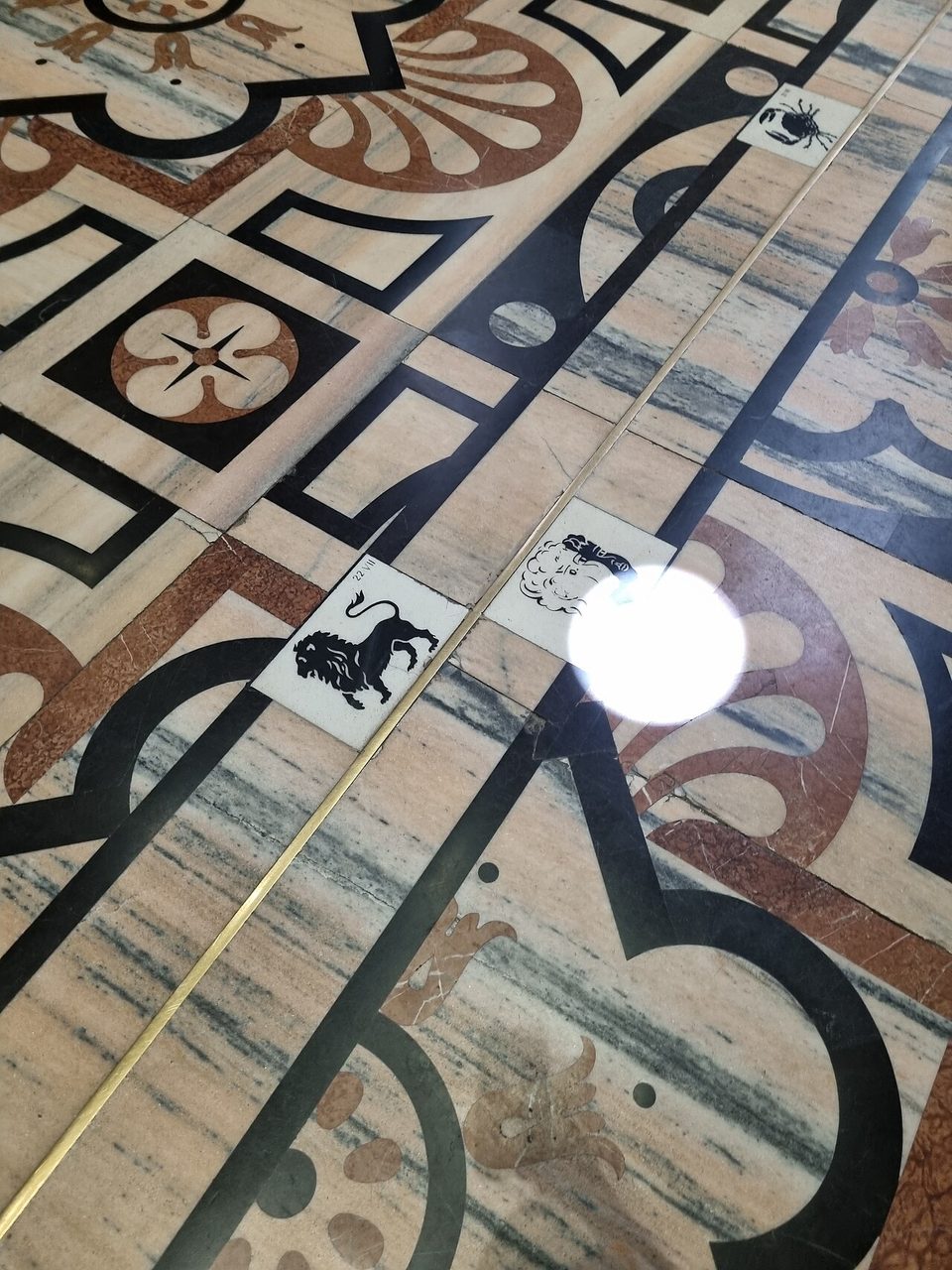
Near the entrance, on the floor: a brass strip cuts across the church from one side to the other
A brass line in the floor and a tiny hole high above: this is a sundial from 1786. At noon a ray of sunlight falls on the strip, and for years Milan set its clocks this way.
Spot the detail
Follow the brass strip to the wall on the left side: where does it end?
The full story
Look down. Through the marble runs a thin strip of brass, as straight as if drawn with a ruler, crossing the and all the aisles. Almost everyone steps over it without seeing it. It is a scientific instrument, the meridiana, the Duomo's sundial.
How the sundial works
It was built in 1786 by two astronomers from the Brera observatory in Milan, Giovanni Angelo Cesaris and Francesco Reggio. The principle is simple. High up on the south side of the church, the one on your right as you come in, almost 24 meters, nearly 80 feet, above the floor, there is a very small hole.
When the sun passes exactly due south, a ray comes through the hole and draws a little disk of light on the floor. The moment the disk touches the strip, it is noon. Not noon by the clock: true noon, by the sun.
One time for Milan
Its purpose was to give Milan a single time, the same for everyone. When the light touched the brass a signal went out and, from the Castello, the city's castle, a cannon fired: the city set its clocks. A church this big is perfect for the job: the higher the hole and the darker the interior, the more precise the measurement.
A calendar as well
There is more. The sun does not climb to the same height all year. In summer it is high, and the disk falls close to the south side. In winter it is low, and the disk slides far away, toward the opposite side.
That is why beside the strip you find marble slabs with the signs of the zodiac: they show where the light lands at different times of the year. The sundial tells the time and doubles as a calendar.
Does it still work? Yes. In 1976 it was checked again, after the floor of the church had sunk slightly, and it still marks noon with only a tiny error.
Think of the setting. When the astronomers laid this line, the Duomo still had no finished facade, and the Madonnina, the gilded statue of the Virgin on the tallest , had been up there for a dozen years. The cathedral was an open building site, and meanwhile it hosted an astronomy experiment without anyone finding that at all strange.
If you come by in the middle of the day under a clear sky, look for the disk of light on the floor. It has been keeping the same appointment for more than two centuries.
Next stop
Walk down the nave to where it crosses the transept and turn into the right arm