Stop 7 of 8
The baptistery under the square
Where to stand
Below the floor, in the archaeological area: you go down a narrow staircase at the facade end
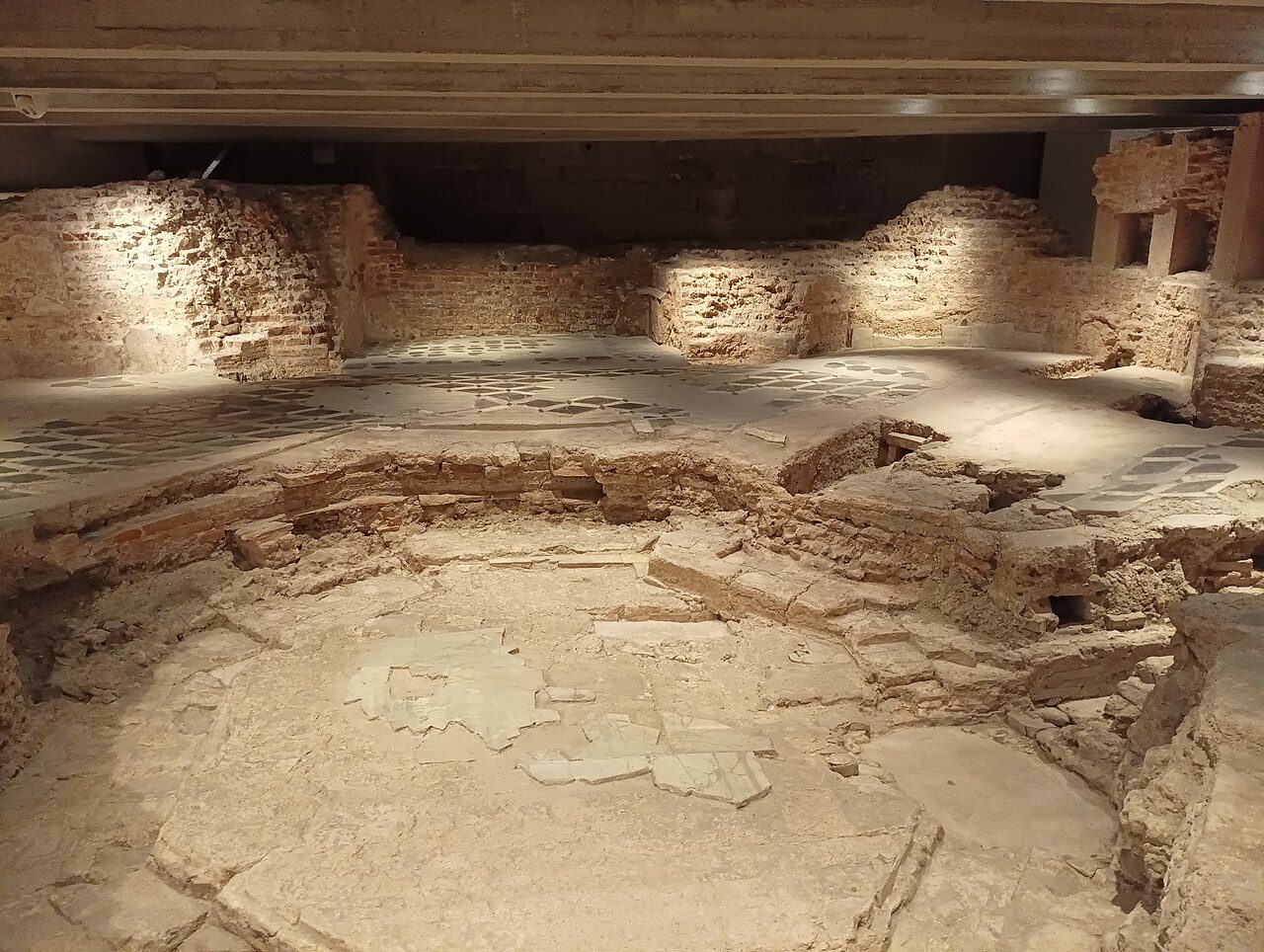
Four meters below the square lie the remains of a fourth-century baptistery. Here, on Easter night in 387, the bishop Ambrose baptized Augustine. It is a thousand years older than the Duomo.
Spot the detail
The basin in the middle: count its sides
The full story
Go down the stairs and let your eyes adjust. You are about four meters, some 13 feet, below the square, at the level of Roman Milan.
It is the end of the fourth century. Milan is one of the capitals of the Roman Empire, and its bishop is Ambrose, Ambrogio in Italian, the man who will become the city's patron saint. Where the Duomo and the square are today stood an entire sacred complex, with its basilicas and their baptisteries.
The baptistery of Ambrose
What you have in front of you is the baptistery of San Giovanni alle Fonti, Saint John at the Fonts, built in the very years of Ambrose. A baptistery is the building where baptism was celebrated, and in those days you received it as an adult, by stepping into a basin.
Do you recognize the shape? An octagon almost twenty meters across, with a basin in the middle that also has eight sides.
The baptism of Augustine
On Easter night in 387 a professor of rhetoric born in Africa, restless and brilliant, stepped down into this water. His name was Augustine. With him were his son Adeodatus and a few friends, and the one who baptized him was Ambrose himself.
That man would become Saint Augustine, the author of the Confessions, one of the most widely read thinkers in Christian history. There are not many places where you can point a finger at the spot where something like that happened.
Look at the floor around it too. The fragments of paving in colored marbles are a little more recent: they date from the sixth century. Down here they also found the remains of the of Santa Tecla, the basilica that occupied the space of today's square.
Demolition and rediscovery
All of this vanished when work on the Duomo began. The baptistery was demolished at the end of the fourteenth century, in the first years of construction, and then forgotten. A few remains were struck in the nineteenth century, but it was only brought back to light in the early 1960s, while the first line of the underground railway was being dug.
On your way back up, think about this. The Duomo, which looks so ancient from outside, is the latecomer down here.
About this stop
A whole complex of churches. In the fourth century, when Milan was a capital of the Roman Empire, this was the site of the basilica of Santa Tecla and the baptistery of San Giovanni alle Fonti, where the bishop Ambrose baptized Augustine. Then there was Santa Maria Maggiore, the old cathedral that the Duomo replaced a piece at a time. The remains of the baptistery and of Santa Tecla can still be seen, under the square.
Next stop
Go back up into the church and make your way to the climb to the terraces, on the roof