Stop 7 of 7Must-see
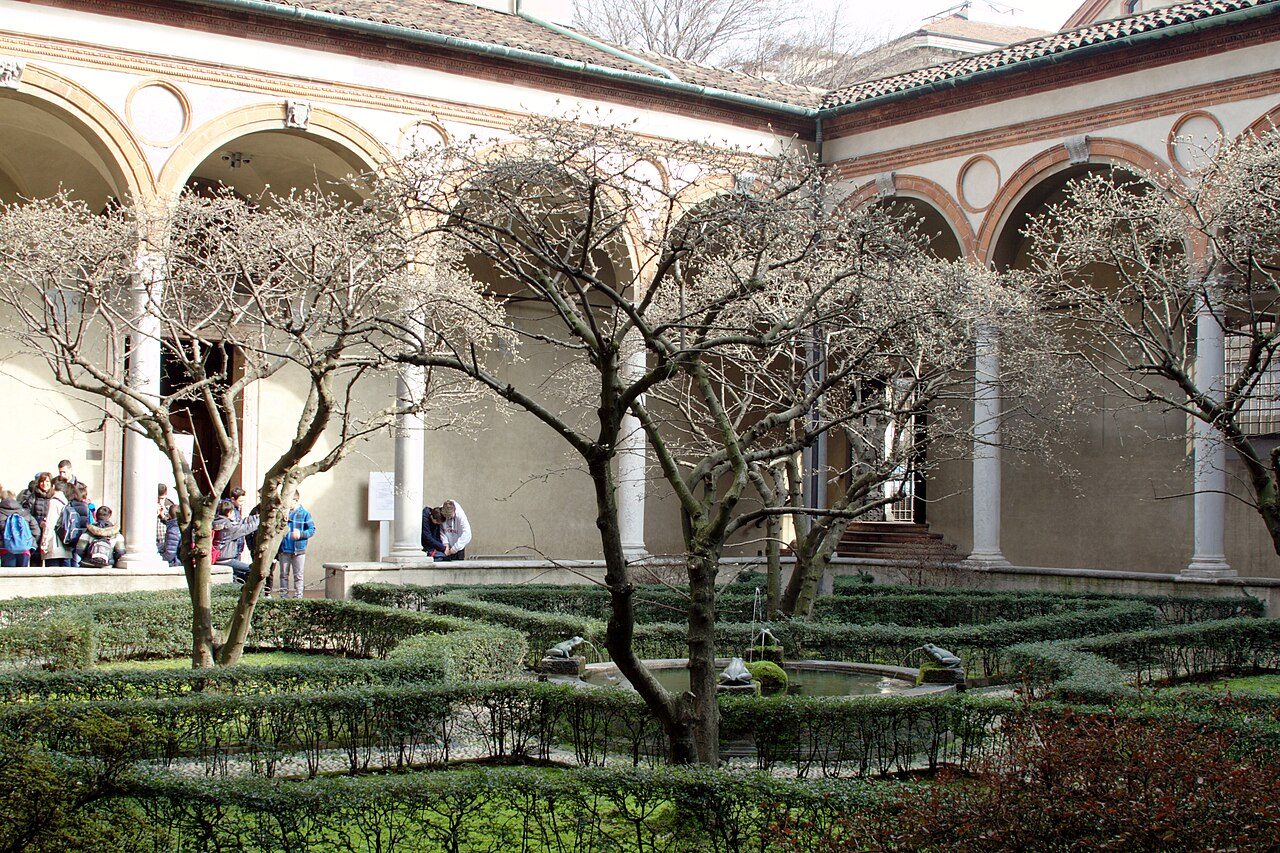
The Chiostro delle Rane
Where to stand
In the small cloister next to the tribuna, near the fountain in the middle of the courtyard
The Cloister of the Frogs, the smallest in the convent: five arches a side, a fountain with bronze frogs and the rising above the roofs. It is attributed to Bramante, like the Sacrestia Vecchia, the Old Sacristy, that opens off one side.
Spot the detail
Above the sacristy door is a stone relief that isn't stone. Who are the two saints beside the Madonna?
The full story
After so much solemn architecture, here is a place on a human scale. It is a square, five arches a side, with smooth marble columns and arches outlined in . In the center is a fountain with the bronze frogs that give the Chiostro delle Rane, the Cloister of the Frogs, its name.
The convent had far bigger cloisters, planned from the start by the architect Guiniforte Solari. This one came last, at the end of the 1400s, together with the , the domed east end of the church, and the sacristy, when Ludovico il Moro, duke of Milan, was rebuilding half the church. Here too the name that comes up is Donato Bramante, his court architect, and here too the documents are missing. But the proportions speak Tuscan: they recall Brunelleschi's cloisters.
A decoration that stayed temporary
Look at the walls under the portico. They are decorated in , with waves and leafy tendrils scratched into a single layer of plaster. Scholars think this was not the final decoration but a temporary finish, waiting for something better.
Then the duke fell, and the temporary has stayed for five centuries. It is a rule known to anyone who has ever had work done on their home.
Off one side opens the Sacrestia Vecchia, the Old Sacristy, a large hall with painted wooden cabinets along the walls. On the vault the motif of interlaced knots dear to Leonardo returns: that is why some have proposed his name, without proof.
A legend hangs around here too. According to an old Milanese tradition, Ludovico had a tunnel dug to link the Castello Sforzesco, the Sforza castle, to the convent. It is a tradition, not a fact: but it says a lot about how much this place mattered to him.
The fire the friars put out
This corner came close to disappearing. In August 1943 bombs destroyed the Chiostro dei Morti, the Cloister of the Dead, next to the church, and tore the roof off the refectory of the Last Supper. Incendiary bombs fell here and the fire began to spread. It was the friars themselves who put it out, back in the convent for less than twenty years.
Before you leave, look up. Above the portico rises the , closer than you will ever see it from the street. This is the right spot to say goodbye to it.
About this stop
Anecdote
The friars who put out the fire
On the night of August 15, 1943, Allied bombs hit the church and convent of Santa Maria delle Grazie. The Chiostro dei Morti, the Cloister of the Dead, was destroyed; the refectory lost its roof and one wall. Incendiary bombs fell on the Chiostro delle Rane, the Cloister of the Frogs, the smallest in the convent, and the fire began to spread: it was the Dominican friars in person who put it out. In the refectory, the wall with Leonardo's Last Supper was saved by another precaution. It had been protected with sandbags held up by a frame of steel tubes.