Church · The Walled City · 1396–1740
Duomo di Como
Three and a half centuries of building, three styles, two pagans on the facade
In brief
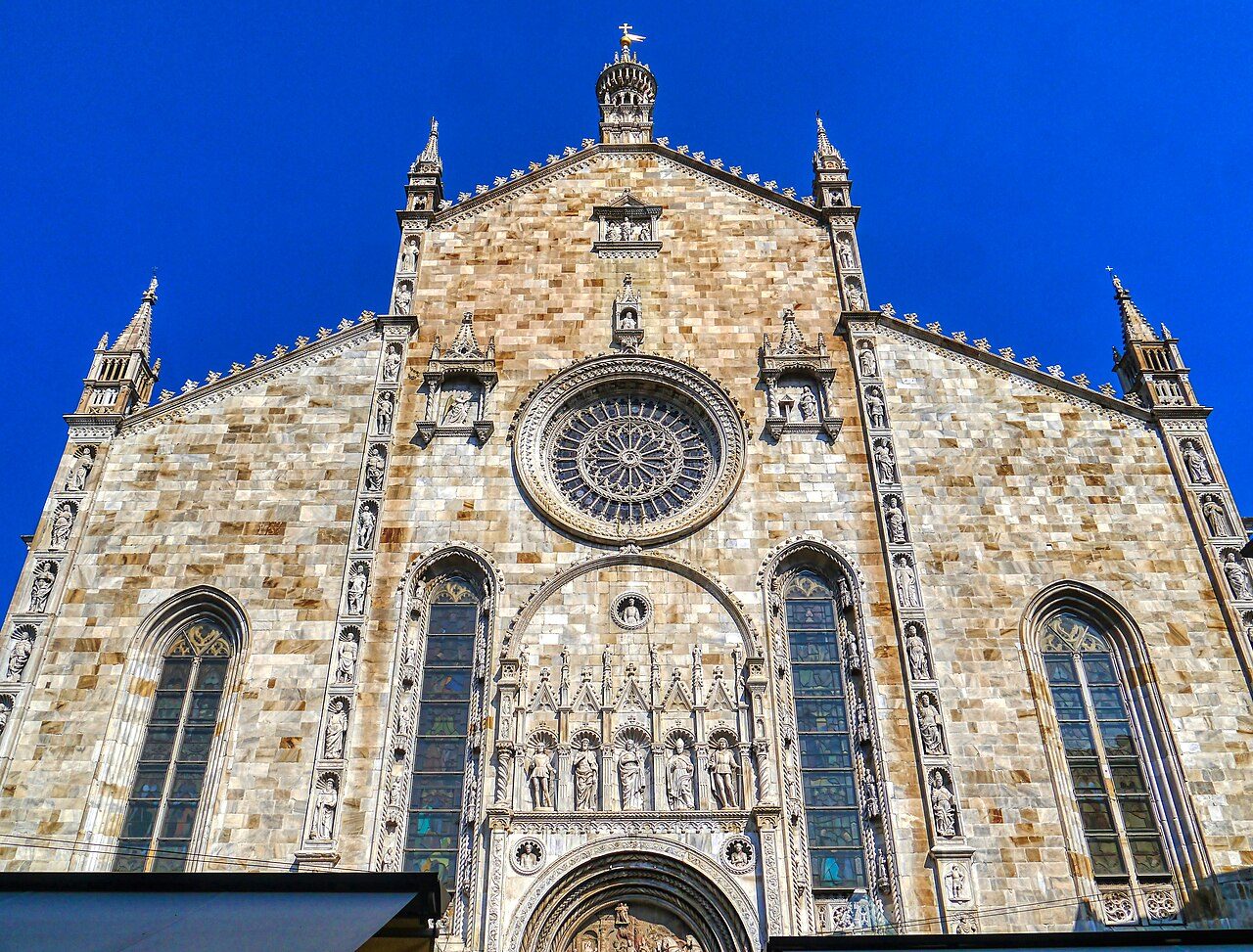
Como's cathedral, begun in 1396 and closed off by its dome only in the 1700s. Gothic in front, Renaissance behind, late Baroque on top: three eras that get along better than you'd expect. Outside it reads like a book in stone; inside it keeps tapestries and an altar covered in gold.
Stories of this place
- Anecdote · The FacadeReadPortrait of a power broker who lost his headOn the facade of the Duomo di Como, among the reliefs on the pilasters in the lower part, one portrait is not of a saint. It is Cicco Simonetta, secretary to the Sforza dukes and for some years the man who in practice ruled Milan. A recent study dates the portrait to about 1470 to 1475, when Simonetta was at the height of his power and came to visit Como. It did not last. Ludovico il Moro, the future duke, had him arrested and then tried by his enemies: on October 30, 1480, Simonetta was beheaded in the castle of Pavia. The portrait, though, is still in its place.
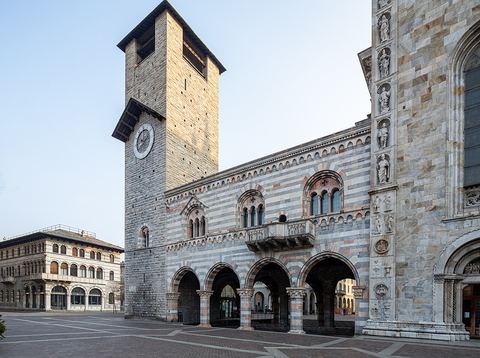
- Record · The FacadeReadA bell weighing almost two metric tonsThe Duomo di Como has no bell tower of its own: the cathedral's bells hang in the civic tower, the one next to the Broletto, the old town hall. With them is the civic bell, cast in Como in 1448 by the bell founder Guillaume de Clermont. It weighs almost two metric tons and is one of the largest historic bells in Lombardy still in use. All five ring together only on exceptional occasions, such as the eve of the Assumption, the feast the cathedral is dedicated to.
- Anecdote · The Two PlinysReadThe eviction of the Plinys that never happenedBeside the central portal of the Duomo di Como, the city's cathedral, stand statues of two ancient Roman writers born in the city, Pliny the Elder and Pliny the Younger. They were not Christians. In 1578, at the height of the Counter-Reformation, the bishop of Vercelli, Giovanni Francesco Bonomi, visited the diocese for the pope and found two pagans on a cathedral facade unworthy. He ordered the statues and their aedicules removed, and advised setting them on columns in the square. The bishop of Como, Gian Antonio Volpi, and the city council took the opposite view. The two Plinys are still there, where the city wanted them a century earlier.
- Anecdote · The Two PlinysReadHercules carved on the altarOn the facade of the Duomo di Como, beside the central portal, stand two ancient Roman writers, Pliny the Elder and Pliny the Younger. They are not the only pagans. Look at the Younger's aedicule, on the right: a column base shows Hercules wrestling the giant Antaeus, and nearby he fights the lion and the Hydra. Next, the right-hand portal. In the lunette the infant Jesus is presented at the Temple, and on the altar in the scene is Hercules with Antaeus again. The model seems to come from the Florentine artist Antonio del Pollaiolo, by way of engravings. In late-1400s Como, this is how antiquity entered a church.
- Legend · The Porta della RanaReadThe frog that would not leaveOn the north side of the Duomo di Como, the city's cathedral, is the Porta della Rana, the Frog Door, named after a small frog carved among the leaves of one jamb. According to a popular legend, during one of the lake's floods the water swamped the cathedral, and a frog climbed up the portal. When the lake drew back, won over by the beauty of the church, it decided never to leave and turned to stone. To this day parents in Como tell their children to look sharp and find it. Since 1912, though, the frog has had no head: a hammer blow knocked it off.
- Anecdote · The Porta della RanaReadThe treasure hunt at the Porta della RanaOn the north side of the Duomo di Como, the city's cathedral, is the Porta della Rana, the Frog Door, a carved portal named after a small frog hidden among its marble leaves. In the early 1800s word got around that a treasure lay buried a short distance from the frog. The story, first put in writing in 1810, caught on well enough that in May 1852 people really did dig beside the door. No trace of the treasure was found. According to a scholar of the late 1800s, though, it was partly this little tale, together with the frog, that made the door famous.
- Anecdote · The Nave and the TapestriesReadA fish for the organ builderIn the mid-1600s the Duomo di Como's old organ was forever being repaired. So the men in charge of the works called from Trento Guglielmo Hermans, a Jesuit from the Low Countries and famous organ builder, who built a new one in eighteen months. It was first played on March 25, 1650, the feast of the Annunciation, and everyone liked it. To thank him, the historian Santo Monti wrote in the late 1800s, they sent him a gift fit for a lake city: a very large fish. We even know what it cost: just over nine lire. That organ was later rebuilt several times: today's dates from the 1900s.
- In culture · Juvarra's DomeReadGadda, reporter at the dome fireOn September 27, 1935, the dome of the Duomo di Como, the city's cathedral, caught fire during work on its copper roofing. The nearby houses were evacuated, while the canvases by the painters Bernardino Luini and Gaudenzio Ferrari and the cathedral's tapestries were moved to the church of San Giacomo, a few steps away. According to the local press, the episode was reported in the pages of a daily newspaper, the Gazzetta del Popolo, by an exceptional correspondent: the writer Carlo Emilio Gadda, who had ties to nearby Brianza, the hill country between Como and Milan.
- In culture · Juvarra's DomeReadThe Duomo that opens like a flowerIn the second half of the 1800s the English writer John Addington Symonds, a historian of the Renaissance, devoted a few pages of a travel essay, Como and Il Medeghino, to the Duomo di Como. For him it was perhaps the most perfect building in Italy for seeing Gothic and Renaissance blend without discord. He found an image for it: the Gothic nave, severe and dim, opens out into the luminous harmonies of choir and transept like a flower unfolding. Try it: walk from the entrance toward the altar and watch the light grow. Symonds, mind you, was biased: among the Italian lakes his vote went to Lake Como.
- In cultureReadThe Duomo in Turner's sketchbookIn 1819, on his first trip to Italy, the English painter William Turner passed through Como with a sketchbook in his pocket. On a page not much bigger than a postcard he drew two views of the Duomo in pencil: one of its side, seen from the south from the street, and a wider one, taken from the water of the lake. Below them he added the gulf of Como. The sheet is part of the Turner Bequest and is kept at the Tate in London. Other sheets in the same sketchbook study the cathedral in more detail.
Ready-made questions
Because they were the most famous sons Como ever had, and in the 1400s that mattered. Pliny the Elder and Pliny the Younger, writers of ancient Rome, were claimed by both Como and Verona, each calling itself their hometown. Como carved them next to the cathedral portal to set the record straight. It could do so because the Duomo's building site answered to the city authorities and not to the bishop. A century later the Church tried to take them down, and failed.
Go to stop: The Two PlinysAlmost three and a half centuries. The founding date is 1396, although work only got going in earnest a few decades later. The nave, aisles and facade are from the 1400s, the area around the altar with its was built in the 1500s and 1600s, and the dome came in the 1700s. On the exact end date the sources vary by a few years around 1740. The beauty of it is that, while changing style three times, the architects always respected the proportions of those who came before them.
Because it borrows one. The old cathedral of Santa Maria Maggiore had a bell tower, but it was demolished to make room for the new, larger building. The bells were placed in the civic tower, the one that flanks the Broletto, the medieval town hall attached to the facade. Ever since, the city's tower has doubled as the cathedral's bell tower. It is one more sign of how closely, in Como, civic power and the Church grew up side by side.
Go to stop: The FacadeBecause in Como the Magi were the object of a special devotion. It was believed that the emperor Frederick Barbarossa, when he had their relics carried from Milan to Cologne, stopped for some time in the city, which was his ally. It is a tradition and not a documented fact, but it was enough to give the three kings the place of honor: the of the main portal holds their Adoration, while the birth of Jesus is on a side portal of the facade.
Go to stop: The FacadeIt is a birth defect. The high windows of the nave were designed without a real source of light, because on the outside they are covered by the roofs of the side aisles. In the 1800s painted stained glass in dark tones was added, which took away still more light. Only in recent times have skylights been opened. The exception is the area under the dome, where the light comes down full, as the architect intended: that is why, as you move toward the altar, the church seems to light up.
Go to stop: The Nave and the TapestriesA bishop of Como in the fifth century, patron saint of the city and the diocese. Tradition remembers him as an opponent of heresies and credits him with a miracle: he is said to have brought a governor's son back to life. In the Duomo you find him everywhere: in a niche on the facade, near the Virgin Mary, in the stained glass beside the and above all in the large gilded wooden altar in the right aisle, where the reliefs tell his life. One of the city's Romanesque basilicas is dedicated to him as well.
Go to stop: The Altar of Sant'AbbondioYes, and paradoxically more so today than two centuries ago. Thirty years after it was built water was getting in, and the architect Giulio Galliori enclosed it in a copper-clad shell that altered its outline. In 1935 a fire ravaged the roofing. In the restoration the shell was removed and the dome went back to the shape drawn by Filippo Juvarra. Work on the dome and its interior decoration went on until the early 1950s.
Go to stop: Juvarra's DomeThe stops
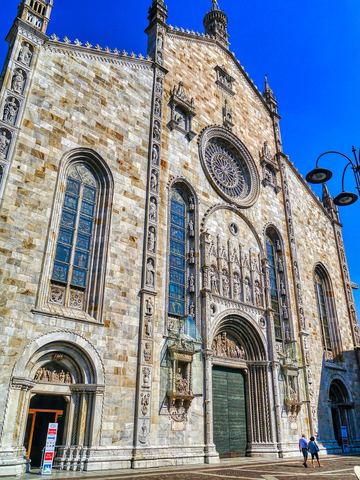
1 The Facade
Pale marble, a rose window, spires: this is the most Gothic part of the Duomo, built in the second half of the 1400s. It is also a page meant to be read from the bottom up, from humankind to God.
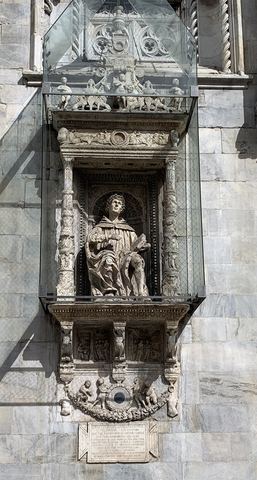
2 The Two Plinys
Beside the main door of a cathedral you expect two saints. Here you get two writers of ancient Rome, born in Como and never Christian. The city put them there out of pride, and defended them when an envoy of the pope ordered them removed.
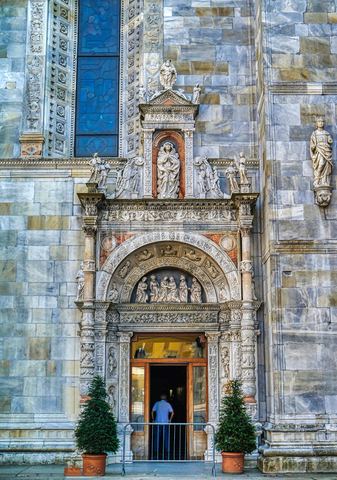
3 The Porta della Rana
The richest portal of the Duomo, carved in the early 1500s by the Rodari brothers. Porta della Rana means Frog Door: it is named for a small frog hidden among the leaves, the star of a legend, a treasure hunt and a hammer blow.
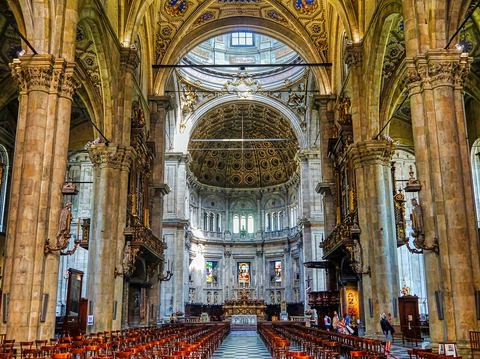
4 The Nave and the Tapestries
Inside, the Duomo is Gothic but wide and calm, the Lombard way. Between the piers hang tapestries woven in the 1500s and 1600s in Florence, Ferrara and Brussels, given in large part by the city's guilds and confraternities.
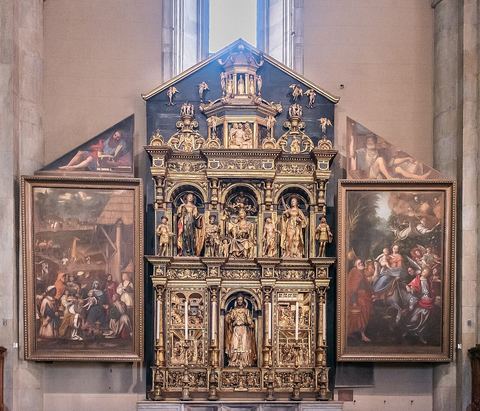
5 The Altar of Sant'Abbondio
A gilded wooden altar as tall as a three-story house, carved in the early 1500s by Giovanni Angelo Del Maino. The canvases beside it, by Bernardino Luini and Gaudenzio Ferrari, were once its shutters.
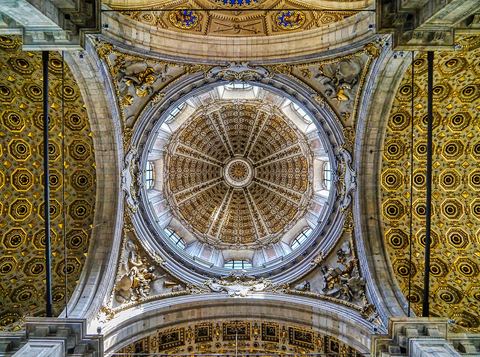
6 Juvarra's Dome
The last piece of the Duomo, arriving more than three centuries after the first. Filippo Juvarra, architect to the House of Savoy, designed it, and in 1935 a fire ravaged it. That very disaster gave it back the shape its author intended.
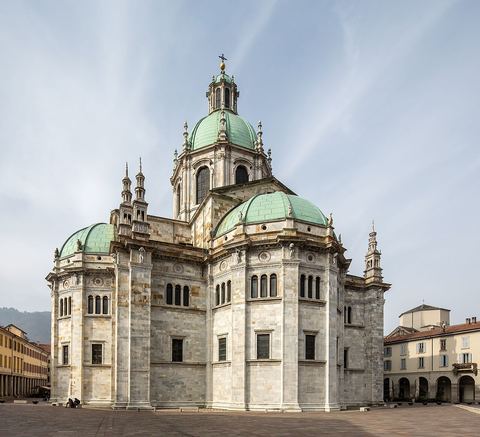
7 The Apses and the Stone of 1396
From behind, the Duomo is a different church: no spires, but three Renaissance apses with the dome above them. It is the best spot for seeing three centuries of styles stacked one on top of the other.
Timeline
- Early 11th centuryThe church of Santa Maria Maggiore, near the lake, becomes the cathedral of Como.
- 1396Official date of the refounding: the old cathedral is to be rebuilt from the foundations. Work gets going in earnest a few decades later.
- 1486The first phase of work ends: the Gothic nave and aisles and the facade are standing.
- 1487Tommaso Rodari becomes chief engineer of the works. He stays until 1526, amid statues, portals and the design of the apses.
- 1513Building begins on the main apse: the Gothic Duomo continues in Renaissance forms.
- 1578The papal visitor Bonomi orders the statues of the two Plinys removed from the facade. Bishop and city object.
- 1731Filippo Juvarra is called in to solve the problem of the dome. The work is completed around 1740.
- 1935A fire ravages the roofing of the dome. The restoration removes the 18th-century shell and recovers Juvarra's shape.
Who's who
Tommaso Rodari
sculptor and architect, head of the building site
Born in Maroggia, on Lake Lugano, around 1460. He led the works for almost forty years and, with his brothers, carved most of the Duomo's statues, the side portals and several altars.
Pliny the Elder
writer and naturalist of ancient Rome
From Como, author of the Natural History, the great encyclopedia of antiquity. He died in 79 AD during the eruption of Vesuvius. His statue is to the left of the central portal.
Pliny the Younger
lawyer, consul and writer of ancient Rome
Nephew and adopted son of the Elder. He left a famous collection of letters and a speech in praise of the emperor Trajan. His statue is to the right of the central portal.
Benedetto Giovio
scholar and historian from Como
Older brother of the better-known Paolo Giovio and a fierce champion of the Plinys' Como origins. In 1498 he composed the inscriptions under their statues. He is buried in the Duomo.
Giovanni Angelo Del Maino
wood sculptor
From Pavia, a master of painted and gilded carving. The great altar of Sant'Abbondio, made in the early 1500s, is confidently attributed to him, although no document proves it.
Filippo Juvarra
architect, designer of the dome
Born in Messina in 1678, chief architect to the House of Savoy in Turin. In 1731 he was called to Como for the dome. He died in Madrid in 1736, while working on the design of the royal palace.
Words to know
Where it is
The neighborhood
The Walled City
Related places
The story of the place
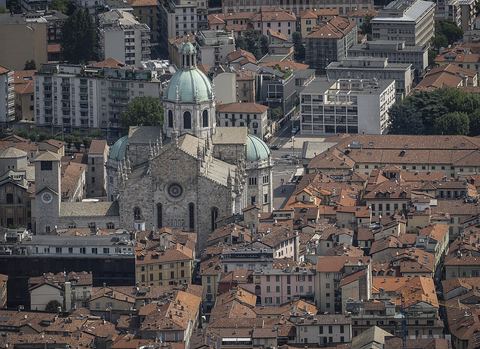
The Duomo di Como, the city's cathedral, is a church that changed style three times without ever starting over. It is Gothic in the facade and the aisles, Renaissance in the , late Baroque in the dome. And yet, when you look at it, it seems like a single thing.
From 1396 to the dome
Before it there was another cathedral, Santa Maria Maggiore, Romanesque and smaller. It stood close to the lake, and every so often the lake let itself in. At the end of the 1300s the city decided to rebuild it from the foundations.
The official date is 1396, the same as the Certosa di Pavia, the great charterhouse south of Milan, and ten years after the Duomo of Milan: these are the years when the Visconti, lords of Milan and of Como too, were opening big building sites. The ones paying, though, were mostly the city's merchants. Gian Galeazzo Visconti, duke of Milan, chipped in a hundred gold coins.
Work only got going in earnest a few decades later, and it moved forward in a curious way: the new church grew around the old one, which stayed in use for as long as it could. The 1400s brought the aisles and the facade.
Then Tommaso Rodari came on the scene, a sculptor from Lake Lugano who ran the works for almost forty years and filled the Duomo with statues, portals and altars. With him Gothic gave way to the Renaissance: at the back, three large identical took shape, arranged like a clover leaf.
The dome was still missing. It took another two centuries, a good many rejected designs and a famous architect, Filippo Juvarra, in the service of the House of Savoy in Turin, to close the roof around 1740. In all, almost three and a half centuries.
Surprises to look for
The result is a kind of art history textbook in stone, but with plenty of surprises. On either side of the main door stand two writers of ancient Rome, who were no Christians. A frog is hiding on a side door. Inside you'll find , canvases by Bernardino Luini and Gaudenzio Ferrari, and a gilded wooden altar as tall as a house.
One last thing: the Duomo has no bell tower. Its bells ring from the civic tower a little farther on, beyond the Broletto, the old town hall that the facade is attached to. Here, church and city grew up wall against wall.
Sources
- Cattedrale di Como, sito ufficiale: il Duomo, storia e arte (opens in a new tab)Official site
- Duomo di Como, Lombardia Beni Culturali, scheda di architettura (opens in a new tab)Catalog
- Porta della Rana, Lombardia Beni Culturali, scheda dell'opera (opens in a new tab)Catalog
- Portale maggiore del Duomo di Como, Lombardia Beni Culturali, scheda dell'opera (opens in a new tab)Catalog
- Mirko Moizi, Tommaso Rodari e il Rinascimento comasco, Mendrisio Academy Press, Università della Svizzera italiana (opens in a new tab)Institution
- Rodari, Tommaso, Dizionario Biografico degli Italiani, Treccani (opens in a new tab)Encyclopedia
- Juvarra, Filippo, Dizionario Biografico degli Italiani, Treccani (opens in a new tab)Encyclopedia
- Como, Enciclopedia Italiana Treccani (opens in a new tab)Encyclopedia
- Duomo di Como, FAI Fondo per l'Ambiente Italiano (opens in a new tab)Institution
- Altarpiece of St. Abbondio, Queen's University (opens in a new tab)Institution
- J.M.W. Turner, Two Views of the Duomo, Como, catalogo Tate (opens in a new tab)Institution
- Como Cathedral, alessandrovolta.it (opens in a new tab)Other source
- Il rogo in Duomo del 1935, Espansione TV (opens in a new tab)Other source
- Santo Monti, La cattedrale di Como, Como 1897, Internet Archive (opens in a new tab)Other source
- John Addington Symonds, Sketches and Studies in Italy and Greece, saggio «Como and Il Medeghino», Internet Archive (opens in a new tab)Other source
- Simonetta, Cicco, Dizionario Biografico degli Italiani, Treccani (opens in a new tab)Encyclopedia
- Symonds, John Addington, Enciclopedia Italiana Treccani (opens in a new tab)Encyclopedia
- Cicco Simonetta, Wikipedia in italiano (opens in a new tab)Wikipedia
- Willem Hermans, Wikipedia in italiano (opens in a new tab)Wikipedia
- Duomo di Como, Wikipedia in italiano (opens in a new tab)Wikipedia
- Como Cathedral, Wikipedia in inglese (opens in a new tab)Wikipedia
- Como Cathedral, Wikidata Q1101730, coordinate (opens in a new tab)Other source