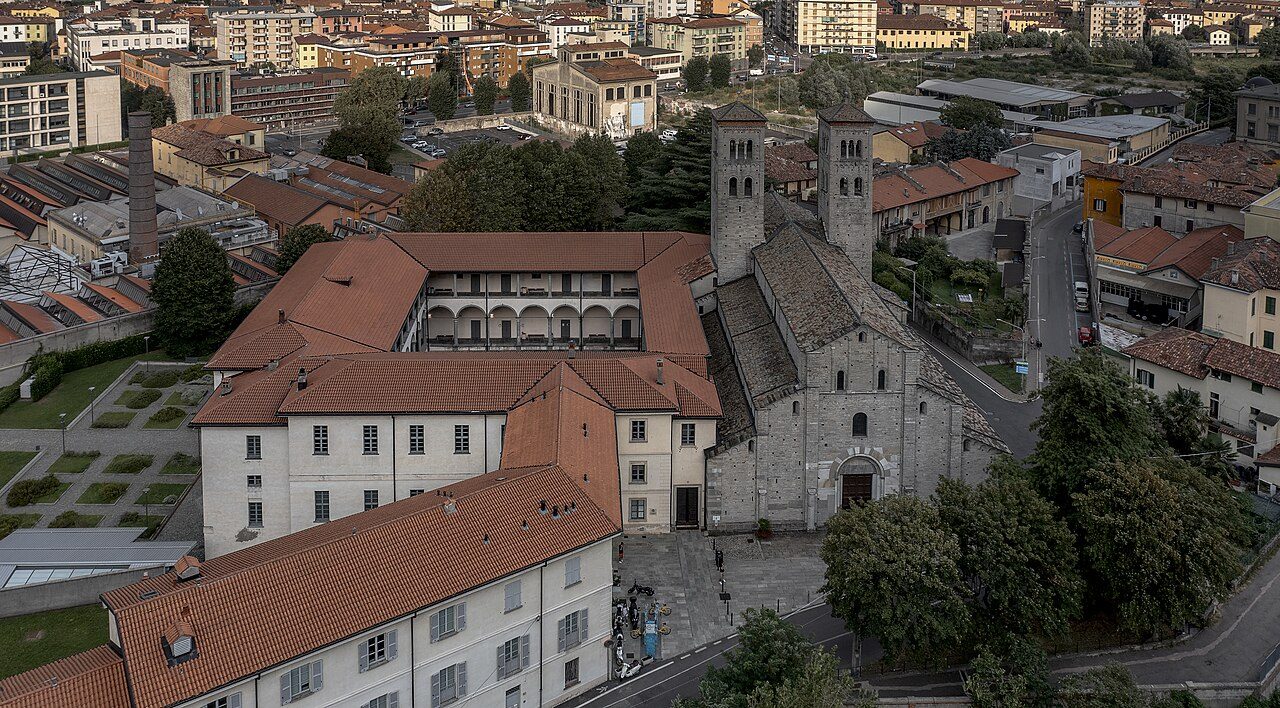
Church · The Borghi · 1050–1095
Basilica di Sant'Abbondio
Twin bell towers and an apse painted like a picture book
In brief
The masterpiece of Como's Romanesque, built by Benedictine monks in the eleventh century outside the walls. Outside, twin bell towers that look as if they came from Germany. Inside, five bare aisles and an apse covered in fourteenth-century frescoes, among the best preserved in Lombardy.
Stories of this place
- Anecdote · The apse and the twin bell towersReadThe bell tower that fell on the churchIn 1784 the north bell tower of the basilica of Sant'Abbondio, one of the twin towers flanking the apse, already partly demolished two centuries earlier, collapsed onto the vault of the choir. It took a piece of the starry sky painted there in the 1300s and wrecked the four thrones that appeared in it, probably those of the Doctors of the Church. For over eighty years the basilica had one tower. Then the restoration of the 1800s rebuilt it to match its twin, following a drawing by the French scholar Fernand De Dartein. What the fallen tower really looked like, no one knows for certain: no record survives.
- Anecdote · The facade and the portalReadThe portico they called ParadiseA portico with an enviable name stood before the facade of the basilica of Sant'Abbondio: the Paradiso, Paradise, the medieval word for a church's atrium. It had two stories; the upper one continued inside as the gallery, used by abbots, bishops and distinguished guests for solemn ceremonies. It was demolished in the second half of the 1500s. Three centuries later Don Serafino Balestra, the priest who led the restoration, found its traces digging in the square, but chose not to rebuild it. He kept the half-columns and had the line where the vault began marked on the stone with the point of a chisel. Nothing else is left of Paradise.
- Legend · The five aislesReadThe pagan's son brought back to lifeSant'Abbondio, the fifth-century bishop of Como for whom the basilica is named, went down in history as the pope's ambassador to Constantinople. Tradition prefers a miracle: he is said to have raised from the dead the son of a pagan official, and the father to have then converted. Artists have depicted no episode more often. Here a canvas attributed to the painter Gian Battista Recchi shows it, near the entrance: in the 1600s, when the church was divided in two for the nuns, it stood on the high altar of the part for the faithful. It is a devotional tale, not documented fact: of Abbondio's life, little is certain.
- Anecdote · The five aislesReadUnderfoot, the cardinal of BalbianelloAmong the slabs in the floor of the nave, in the basilica of Sant'Abbondio, is that of Cardinal Angelo Maria Durini, the last commendatory abbot: the outside prelate who collected the abbey's income without belonging to the community. His life, in fact, was elsewhere. He had been the pope's representative in Warsaw, and on Lake Como he had the Villa del Balbianello built, conceived as a retreat for pleasure and literary leisure. Today it belongs to the FAI, Italy's national trust. He died in 1796 and was buried here. At his death the state took over the commendam's assets, estimated at four times those of the monastery.
- Anecdote · The basilica under your feetReadThe restorer who taught the deafDon Serafino Balestra, the priest who restored the basilica of Sant'Abbondio from 1863, was a seminary teacher: he taught literature, then physics and mechanics, and studied archaeology and inscriptions. But today he is remembered mostly for something else. From 1865 he devoted himself to teaching deaf-mutes, as people said then, and became one of the keenest champions of the oral method: teaching speech and lip-reading, setting signs aside. He also worked for years in France, which gave him the Legion of Honor. In 1885 he was called to run a school for the deaf in Buenos Aires. He died there the next year, far away from his Sant'Abbondio.
- Legend · The basilica under your feetReadThe relics brought from RomeThe floor of the basilica of Sant'Abbondio marks the outline of an older, fifth-century church dedicated to the apostles Peter and Paul. According to a tradition recorded in the 1500s by Como's historians, it rose to guard a treasure. Amanzio, the third bishop of Como, is said to have returned from Rome with relics of Saints Peter and Paul, and to have built a church for them outside the walls, along the Via Regina. It is a story, not a document: other scholars credit Felice, the first bishop. But it helps explain why the two apostles still appear, nine centuries later, in the frescoes covering the apse.
- Record · The stories of Christ in the apseReadSeven centuries with barely a scratchThe frescoes in the apse of the basilica of Sant'Abbondio, with the stories of Christ, are considered one of the most intact early fourteenth-century cycles in Lombardy: twenty scenes still readable after seven centuries. That was far from guaranteed. The church was modernized in the 1500s, adapted for the nuns in the 1600s, hit by the collapse of a bell tower in the 1700s, abandoned and then thoroughly restored. The starry sky of the vaults, painted with powdered lapis lazuli, has lost pieces. The stories of Christ, lower down, are still there.
- In culture · The cloister, from monastery to universityReadThe capital that ended up in a galleryOne of the most precious sculptures of the basilica of Sant'Abbondio is no longer in the church: it is at the Pinacoteca Civica, Como's city art gallery, in the medieval section. It is a twelfth-century capital, in marble from Musso, carved with the stories of Christ's childhood and known as the capital of the Magi. It is not the only piece that left: sculptures from the Carolingian age and some capitals replaced during the restoration of the 1800s are in the city's museums too. If you go and find it, compare it with the fourteenth-century frescoes in the basilica's apse: the same story, told in stone two centuries earlier.
- AnecdoteReadConsecrated by a pope on the roadOn June 3, 1095, the basilica of Sant'Abbondio in Como, just rebuilt by its Benedictine monks, was consecrated by Pope Urban II in person. He had not come on purpose: he was crossing northern Italy on his way to France, and around Como he consecrated more than one church. The building work, for that matter, was not quite finished. A few months later, at Clermont, the pope made the appeal that gave rise to the First Crusade. Sant'Abbondio was a stop along that road.
- In cultureReadThe restoration and Boito's opposite ideaThe restoration of the basilica of Sant'Abbondio, led from 1863 by the priest Serafino Balestra, followed the idea tied to the name of the Frenchman Viollet-le-Duc: return a building to its original style, remaking whatever is missing. Soon afterward an Italian architect would argue the exact opposite: consolidate rather than remake, and keep additions recognizable. He was Camillo Boito, a scholar of medieval architecture and the author of the novella Senso, which Luchino Visconti turned into a film. Sant'Abbondio, with its north bell tower rebuilt as a copy of its twin, is a good example of the method Boito called into question.
Ready-made questions
Because when it was founded, the main road ran past here. The Via Regina followed the lakeshore and linked Milan to the Alpine passes, and along its route, outside the walls, lay the Roman cemeteries. The first basilica rose in the fifth century right in this area of tombs, and the first bishops were buried in it. The Benedictine monks rebuilt it on the same spot. It is the city that later grew elsewhere, leaving Sant'Abbondio off to one side, between the railroad and the factories.
The fourth bishop of Como, who lived in the fifth century, and the city's patron saint. According to tradition he was born in Thessalonica. In 450 Pope Leo the Great sent him to Constantinople to win the agreement of the bishops of the East on a question of faith: the human and divine nature of Christ. The mission succeeded and paved the way for the Council of Chalcedon. Back in Como, he devoted himself to spreading Christianity in the diocese. His relics are under the high altar, and his feast day is August 31.
Go to stop: The altar and the ambassador saintBecause the monks who built the basilica looked north of the Alps. Twin towers flanking the were a fairly common arrangement in the churches of the Rhine valley, while in Italy they are an exception. The road to the Alpine passes ran through Como, and ideas traveled along that road too. Of the two bell towers, though, only the south one is medieval: the other collapsed in 1784 and was rebuilt in the 1800s in imitation of the first.
Go to stop: The apse and the twin bell towersWe don't know. His name is unknown, and art historians call him the Maestro di Sant'Abbondio, the Master of Sant'Abbondio. He worked here between 1315 and 1324, when the bishop of Como was the Franciscan Leone Lambertenghi, the probable patron and the brother of Benno, abbot of the monastery. He was an up-to-date Lombard painter: he knew Giotto's innovations, and his style shows links with the painting of Siena and Umbria. He probably did not work alone, but at the head of a workshop.
Go to stop: The stories of Christ in the apsePeople said so for a long time, starting with the Como scholar Benedetto Giovio in the 1500s: the church of the Apostles was supposedly the bishop's seat until shortly after the year 1000, when the see was moved inside the walls. Several texts still repeat it. But the excavations turned up no proof, and scholars remain divided. What is certain is that it was the church where the first bishops of Como were buried, and that was enough to make it a place of great prestige.
Go to stop: The basilica under your feetA lot, but not all. The walls, the piers, the , the with its carved windows and the south bell tower are from the eleventh century. The frescoes are from the 1300s. The north bell tower, the gallery above the entrance, some capitals and the bare look of the interior, on the other hand, are from the 1800s: the restoration begun in 1863 removed the vaults and decorations added from the 1500s onward to recover the church. It did so with a heavy hand in places, rebuilding what was missing as people imagined it had been.
It occupies the former monastery. Next to the church the Benedictines had their convent, which over the centuries passed to the Augustinian nuns and then, from the 1800s, to the diocesan seminary. When the seminarians left, in the 1960s, the complex stood empty. The city of Como bought it in 1974 and had it restored. Today the sixteenth-century cloister is home to the law courses of the Università dell'Insubria, the local university. The basilica, meanwhile, has remained a church.
Go to stop: The cloister, from monastery to universityThe stops
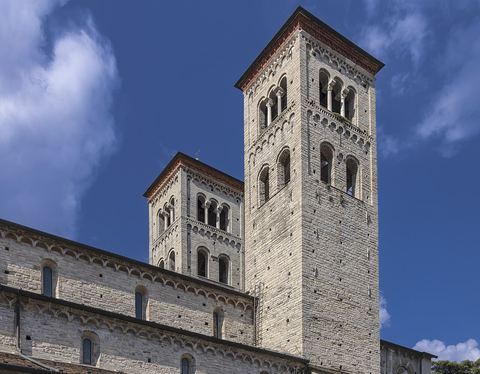
1 The apse and the twin bell towers
The best side of Sant'Abbondio is the back. A long choir, a tall apse and twin bell towers: an arrangement common along the Rhine and almost impossible to find in Italy.
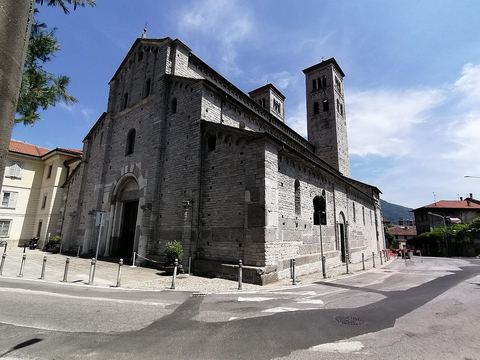
2 The facade and the portal
A sober facade that tells the truth: its five sections announce the five aisles inside. It once had a two-story porch in front, torn down in the 1500s.
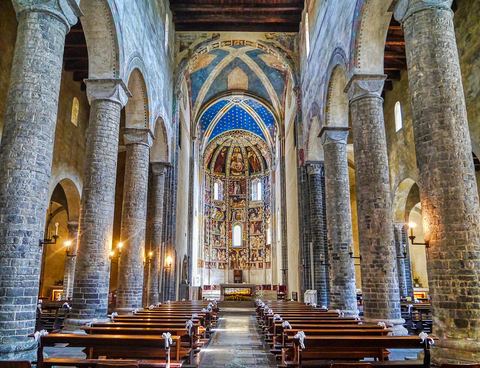
3 The five aisles
Five tall, narrow aisles, with great cylindrical piers in the center: a very rare plan in Como's Romanesque. The walls, bare today, were once covered in frescoes.
4 The basilica under your feet
In the floor, a band of dark marble traces the plan of an older church: the basilica of the Apostles, from the fifth century, found during the excavations of the 1800s.
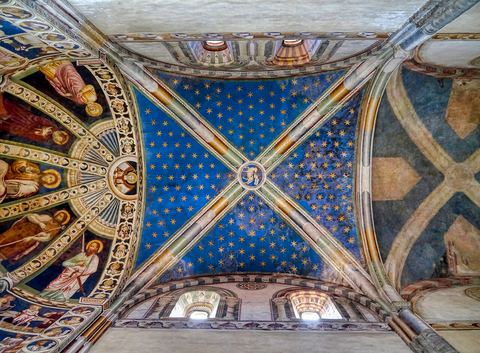
5 The choir and the starry sky
After five bare aisles, the choir is an explosion of color. It was the space reserved for the monks, and in the 1300s it was painted from the entrance arch up to the vaults, with a blue sky full of stars.
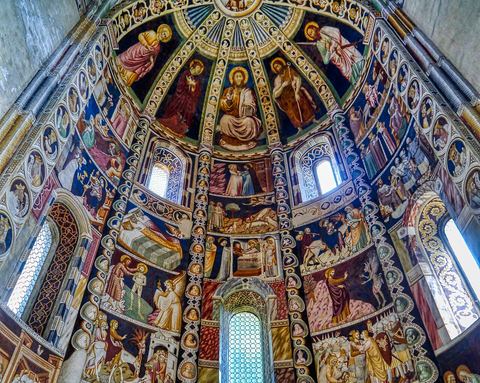
6 The stories of Christ in the apse
Twenty scenes tell the life of Jesus, from childhood to burial: one of the best-preserved early fourteenth-century cycles in Lombardy. It reads from top to bottom, like a page.
7 The altar and the ambassador saint
Under the altar lies Abbondio, fourth bishop of Como and patron saint of the city, beside his two successors. Before he was a saint he was an ambassador of the pope in Constantinople.
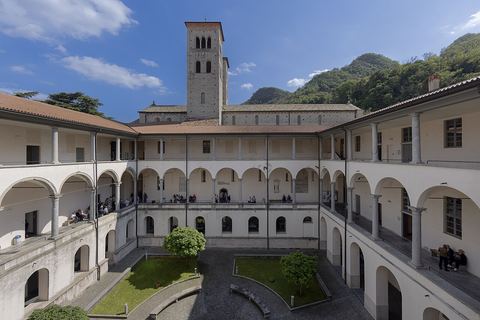
8 The cloister, from monastery to university
The sixteenth-century cloister has changed tenants many times: nuns, seminarians, cholera patients, wounded soldiers. Today it is a campus of the Università dell'Insubria.
Timeline
- 5th centuryOutside the walls, along the Via Regina, the basilica of Saints Peter and Paul is built. Bishop Abbondio is buried in it.
- 818The basilica is dedicated to Saint Abbondio, the bishop buried in it, who will become the city's patron saint.
- 1010Bishop Alberico entrusts the church to a community of Benedictine monks.
- 1050–1095The monks tear down the old basilica and build the Romanesque one. On June 3, 1095, Pope Urban II consecrates it.
- 1315–1324Under Bishop Leone Lambertenghi, the Maestro di Sant'Abbondio frescoes the choir and apse with the stories of Christ.
- 1784The north bell tower collapses onto the vault of the choir and damages part of the frescoes.
- 1863Don Serafino Balestra begins the restoration that returns the basilica to its Romanesque look and rediscovers the early Christian church.
- 1974The city of Como buys the abandoned complex. The former monastery will become a campus of the Università dell'Insubria.
Who's who
Abbondio
fourth bishop of Como, patron saint of the city
In 450 Pope Leo the Great sent him on a mission to Constantinople. He died around 468 and was buried here: the basilica bears his name.
Alberico
bishop of Como
Shortly after the year 1000 he entrusted the basilica to the Benedictine monks, who became a rich and prestigious community and rebuilt it.
Urban II
pope
He consecrated the basilica on June 3, 1095, during the journey that took him to France, where he made the appeal for the First Crusade.
Leone Lambertenghi
bishop of Como, Franciscan friar
Bishop of Como until his death in 1325, and brother of Benno, abbot of Sant'Abbondio. He is the probable patron of the frescoes in the choir and apse.
Maestro di Sant'Abbondio
anonymous painter of the early 1300s
The author of the frescoes in the choir and apse. His name is unknown: art historians call him this, the Master of Sant'Abbondio, after the church.
Serafino Balestra
priest from Como, promoter of the restoration
From 1863 he led the excavations and the restoration that removed the later additions and gave the basilica back its Romanesque look.
Words to know
Where it is
The neighborhood
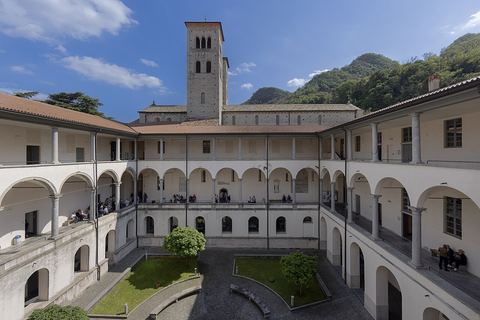
The Borghi
Related places
The story of the place
Sant'Abbondio stands where you would not expect a masterpiece today: outside the center, at the foot of the hill, between the railroad and the factories. In the Middle Ages it was the other way around. The Via Regina ran past here, the road that followed the lakeshore and led from Milan to the Alpine passes, and this church stood guard over it.
From Abbondio's tomb to the monks
The story begins in the fifth century, with a basilica dedicated to the apostles Peter and Paul, built in an area of ancient Roman tombs. Abbondio was buried there, the fourth bishop of Como and an ambassador of the pope, who in time became the city's patron saint. He is the one who gave the church its name: it has been dedicated to him since the ninth century.
The turning point comes shortly after the year 1000. Bishop Alberico hands the place over to a community of Benedictine monks, which soon grows rich and prestigious. The monks tear down the old church and raise a new, far more ambitious one, all in gray stone. In 1095 it is consecrated by a pope who happens to be passing through, Urban II.
An unusual church for Italy
That church is, in essence, what you see. And it is an unusual building for Italy: five tall, narrow aisles, a long, deep , twin bell towers flanking the . These were ideas that came from beyond the Alps, from France and the Rhine valley, along the same road that ran past the door. In the 1300s a painter whose name is lost covered the apse with the stories of Christ, and that cycle is still there, almost whole.
From the 1500s to the restoration
Then came less gentle centuries. In the 1500s the church was modernized to suit the taste of the day, with vaults and large windows. In 1784 one of the bell towers collapsed. The monastery became a convent of nuns, a seminary, a quarantine hospital, a military hospital.
From 1863 a priest from Como, Serafino Balestra, stripped away the additions and returned the basilica to its medieval look, rebuilding whatever was missing. With a heavy hand in places, scholars say today, but the result is the bare, severe church in front of you.
The visit is short and should not be rushed. First walk around the building, because its best side is the back. Then go in, walk down the aisles and head for the far end: all the color is there. If you have time for only one thing, make it the frescoes in the .
Sources
- Basilica di S. Abbondio, Lombardia Beni Culturali (opens in a new tab)Catalog
- Monastero di S. Abbondio (complesso), Lombardia Beni Culturali (opens in a new tab)Catalog
- Como, Enciclopedia dell'Arte Medievale Treccani (opens in a new tab)Encyclopedia
- Sant'Abbondio, vescovo: nota agiografica, Diocesi di Como (opens in a new tab)Institution
- Como, dai paleocristiani a Sant'Abbondio, La Nuova Bussola Quotidiana (opens in a new tab)Other source
- Basilica of St Abbundius, Monumenti Aperti (opens in a new tab)Other source
- Basilica di Sant'Abbondio, Wikipedia in italiano (opens in a new tab)Wikipedia
- Basilica of Sant'Abbondio, Wikipedia in inglese (opens in a new tab)Wikipedia
- Abbondio di Como, Wikipedia in italiano (opens in a new tab)Wikipedia
- Papa Urbano II, Wikipedia in italiano (opens in a new tab)Wikipedia
- Camillo Boito, Wikipedia in italiano (opens in a new tab)Wikipedia
- Leone Lambertenghi, Wikipedia in italiano (opens in a new tab)Wikipedia
- Angelo Maria Durini, Wikipedia in italiano (opens in a new tab)Wikipedia
- Basilica di Sant'Abbondio (Q2263559), Wikidata (opens in a new tab)Other source
- Frescos in Sant'Abbondio (Como), Wikimedia Commons (opens in a new tab)Other source
- The Basilica of Sant'Abbondio in Como, New Liturgical Movement (opens in a new tab)Other source
- The Middle Ages in Technicolor, Grand Hotel Tremezzo Gazette (opens in a new tab)Other source
- Sant'Abbondio Basilica, Como and its Lake (opens in a new tab)Other source
- I restauri di Serafino Balestra, Sant'Abbondio (1010-2010), Diocesi di Como (opens in a new tab)Institution
- Guida alla visita: l'interno, Sant'Abbondio (1010-2010), Diocesi di Como (opens in a new tab)Institution
- Sant'Abbondio, Sant'Abbondio (1010-2010), Diocesi di Como (opens in a new tab)Institution
- La basilica cinque-seicentesca, Sant'Abbondio (1010-2010), Diocesi di Como (opens in a new tab)Institution
- Il monastero, Sant'Abbondio (1010-2010), Diocesi di Como (opens in a new tab)Institution
- Serafino Balestra, Dizionario storico della Svizzera (opens in a new tab)Encyclopedia
- Tommaso Pendola, Italian Teacher of the Deaf, UCL Ear Institute and Action on Hearing Loss Libraries (opens in a new tab)Institution
- Serafino Balestra, Wikipedia in italiano (opens in a new tab)Wikipedia
- Villa del Balbianello, FAI Fondo per l'Ambiente Italiano (opens in a new tab)Institution
- Durini, Angelo Maria, Dizionario Biografico degli Italiani Treccani (opens in a new tab)Encyclopedia
- Atrio, Enciclopedia dell'Arte Medievale Treccani (opens in a new tab)Encyclopedia
- L'esperienza pionieristica dell'Istituto delle Sordomute Povere di Bologna, Studi sulla Formazione, Firenze University Press (opens in a new tab)Institution
- Il Miracolo di Sant'Abbondio, una tela del Pomarancio a Cremona e il suo restauro, Ministero della cultura (opens in a new tab)Institution