Monument · The Walled City · 1215
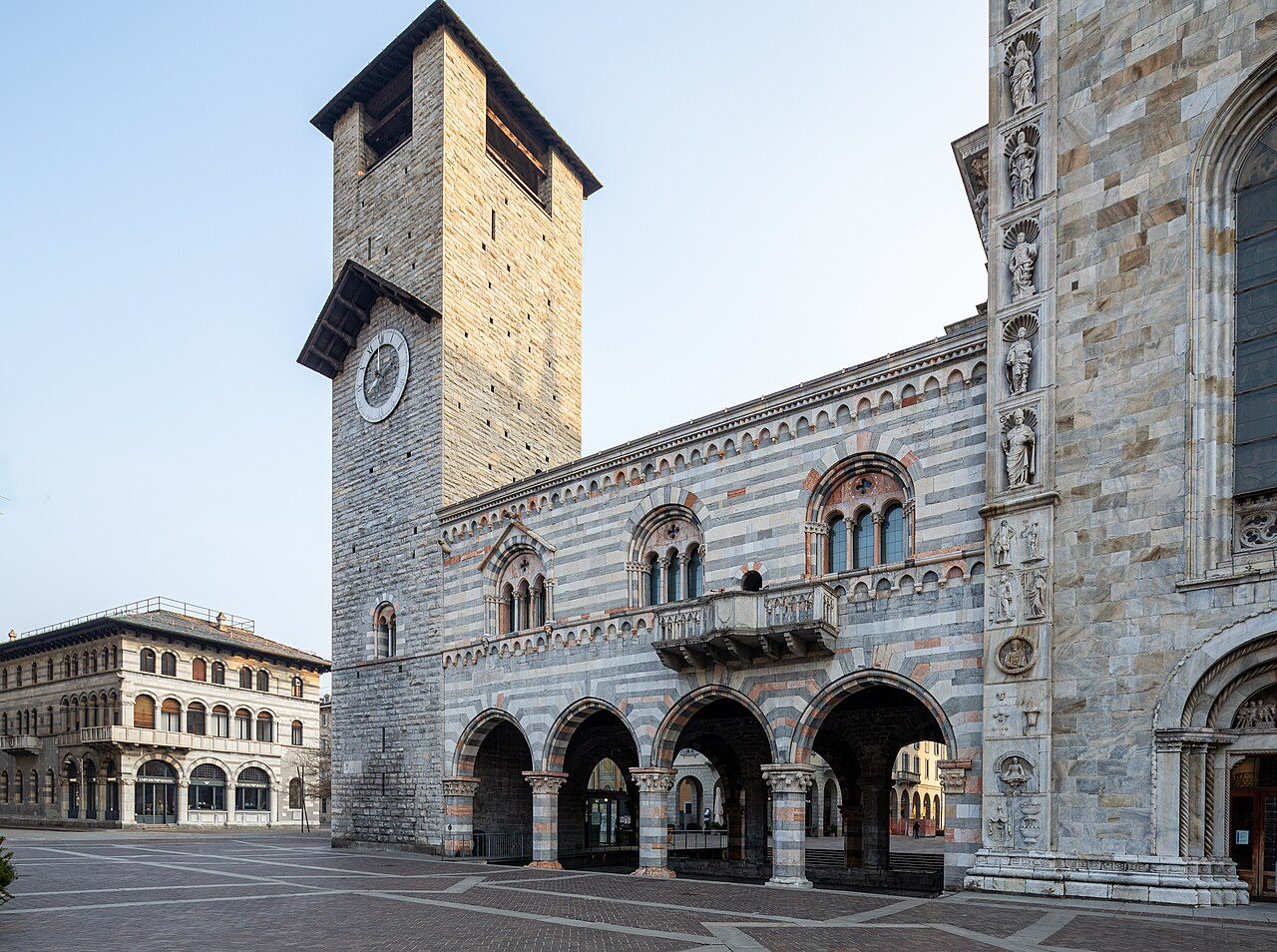
Broletto e Torre civica
The striped medieval city hall that got cut short by the Duomo
In brief
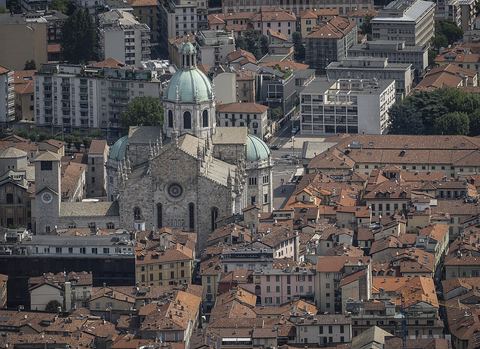
The palace of Como's medieval city government, dated 1215, with its stone tower. It is banded in white, gray and red and stuck fast to the Duomo, the cathedral: a piece of it was sliced off to make room for the church.
Stories of this place
- In culture · The striped facadeReadUp at five for the BrolettoGeorge Edmund Street, the English architect who later designed the Royal Courts of Justice in London, reached Como one evening in the mid-19th century. An Austrian band was playing in Piazza del Duomo, and he stayed to look by moonlight at the colored marble front of the Broletto, the medieval city hall. His carriage was leaving at seven: soon after five in the morning he was in the square, sketching. In the book that followed he wrote that for beauty the Broletto was scarcely inferior to any building he had seen in Italy. And the Duomo, the cathedral next door? He went in reluctantly and found it large but uninteresting.
- In culture · The striped facadeReadThe Broletto window Ruskin likedJohn Ruskin, the 19th-century English art critic, stopped in front of a window of the Broletto, Como's medieval city hall with its bands of colored stone, and drew it. The color plate that Thomas Shotter Boys made from it is the fifth in the first volume of The Stones of Venice, published in 1851. Ruskin also made a quick watercolor of it, to show how marbles are inlaid, and in 1875 he gave it to the drawing school at Oxford that bears his name. Today the sheet is at the Ashmolean Museum.
- Anecdote · The window and balcony for announcementsReadWhen the city hall became a theaterIn the 18th century the hall of the Broletto, Como's medieval city hall, where the citizens' assembly once met, changed audiences. From 1712 it housed a wooden stage for popular shows. Then, to a design by Innocenzo Colomba, it became a real theater, with some fifty boxes, ready in 1764. To fit it in, the palace was raised by one floor. The curtain went up until 1808. Then the city built itself the Teatro Sociale, opened in 1813, and the papers of the notarial archive arrived in the Broletto's hall.
- In culture · The window and balcony for announcementsReadThe Englishman who erased a floor of the BrolettoIn the mid-19th century the Broletto, Como's medieval city hall, had an extra floor, added in the 18th century to fit a theater. George Edmund Street, an English architect, could not stand it. In his book Brick and Marble in the Middle Ages he wrote that above the cornice some barbarian had added another story, nearly destroying the effect of the building. Then he did the simplest thing: in the plate that illustrates the Broletto, that floor is not there. A footnote says he sees no need to apologize for the omission. At the end of the century the restorers proved him right, and demolished it for real.
- Anecdote · The Torre civicaReadA cathedral without a bell towerThe Duomo, Como's cathedral, has no bell tower. The one belonging to the old cathedral was demolished when the church was enlarged, and the bells were moved as a temporary measure to the tower of the Broletto, the medieval city hall next door. They never left: to this day the cathedral's bells ring from the Torre civica, the civic tower. The tower built to summon the citizens' assemblies has become, without anyone ever really deciding it, the bell tower of the church next door.
- In culture · The Torre civicaReadTurner and the tower that was tallerIn 1819 William Turner, the English painter, began the lakes leg of his first journey to Italy in Como. From the northwest corner of Piazza del Duomo he drew the cathedral and the Broletto, the medieval city hall with its tower, in pencil, noting colors and proportions on the page. The scholar who cataloged his sketchbooks called it a marvel of notes taken on the fly. The drawing, now at the Tate in London, is also a document: it shows the Broletto with an extra floor and the clock tower taller than it is today.
- Anecdote · Under the porticoReadThe Broletto fire of 1408In 1408 two families, the Rusca and the Vittani, were fighting over Como. During the clashes a man from Franchino Rusca's faction, Lorenzo da Morcote, set fire to the Broletto, the city's medieval city hall. The archive with the notaries' registers was destroyed, and the building was so badly damaged that the offices were moved into rented houses. The restoration, directed by Pietro da Breggia, the architect who also ran the building site of the Duomo, the cathedral, was finished in 1436. The plainer piers in the middle of the portico date from that work. The palace returned to its public functions only in 1449.
- Anecdote · Under the porticoReadThe short-lived Repubblica di Sant'AbbondioIn the summer of 1447 Filippo Maria Visconti, Duke of Milan, died, and Como seized the chance to be free again: the Repubblica di Sant'Abbondio was born, a republic named after the city's patron saint. One of its first acts was to demolish the Visconti's fortified citadel. Its walls had swallowed a corner of the Broletto, the medieval city hall, and removing them left a mark: the arch at that corner had to be repaired, and the palace returned to its public functions only in 1449. Freedom did not last. Between 1450 and 1451 Como submitted to Francesco Sforza, the new Duke of Milan, and the republic ended there.
- Anecdote · Under the porticoReadThe city hall that looked lowerFor centuries the Broletto, Como's medieval city hall on Piazza del Duomo, looked lower than it is. The level of the square had been raised by more than a meter, according to the most common explanation because of the lake's floods, and the ground-floor portico had been filled in up to the new level, hiding the bases of the piers. The arches looked squat and squashed. Only the restorations completed in the early 1970s brought the floor of the portico back to its original level: that is why today it sits lower than the square.
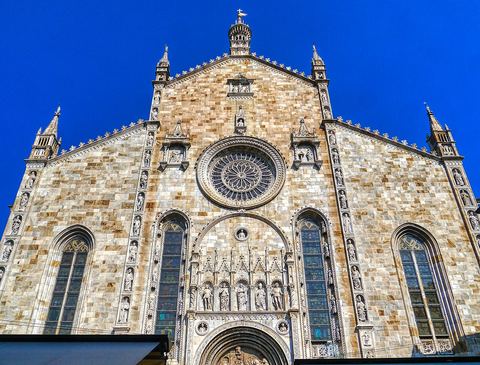
- Anecdote · Where the Broletto meets the DuomoReadThe theater that cut a Duomo window in halfIn 1764 the hall of the Broletto, Como's medieval city hall attached to the Duomo, became a theater and needed more room. One side touched the cathedral's marble-clad flank. The theater's backers asked the Duomo's administrators to let them remove that marble: it uselessly took up part of the hall, they wrote. They got it, promising to pay for any damage. A tall cathedral window was left cut in half: half outside, half shut inside, carved reliefs and all. The historian Santo Monti still saw it that way in 1897 and tells the story: how much pointless expense, he wrote, a little more common sense would have spared.
Ready-made questions
It is the diminutive of brolo, which in the Middle Ages meant a plot of farmland enclosed by a wall. The shift from meadow to palace happened in Milan, where justice was already being administered in a in the 11th century: the name stuck to the building put up next to it and from then on meant the town hall in various Lombard cities, such as Como, Monza and Brescia. In Como too, before the palace, there was a meadow where citizens gathered in assembly.
Because in the 13th century the Comune, the self-governing city, wanted its seat next to the cathedral, and because the cathedral then grew. The was built beside the old Santa Maria Maggiore. When, from the end of the 14th century, the church was rebuilt much larger, the new left aisle needed the space the palace occupied: in the 15th century the Broletto was shortened on its south side and lost its outdoor staircase. The facade of the Duomo was then aligned with that of the city hall.
Go to stop: Where the Broletto meets the DuomoBecause these are different stones, laid in horizontal bands: white, gray and red. The white is Musso marble, the same used later for the facade of the Duomo. The gray is Moltrasio limestone. These are materials from the quarries on the lake. The striped effect gives richness to a building with simple forms and sets it apart from the tower, which is all bare stone worked in .
Go to stop: The striped facadeBecause the floor of the portico is the 13th-century one, while the square was raised in the centuries that followed. The most common explanation points to the lake's floods, which pushed the people of Como to raise the level of the streets. The portico was filled in up to the new level and the bases of the piers vanished underground. The 20th-century restorations, completed in the early 1970s, brought the original level back to light.
Go to stop: Under the porticoOnly in part. The tower was most likely built together with the palace, in the early 13th century, to carry the bell that summoned the assemblies. In 1910 the upper part was taken down because it was judged unsafe, and it was rebuilt between 1926 and 1927. The heritage records of the Lombardy Region warn that nobody knows whether the present height matches the original. A drawing by Turner from 1819 shows a tower taller than today's.
Go to stop: The Torre civicaIn the 14th century the walls of the hall were painted. In 1897 the city commissioned the restorer Giuseppe Steffanoni, from Bergamo, to detach the surviving fragments: a Madonna enthroned with the Child, a young man facing Death and a frieze of coats of arms. Scholars date them to the first decades of the 14th century and attribute them to a painter known as the First Master of Santa Margherita. They belong to Como's civic collections: the national catalog lists them at the Pinacoteca di Palazzo Volpi, the city's picture gallery.
Go to stop: The window and balcony for announcementsYes: the has two facades. The rear one repeats the layout of the one on the square, with four wider arches and, above, four instead of three. The last arch on the right is round, that is, semicircular, and was probably rebuilt in the 15th century. Among the windows, the second from the right is the most elaborate: at its center are four colonnettes knotted together, a showpiece by the medieval stonecutters.
Go to stop: Under the porticoThe stops
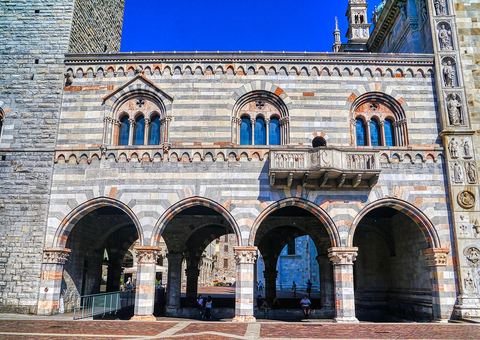
1 The striped facade
Como's medieval city hall: a portico below, a great hall above and three colors of stone laid in bands. A plaque dates it to 1215, but the arches and windows tell a slightly longer story.
2 The window and balcony for announcements
The second floor was the voice of the city government: from a window with a little roof, then from a balcony, it spoke to the square. Behind it lies the assembly hall, which became a theater in the 18th century.
3 The Torre civica
The city's tower: rough stone, a clock, bells at the top. It called citizens to assembly and today it rings for the Duomo, the cathedral, which has no bell tower of its own. The upper part was rebuilt in the 20th century.
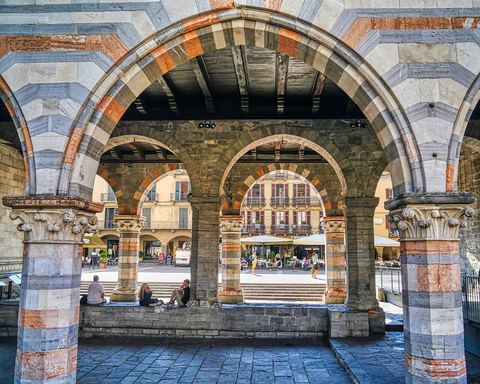
4 Under the portico
The ground floor was a covered square. The floor is lower than today's piazza, because the city around it was raised. The piers in the middle are plainer: they were rebuilt after the fire of 1408.
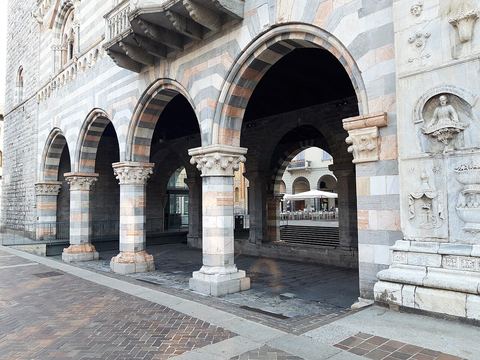
5 Where the Broletto meets the Duomo
The Broletto is joined to the Duomo because the Duomo grew into it. In the 15th century, to make room for the aisle of the new cathedral, the city hall lost its southern end and its grand staircase.
Timeline
- 1205The Comune buys the assembly meadow from the Church, next to the cathedral, to build its own seat there.
- 1215A plaque records the completion of the palace, commissioned by the podestà Bonardo da Codazzo.
- 1335Como passes to the Visconti of Milan. Their citadel swallows a corner of the Broletto, which begins to lose importance.
- 1408During the feuds between the Rusca and the Vittani the palace is set on fire. The restoration will end in 1436.
- 15th centuryThe building site of the new Duomo forces the cutting of the Broletto's southern end and the demolition of the outdoor staircase.
- 1764The hall, raised by one floor, becomes a theater. It will stay in use until 1808.
- Late 19th centuryA restoration removes the floor added in the 18th century and reopens the medieval three-light windows.
- 1926–1927The upper part of the tower, taken down in 1910 because it was unsafe, is rebuilt.
Who's who
Bonardo da Codazzo
podestà of Como
The magistrate who, according to the plaque on the facade, had the palace completed in 1215. In the sources his name also appears as Bernardo da Codazo.
Azzone Visconti
lord of Milan
In 1335, with Como subject to Milan, he had the fortified citadel built, which swallowed a corner of the Broletto.
Pietro da Breggia
architect
He directed the restoration of the Broletto after the fire of 1408, completed in 1436. In those years he was also the architect of the Duomo's building site.
Innocenzo Colomba
designer of the theater
A native of Arogno, he signed the design that from 1763 turned the assembly hall into a theater, with an extra floor above the three-light windows.
John Ruskin
English art critic
He drew a window of the Broletto, published in 1851 among the plates of The Stones of Venice, and painted it in watercolor for the drawing school at Oxford.
William Turner
English painter
In 1819 he drew the Duomo and the Broletto in pencil from the square. The sheet, now at the Tate, shows the palace with an extra floor and a taller tower.
Words to know
Where it is
The neighborhood
The Walled City
Related places
The story of the place
Two buildings matter on this square, and they touch. One is the Duomo, Como's cathedral. The other, the striped one with the stone tower beside it, is the : for centuries it was Como's city hall.
From meadow to palace
The name comes from brolo, a walled plot of land. Here, next to the old cathedral of Santa Maria Maggiore, there was a meadow where citizens were already gathering in assembly in the 11th century. In 1205 the Comune, the self-governing city, bought that land from the Church to build its own seat.
A plaque on the facade records that the palace was completed in 1215, when Bonardo da Codazzo was , the city's chief magistrate. The layout is that of every in Lombardy: an open portico below, a single great hall above.
Inside, assemblies were held, justice was handed down, the Società dei Mercanti, the merchants' guild, met, and the archives were kept. The tower next door carried the bell that called everyone together.
Decline and the cut
The golden age lasted little more than a century. In 1335 Como fell to the Visconti, lords of Milan, and the palace of the Comune counted for less and less. In 1408 it was set on fire during the feuds between two rival families, the Rusca and the Vittani.
Then came the building site of the new Duomo, rising right alongside. Over the course of the 15th century, to make room for it, the had its southern end cut off, grand staircase included. That is why the two buildings are joined today, and why the tower of the Comune serves as the cathedral's bell tower.
Theater, archive, restoration
What followed was a string of fallback jobs. In the 18th century the hall became a theater, with an extra floor built for the purpose. In the 19th it was a notarial archive.
At the end of that century a restoration removed the added floor and reopened the medieval windows. In the 1920s the upper part of the tower, taken down because it was unsafe, was rebuilt.
The visit is short: half an hour is enough. But it is rare to see the civic and religious powers of the Middle Ages still shoulder to shoulder, on the same line. And if you look closely, you can tell which of the two won.
Sources
- Palazzo del Broletto, complesso. Lombardia Beni Culturali (opens in a new tab)Catalog
- Torre del Broletto. Lombardia Beni Culturali (opens in a new tab)Catalog
- Como, Enciclopedia dell'Arte Medievale Treccani (opens in a new tab)Encyclopedia
- Broletto, Vocabolario Treccani (opens in a new tab)Encyclopedia
- Duomo di Como, FAI Fondo per l'Ambiente Italiano (opens in a new tab)Institution
- Madonna in trono con Bambino dal palazzo del Broletto, Catalogo generale dei beni culturali (opens in a new tab)Catalog
- J. M. W. Turner, The Duomo and the Broletto, Como, 1819. Tate (opens in a new tab)Institution
- John Ruskin, A Window of the Broletto, Como. Ashmolean Museum (opens in a new tab)Institution
- Broletto of Como, tavola da The Stones of Venice. Royal Society (opens in a new tab)Institution
- The Stones of Venice, volume I, indice delle illustrazioni. Ruskin Library, Lancaster University (opens in a new tab)Institution
- Broletto, Italia.it (opens in a new tab)Institution
- George Edmund Street, Brick and Marble in the Middle Ages, seconda edizione, Londra 1874, Project Gutenberg (opens in a new tab)Other source
- Santo Monti, La cattedrale di Como, Como 1897, Internet Archive (opens in a new tab)Other source
- Como, Enciclopedia Italiana Treccani (opens in a new tab)Encyclopedia
- Cittadella Viscontea, Como. Lombardia Beni Culturali (opens in a new tab)Catalog
- George Edmund Street, The Victorian Web (opens in a new tab)Other source
- Broletto di Como, Wikipedia in italiano (opens in a new tab)Wikipedia
- Duomo di Como, Wikipedia in italiano (opens in a new tab)Wikipedia
- Broletto (Como), Wikipedia in tedesco (opens in a new tab)Wikipedia
- Broletto, Wikipedia in inglese (opens in a new tab)Wikipedia
- Teatro Sociale (Como), Wikipedia in italiano (opens in a new tab)Wikipedia
- Repubblica di Sant'Abbondio, Wikipedia in italiano (opens in a new tab)Wikipedia
- Storia di Como, Wikipedia in italiano (opens in a new tab)Wikipedia
- George Edmund Street, Wikipedia in inglese (opens in a new tab)Wikipedia