Stop 4 of 7
The Nave and the Tapestries
Where to stand
Just inside, at the start of the nave, with the main portal behind you and your eyes toward the altar
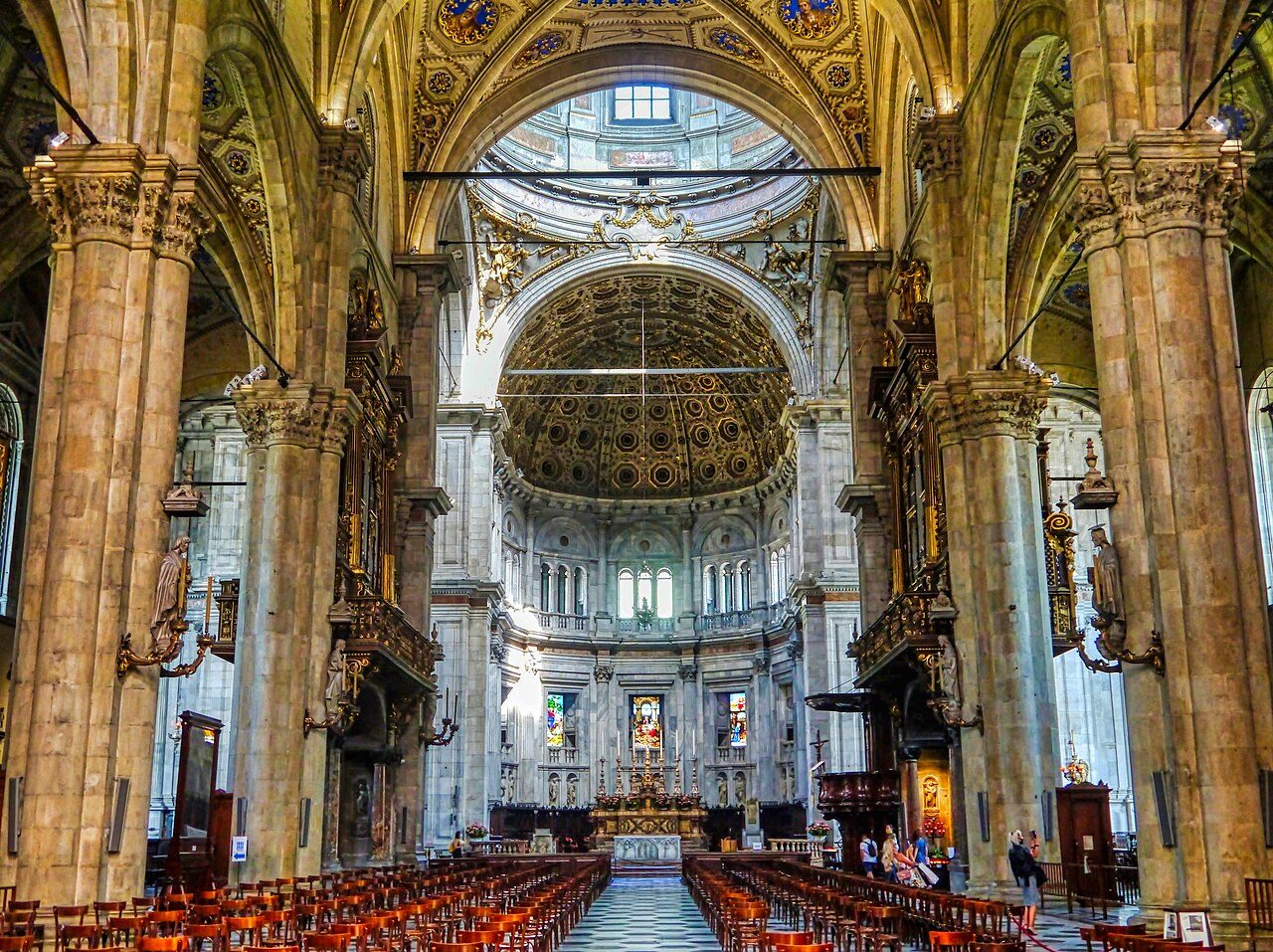
Inside, the Duomo is Gothic but wide and calm, the Lombard way. Between the piers hang woven in the 1500s and 1600s in Florence, Ferrara and Brussels, given in large part by the city's guilds and confraternities.
Spot the detail
Near the main portal, find the two holy water stoups and look at what holds them up
The full story
Stop here and let your eyes adjust. Outside you had a facade that points upward; inside, the space spreads out. This is Gothic the way Lombardy liked it: pointed arches and ribbed vaults, yes, but broad bays, without the upward thrust you would expect.
A nave and two aisles, two rows of piers, and at the far end a different light, brighter, coming down from the dome. Keep it in mind: you will get there.
You will also notice that there is not much light. You are not imagining it. The high windows of the nave were designed without a real opening to the outside, because they are covered by the roofs of the side aisles. The Gothic Duomo was born in half-light, and the dark stained glass of the 1800s did not help.
The tapestries between the piers
Now look between the piers. Those large scenes hanging from one arch to the next are not paintings: they are of wool and silk, woven in the 1500s and 1600s. The Duomo's collection is special because it brings together pieces from the best Italian workshops of the time, such as Florence and Ferrara, and from Brussels, then the most renowned center in Europe. They tell stories of the Virgin Mary and episodes from the Bible.
The best part is who gave them. Not a prince: working people. Some come from the Consorzio dei Battilana, the guild of the wool beaters, others from the Merciai, the haberdashers, others again from a confraternity of the cathedral. It is the same story as the whole Duomo: in Como the cathedral was wanted and largely paid for by the merchants, and they were keen to leave their mark.
One of the shows the passing of the Virgin, meaning her death, woven in Ferrara shortly after the middle of the 1500s. The preparatory design is attributed, with a probably attached, to Giuseppe Arcimboldi. Yes, him: the Milanese painter who became famous for heads made up of fruit and vegetables. Before the oddities, he worked for cathedrals.
Alessandro Volta's spot
Before you move on, a thought for one distinguished churchgoer. Alessandro Volta, the inventor of the battery, was from Como, and as an old man he came to Mass in the Duomo every day. A plaque in the floor, laid in 1999 for the two hundredth anniversary of the battery, marks the spot where he used to stand.
About this stop
Anecdote
A fish for the organ builder
In the mid-1600s the Duomo di Como's old organ was forever being repaired. So the men in charge of the works called from Trento Guglielmo Hermans, a Jesuit from the Low Countries and famous organ builder, who built a new one in eighteen months. It was first played on March 25, 1650, the feast of the Annunciation, and everyone liked it. To thank him, the historian Santo Monti wrote in the late 1800s, they sent him a gift fit for a lake city: a very large fish. We even know what it cost: just over nine lire. That organ was later rebuilt several times: today's dates from the 1900s.
It is a birth defect. The high windows of the nave were designed without a real source of light, because on the outside they are covered by the roofs of the side aisles. In the 1800s painted stained glass in dark tones was added, which took away still more light. Only in recent times have skylights been opened. The exception is the area under the dome, where the light comes down full, as the architect intended: that is why, as you move toward the altar, the church seems to light up.
Next stop
Walk down the right aisle toward the transept, as far as the large gilded wooden altar