Stop 1 of 7Must-see
The Facade
Where to stand
In Piazza del Duomo, far enough back from the central portal to take in the whole facade, right up to the tip
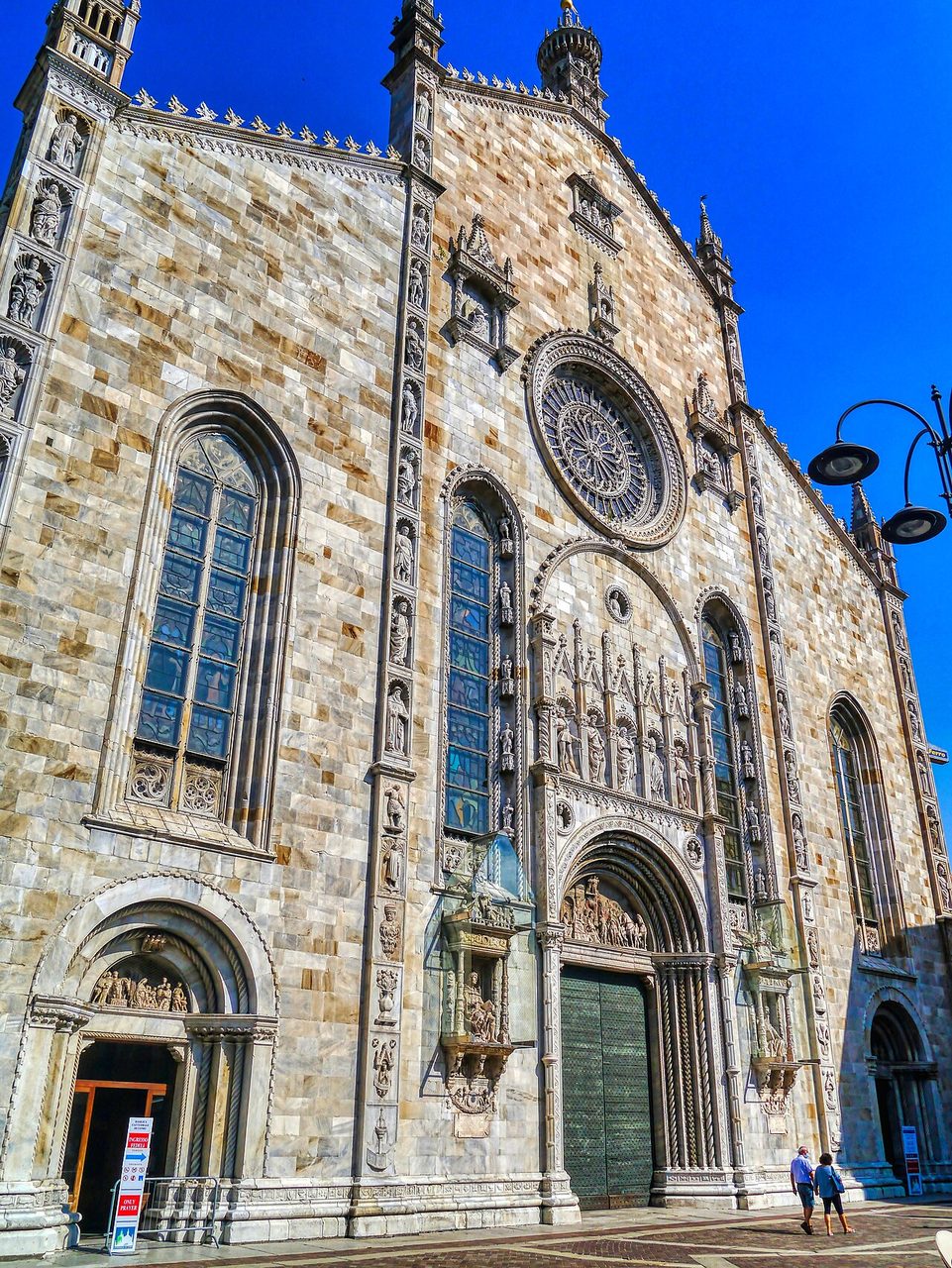
Pale marble, a , spires: this is the most Gothic part of the Duomo, built in the second half of the 1400s. It is also a page meant to be read from the bottom up, from humankind to God.
Spot the detail
In the lowest band, among the reliefs, find an inscription in Italian in the middle of the Latin ones
The full story
Take a few steps back, until you can see all of it. The facade of the Duomo, Como's cathedral, is tall and pale, and it narrows as it rises.
Four divide it into three parts and end in spires. In the middle is a large , at the top a slender point. The stone is Musso marble, light gray: it was quarried up the lake and reached Como by boat, every week.
Look to the left. The facade is attached to the Broletto, the old town hall. They were not peaceful neighbors: to make room for the new cathedral a piece of the Broletto was torn down, and you can still see the cut on the side of the building. In Como the church helped itself to a slice of city hall.
Reading it from the ground up
The facade was built in the second half of the 1400s. But the interesting thing is not the date: it is how you read it. Start from the central portal and let your eyes climb.
Above the door, in two roundels, are Adam and Eve: humanity. A little higher, in five pointed niches, the Virgin Mary among four saints dear to the city, including Abbondio, its patron. Then a youth inside a circle, who stands for the Holy Spirit. Then the .
And at the top God the Father and the risen Christ. From bottom to top, from earth to heaven: the facade is a diagram, and you are on the ground floor.
Now look at the above the central portal. You would expect the birth of Jesus, and instead the place of honor goes to the Magi.
They were deeply venerated in Como. The story went that Frederick Barbarossa, the emperor, carrying their relics from Milan to Cologne, stopped right here, in a city that was his ally. It is a tradition, not a proven fact, but it explains the choice.
The phrases carved down low
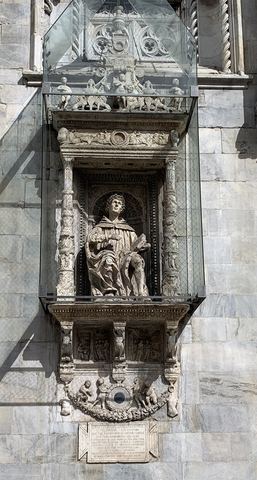
Down low, though, the facade speaks straight to the passerby. Among leaves, fruit and figures are short carved phrases, almost like signs: “Venite adoremus,” “Pax vobis,” “Timete Deum.” And at the base of a , to the right of the central portal, comes the most practical request of all, next to a relief of a church with its bell tower: do good to this holy work. In other words: leave a donation for the building site.
The facade straightened in the 1900s
One last thing you cannot see, and it is better that way. In the 1900s the upper part of the facade was leaning forward, over the square, to a worrying degree. It was taken apart and put back together piece by piece, plumb straight. What you are looking at is the facade of the 1400s, only straightened.
About this stop
Anecdote
Portrait of a power broker who lost his head
On the facade of the Duomo di Como, among the reliefs on the in the lower part, one portrait is not of a saint. It is Cicco Simonetta, secretary to the Sforza dukes and for some years the man who in practice ruled Milan. A recent study dates the portrait to about 1470 to 1475, when Simonetta was at the height of his power and came to visit Como. It did not last. Ludovico il Moro, the future duke, had him arrested and then tried by his enemies: on October 30, 1480, Simonetta was beheaded in the castle of Pavia. The portrait, though, is still in its place.
Record
A bell weighing almost two metric tons
The Duomo di Como has no bell tower of its own: the cathedral's bells hang in the civic tower, the one next to the Broletto, the old town hall. With them is the civic bell, cast in Como in 1448 by the bell founder Guillaume de Clermont. It weighs almost two metric tons and is one of the largest historic bells in Lombardy still in use. All five ring together only on exceptional occasions, such as the eve of the Assumption, the feast the cathedral is dedicated to.
Because it borrows one. The old cathedral of Santa Maria Maggiore had a bell tower, but it was demolished to make room for the new, larger building. The bells were placed in the civic tower, the one that flanks the Broletto, the medieval town hall attached to the facade. Ever since, the city's tower has doubled as the cathedral's bell tower. It is one more sign of how closely, in Como, civic power and the Church grew up side by side.
Because in Como the Magi were the object of a special devotion. It was believed that the emperor Frederick Barbarossa, when he had their relics carried from Milan to Cologne, stopped for some time in the city, which was his ally. It is a tradition and not a documented fact, but it was enough to give the three kings the place of honor: the of the main portal holds their Adoration, while the birth of Jesus is on a side portal of the facade.
Next stop
Walk up to the central portal and look at the two statues in the aedicules on either side