Stop 7 of 7Must-see
The auditorium and the opening nights
Where to stand
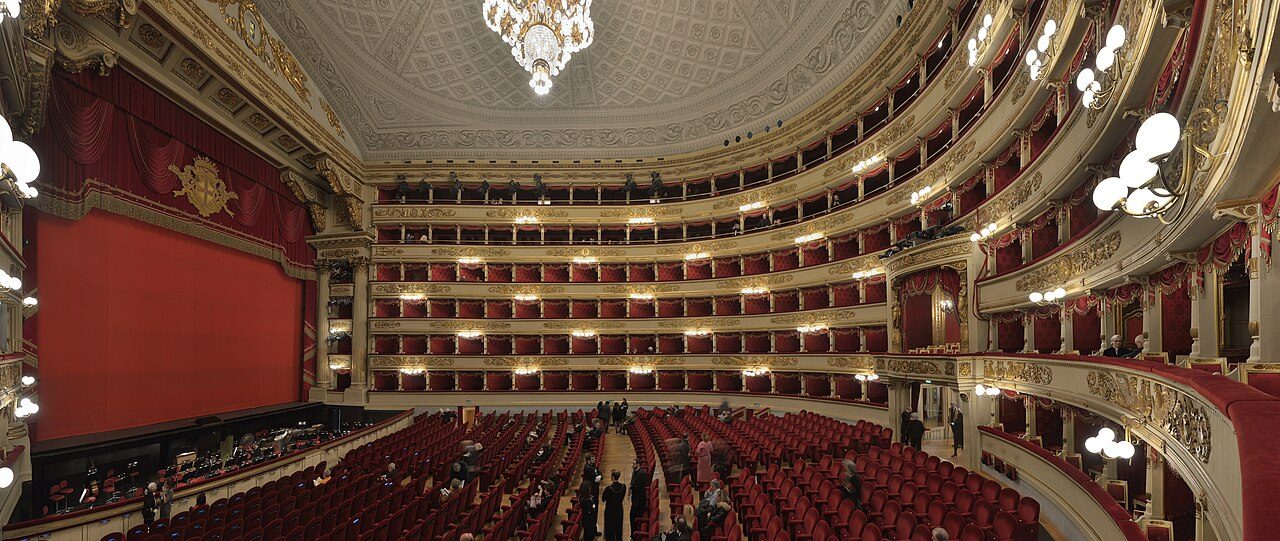
Looking out from one of the boxes on the museum route. If there is a rehearsal the boxes stay closed: read on anyway
A red and gold horseshoe, with four tiers of and two galleries. The people sitting down below are not in charge here: the is, the gallery at the very top, which applauds and boos without fear or favor.
Spot the detail
Above the proscenium, in the center, is a clock held up by two female figures. How does it show the hours, and how the minutes?
The full story
Here it is. After all that stern facade, the auditorium hits you all at once: red, gold, ivory, and that horseshoe curve that seems to wrap its arms around the stage. Give your eyes half a minute, then start reading.
How the auditorium is laid out
Down below is the . Around it rise four tiers of , one above the other, and higher still, two galleries. The top one is the . At the center of the curve is the royal box.
The parapets are ivory-lacquered wood, with gilded papier-mâché decoration. Much of what you see was remade after the bombs of World War II. The great chandelier dates from then too: it is a faithful copy of the one destroyed in the bombing.
The horseshoe is the typical shape of Italian theaters of the 1700s, and it has a logic of its own. From the you can see the stage, but you also get a very good view of whoever is sitting in the boxes opposite. This was a theater where you went to watch and to be watched. And yet the sound is wonderful: a twentieth-century acoustics study rated La Scala's acoustics excellent, on a par with the Vienna opera house.
The fiascos and the loggione
Now look up at the top gallery. That is where the sit, the enthusiasts famous for their intense and often merciless verdicts.
In this hall, fiascos have a distinguished history. The premiere of Vincenzo Bellini's Norma was one. In the early 1900s the premiere of Giacomo Puccini's Madama Butterfly was a resounding fiasco.
And in 2006 the tenor Roberto Alagna, heckled during Aida, walked off the stage in the middle of a scene. His understudy had to rush on and sing in his place.
Not even Giuseppe Verdi always had it easy. After the bad feeling that arose around his Giovanna d'Arco, for more than twenty years he gave no premiere to this stage. Then he came back, and gave La Scala the premieres of Otello and Falstaff, the masterpieces of his old age.
Opening night on December 7
The most famous ritual is opening night on December 7, the feast of Saint Ambrose, patron saint of Milan. The season has opened that evening since 1951, at the wish of the conductor Victor De Sabata. On that very December 7, in I vespri siciliani, Maria Callas had her first Milan triumph.
Empty, the auditorium can look like a museum. It is not. Soon the lights will go down again, and up at the top someone will decide whether to applaud.
About this stop
Anecdote
The night Toscanini stopped
On April 25, 1926, La Scala staged the opera Turandot for the first time. Its composer, Giacomo Puccini, had died more than a year earlier without finishing it. The conductor was Arturo Toscanini. Halfway through the third act, after the death of the slave girl Liù, Toscanini stopped the orchestra, laid down his baton, and turned to the audience. He said the opera ended there, because at that point the maestro had died. The exact words change from one reporter to the next; the gesture does not. The curtain came down. For one night La Scala heard only Puccini's notes, up to the last page he had completed.
Anecdote
The tenor who walked off La Scala's stage
La Scala's , the top gallery, forgives no one. In 2006, during a performance of Verdi's Aida, the tenor Roberto Alagna was heckled by the audience. Instead of carrying on, he walked off the stage. The show did not stop: his understudy, Antonello Palombi, had to come on with the scene already under way and continue in his place. It is the episode most often cited when people talk about the loggionisti, the regulars up there, famous for the severity of their verdicts.
From the Museo Teatrale, the theater's museum, housed in the small building next to the theater. The museum route passes through the of the and lets you look out over the auditorium from some of the third-tier boxes. There is one condition: the view is available only when there are no rehearsals, performances, or other events in the hall. If you find the boxes closed, the last stop of this visit will describe the auditorium for you.
Because it is the feast of Saint Ambrose, the patron saint of Milan. The December 7 opening night was introduced in 1940 and became a fixed rule from 1951, at the wish of the conductor Victor De Sabata. On that very evening in 1951 Maria Callas had her first great success here. Since then, opening night at La Scala has been one of the most eagerly awaited events of the year in Milan.
They are the audience of the , the highest gallery in the auditorium. They are enthusiasts who follow opera with great expertise and are famous for the severity of their verdicts: they applaud with enthusiasm, but they boo even the most celebrated names without fear. In 2006 their heckling drove the tenor Roberto Alagna to walk off the stage during Aida. For a singer, winning over the loggione at La Scala is a kind of final exam.