Stop 1 of 7
Piazza della Scala
Where to stand
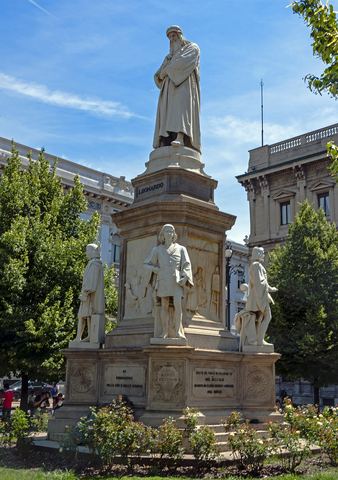
In the middle of the square, near the monument, turning slowly on the spot
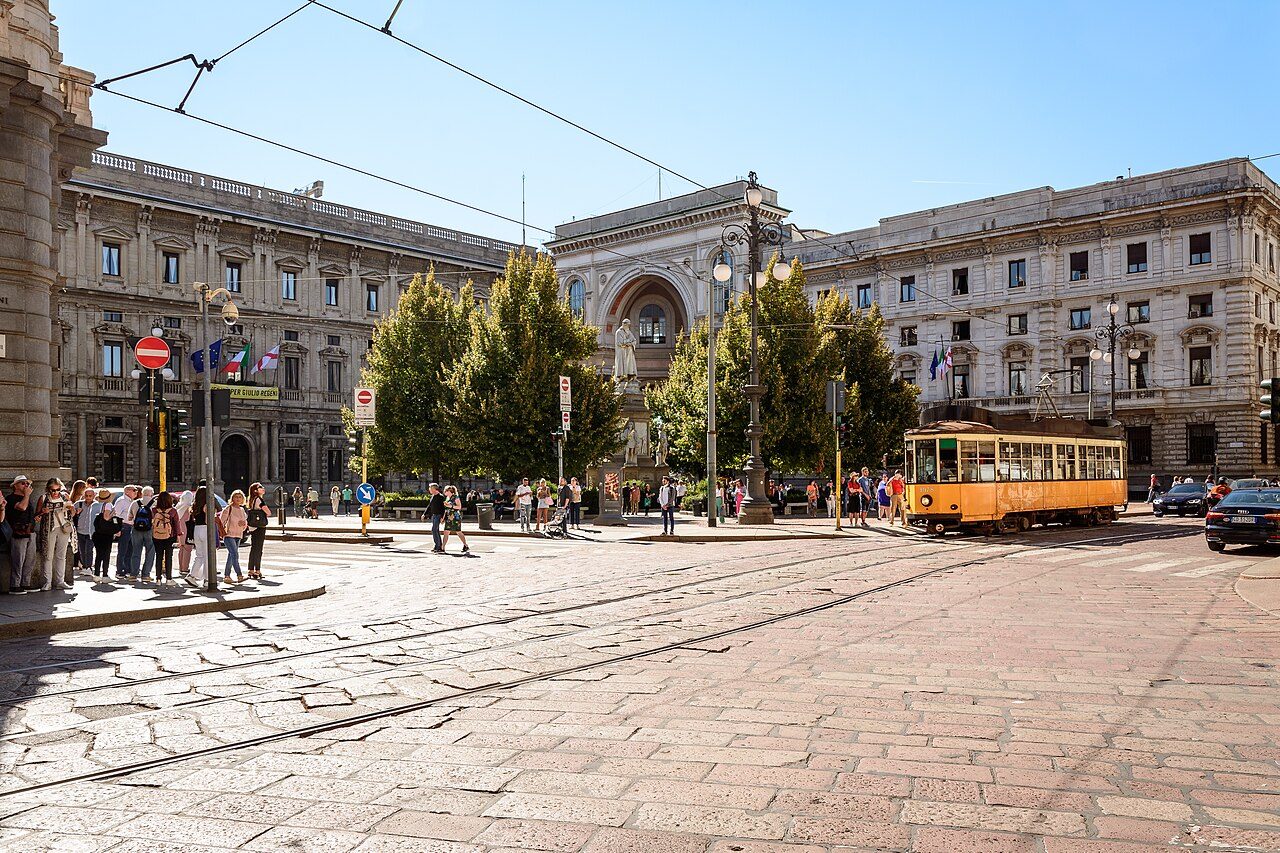
It looks like the theater's natural forecourt, but the square is eighty years younger: it was opened in 1858 by tearing down the houses that stood in front of La Scala. Around you, each side tells of a different era of Milan.
Spot the detail
Compare the theater with Palazzo Marino, the city hall facing it. Which of the two facades is older?
The full story
Turn all the way around. A theater, a city hall, a glass arcade, a bank building: it looks like a square drawn up on paper, all at once. In fact it was made by subtraction, and late.
First, a narrow street
When La Scala opened in 1778, there was no square here. There was a narrow street, the Contrada della Scala, and a row of houses in front of the theater. Anyone arriving saw the facade only from close up, a few steps away. It stayed that way for eighty years.
Then, in 1858, the buildings opposite were torn down, including the one that housed the historic Caffè Martini. The theater suddenly found itself with a stage of its own: the space you are standing in now.
The buildings around the square
The rest arrived one piece at a time. The oldest of the group is Palazzo Marino, across the square from the theater. The architect Galeazzo Alessi designed it in the 1500s, and since 1861 it has been Milan's city hall. Next comes the arch of the Galleria Vittorio Emanuele II, the covered street of iron and glass that leads straight to Piazza del Duomo, the cathedral square.
The last two buildings date from the early 1900s and carry the same signature: Luca Beltrami, the architect who gave this space the look you see. His is the large building put up for the Banca Commerciale Italiana, and his is the one that bears his name. He even took care of the square's lighting and street furniture.
Here is the secret of the place. It looks old and all of a piece, but it is largely a stage set assembled in the 1800s and 1900s around a theater from the 1700s. Milan wanted a drawing room worthy of its opera, and built itself one, a building at a time.
Finally, look to the left of the theater. The small building with the portico is the Casino Ricordi, and inside it is the Museo Teatrale, the theater's museum. You will get there at the end.
A square made for looking at a theater: keep that in mind, because the facade you are about to study was never meant to be seen from here.
About this stop
Legend
The curse of Palazzo Marino
Palazzo Marino, Milan's city hall facing La Scala, began as the home of Tommaso Marino, a 1500s Genoese banker, hugely rich and disliked by the Milanese. According to legend, an enemy cursed him: that palace, the fruit of his plunder, would end in ruin. It nearly did. Marino died in 1572 drowning in debt; the palace, left unfinished, passed to the state. The side facing Piazza della Scala waited three centuries for its facade. Tradition adds another shadow: his granddaughter Marianna de Leyva is said to have been born here, the nun who inspired the Nun of Monza in the writer Alessandro Manzoni's novel I promessi sposi, The Betrothed.
This stop on the map
Next stop
Walk up to the monument in the middle of the square