Stop 4 of 8
The basilica under your feet
Where to stand
Along the central nave, with your eyes on the floor
In the floor, a band of dark marble traces the plan of an older church: the basilica of the Apostles, from the fifth century, found during the excavations of the 1800s.
Spot the detail
Find the band of dark marble in the floor that follows neither the piers nor the aisles
The full story
You are walking on top of another church. Look down: a band of dark marble runs through the floor and has nothing to do with the layout of the aisles. It is the outline of a vanished building, marked there so that no one would forget it.
The discovery under the floor
It was found by Don Serafino Balestra, the priest from Como who led the restoration of the basilica from 1863. Digging under the floor, his workers came upon the walls of an older building. It was the church the monks had torn down eight centuries earlier to make room for their own: the basilica of the Apostles, dedicated to Peter and Paul.
It was a church in the shape of a Latin cross, with a single nave and a semicircular . Along its sides it had two long rooms for the catechumens, the adults preparing for baptism, and in front a porch. Where the marble in the floor turns from dark to light, that is where the old openings were. The restorers of the 1800s dated those foundations to between the end of the fourth century and the first half of the fifth.
A founder still debated
Scholars do not agree on who founded it. For some it was Felice, the first bishop of Como, at the end of the fourth century. For others it was Amanzio, the third bishop, in the first half of the fifth. According to tradition, Amanzio had brought some relics of Saints Peter and Paul from Rome, and built the basilica to house them.
The site was not chosen at random. Here, outside the walls and along the road, the Roman cemeteries already stood. The first Christians of Como buried their bishops here, Abbondio among them. It was his tomb that changed the name of the church.
For a long time people said this was the first cathedral of Como. There is no proof, and scholars remain divided. But one thing is certain: the Christian history of the city runs through this spot, under your shoes.
About this stop
Anecdote
The restorer who taught the deaf
Don Serafino Balestra, the priest who restored the basilica of Sant'Abbondio from 1863, was a seminary teacher: he taught literature, then physics and mechanics, and studied archaeology and inscriptions. But today he is remembered mostly for something else. From 1865 he devoted himself to teaching deaf-mutes, as people said then, and became one of the keenest champions of the oral method: teaching speech and lip-reading, setting signs aside. He also worked for years in France, which gave him the Legion of Honor. In 1885 he was called to run a school for the deaf in Buenos Aires. He died there the next year, far away from his Sant'Abbondio.
Legend
The relics brought from Rome
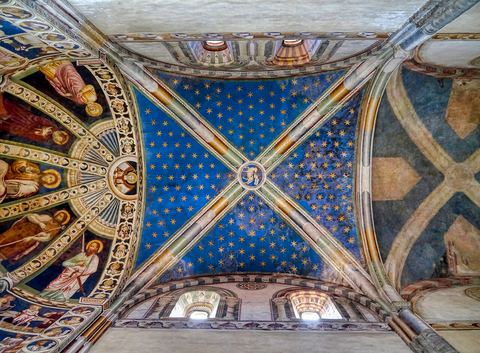
The floor of the basilica of Sant'Abbondio marks the outline of an older, fifth-century church dedicated to the apostles Peter and Paul. According to a tradition recorded in the 1500s by Como's historians, it rose to guard a treasure. Amanzio, the third bishop of Como, is said to have returned from Rome with relics of Saints Peter and Paul, and to have built a church for them outside the walls, along the Via Regina. It is a story, not a document: other scholars credit Felice, the first bishop. But it helps explain why the two apostles still appear, nine centuries later, in the frescoes covering the .
People said so for a long time, starting with the Como scholar Benedetto Giovio in the 1500s: the church of the Apostles was supposedly the bishop's seat until shortly after the year 1000, when the see was moved inside the walls. Several texts still repeat it. But the excavations turned up no proof, and scholars remain divided. What is certain is that it was the church where the first bishops of Como were buried, and that was enough to make it a place of great prestige.
Next stop
Carry on to the end of the nave and stop where the choir begins, under the great arch