Stop 5 of 8Must-see
The nuns' sky
Where to stand
In the nuns' hall, just past the dividing wall: turn toward the wall and look under the arch that leans against it
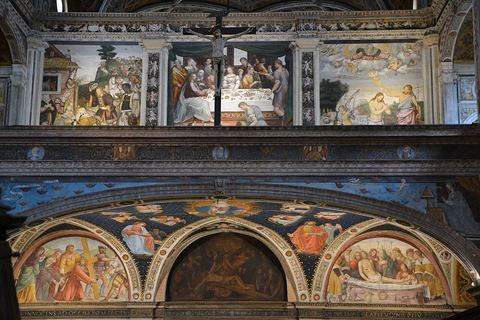
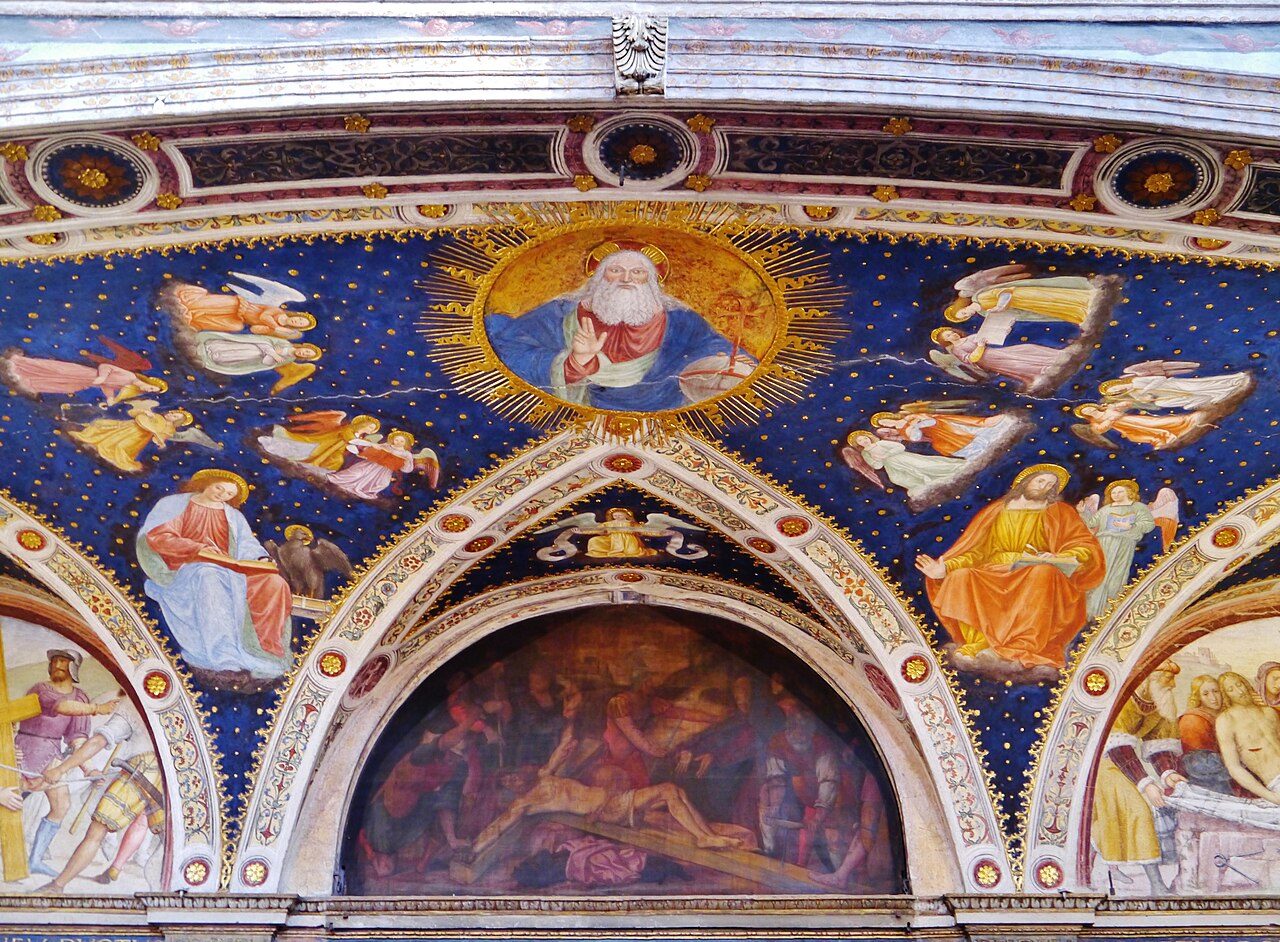
You are in the hidden half of the church. Built against the wall is an arched bridge, the , and under the bridge is the oldest painting in San Maurizio: a blue night full of golden stars.
Spot the detail
A row of small red roundels runs along the edges of the starry sky. How many can you count?
The full story
You have just done something that was impossible for three centuries: you have crossed over. This is the nuns' church, and the first glance tells you who mattered most: it is longer than the other, and painted with just as much care.
Turn toward the wall you came from. Leaning against it is a structure on a low arch, a , a kind of bridge that covers the first part of the hall. From this side the nuns sang during the Mass that a priest was celebrating on the other. The people in church, over there, heard women's voices and saw no one.
The sky under the arch
Now look under the arch. The vault is a night sky, blue, dotted with golden stars. At the center, in a roundel ringed with rays, God the Father gives his blessing. Around him are pairs of angels and the four evangelists.
It is the oldest piece of the whole decoration, painted when the church had only just been finished, and the style confirms it: gentle figures, still fifteenth-century in feel, in a Milan where Leonardo had already changed the rules. The painter's name has not come down to us. Scholars have thought of the workshop of Vincenzo Foppa, then that of Bergognone, two Lombard masters of the previous generation.
In all likelihood it was the nuns themselves who ordered it. Think about it: women who had promised never to go out again had a sky painted for themselves, before anything else.
The choir and the loggia
Then step back a few paces and take in the whole hall. There is the great wooden choir, with the stalls where the community sat to pray. Above the chapels runs a loggia, an upper gallery, and between its arches women's faces look out from painted roundels.
They are saints. Some have features so precise that scholars suspect portraits: perhaps the nuns of the day, who found themselves as saints on the walls of their own home.
Everything in here was designed for the people who spent their lives in it. For the nuns this was not a place to visit. It was the whole world, sky included.
About this stop
They are saints: women's faces painted inside mock medallions along the loggia, the gallery that runs above the chapels. Putting a name to each is hard, because not all of them carry a distinguishing attribute. The painter is unknown; in the past the name of Boltraffio, a pupil of Leonardo, was suggested. The curious thing is that some faces are so individual they suggest real portraits. The scholars' hypothesis is that, at least in some cases, the faces were lent by the nuns who lived here in the early 1500s.
Next stop
Stay where you are and lower your eyes to the scenes painted on the dividing wall and the walls beside it