Stop 6 of 8
The Passion painted for the nuns
Where to stand
In the nuns' hall, at the foot of the dividing wall, looking at the scenes painted on the wall and the walls beside it
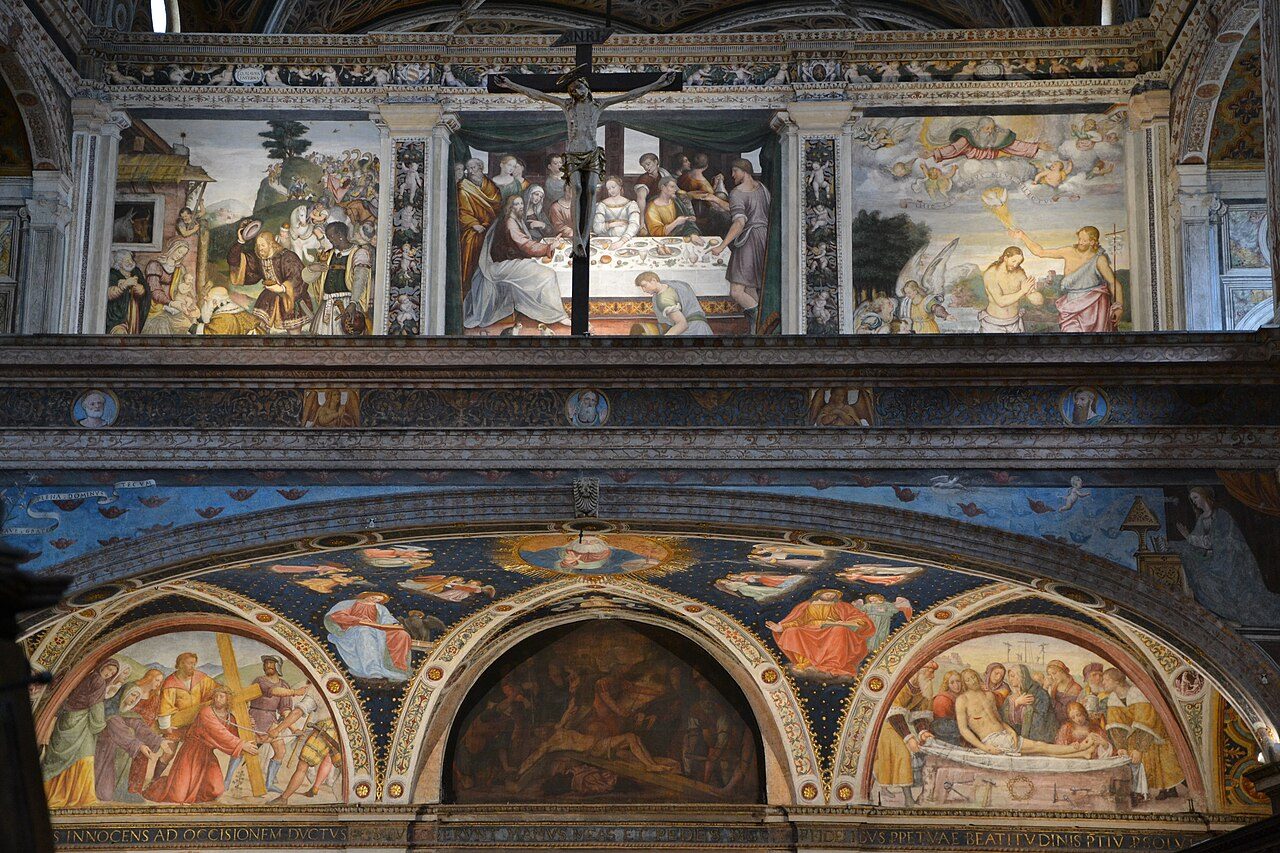
On their side of the wall the nuns had the Passion of Christ told by Bernardino Luini, from the Mount of Olives to the Resurrection. It is more sober painting than in the other hall: made for praying, not for showing off.
Spot the detail
In the Burial of Christ there is someone who does not appear in the Gospel. Can you spot who?
The full story
This is the back of the wall you saw from the other side, and Luini treats it differently. Over there the job was to impress the city: painted architecture, in their finest clothes. Here the audience was nuns who would look at the same images every day, for their whole lives. What was needed was a story to follow slowly, scene by scene.
The story, scene by scene
The story is the Passion of Christ. On one side it begins with the prayer on the Mount of Olives: Jesus on his knees, the disciples asleep, Judas arriving at the head of the soldiers.
Then comes Christ mocked, shown to the crowd by Pilate. Up in the are the climb to Calvary and the cross. On the other side it ends with the burial, with the Resurrection and the frightened soldiers, and with the meeting between the risen Christ and Mary Magdalene, who wants to touch him and cannot.
Between one scene and the next stand the female saints dear to the convent, among them Catherine and Agatha. With them are two male saints, Roch and Sebastian.
How Luini paints
Look at how all this is painted. Warm colors, soft outlines, nobody screaming. The soldiers mocking Christ have grotesque faces, but the rest is composed, almost silent.
That was Luini, and the nineteenth century adored him for it, to the point of calling him the Raphael of Lombardy. According to scholars there really is something of Raphael in his mature painting, perhaps seen in Rome.
Openings and the upper scenes
At the center of the wall, look for the openings. There is the grille through which the priest's voice came, and there are two small hatches: through one the nuns received communion, through the other they adored the consecrated host. All contact with the other church passed through there.
Finally, raise your eyes above the arch. The three scenes at the top, with the Wedding at Cana in the center, are a generation later. They were painted after the middle of the century by Luini's sons and other painters. The central one was paid for by a nun, Sister Maura Taverna, who had her name written on the wall.
Bear it in mind: in here the women were not just spectators. They were also the ones ordering the paintings.
Next stop
Walk to the far end of the hall, opposite the dividing wall, and look for the chapel full of animals