Stop 3 of 8
The Sala del Cenacolo
Where to stand
In the monastery's old refectory, at the center of the hall, facing the end wall
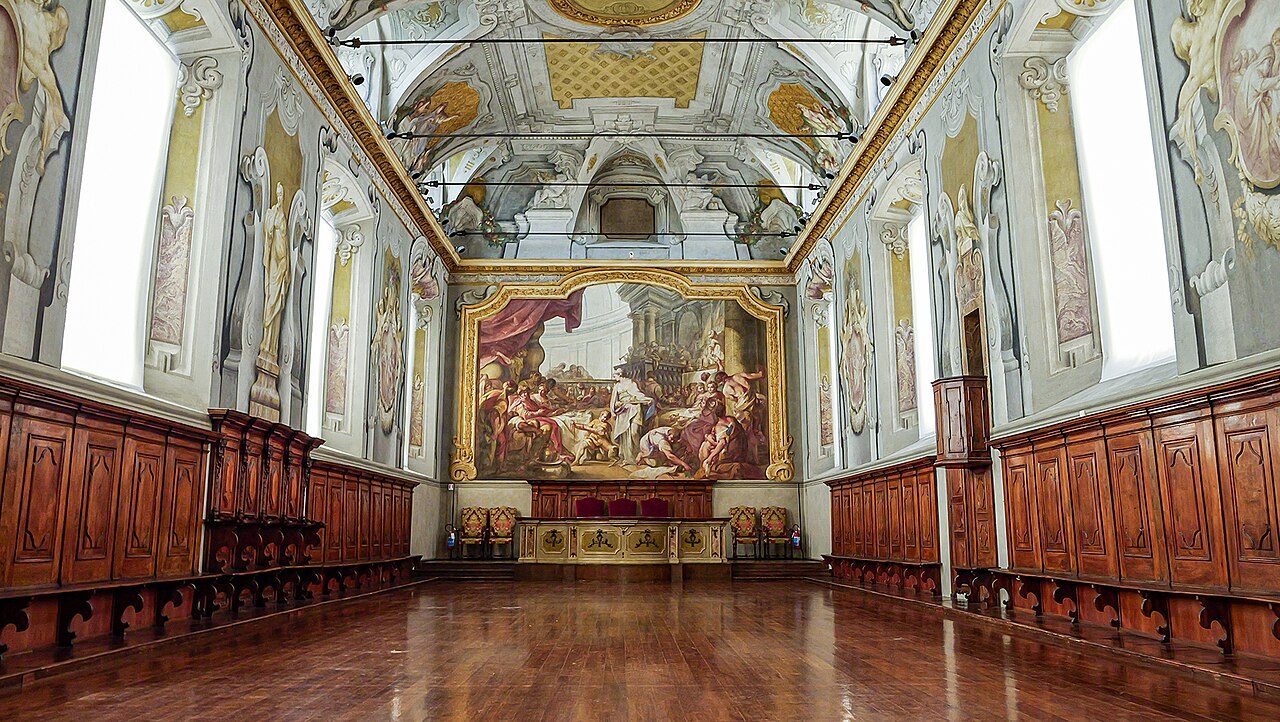
The monks' , built and frescoed in the early 1700s. It is one of the few rooms of barocchetto lombardo, the light Lombard Baroque, left in Milan. On the end wall there is a huge painted banquet: the Wedding at Cana.
Spot the detail
Look at the cornices, brackets and balustrades on the walls and vault: are they real or painted?
The full story
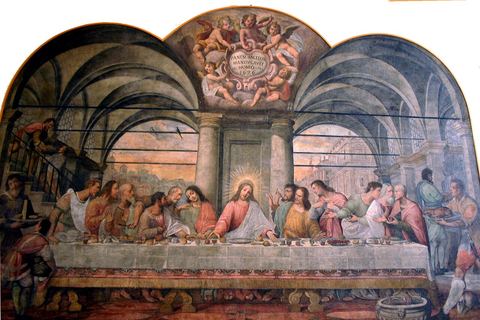
The name can mislead you. This is not Leonardo's Cenacolo, his Last Supper, which is at Santa Maria delle Grazie. Cenacolo means a room where you eat supper. The monks ate here: it is their .
The hall was built between 1709 and 1712, when the monastery was enlarged. Vault and walls are covered in paint. Today it is one of the few examples left in Milan of barocchetto lombardo, the Baroque of the early 1700s.
There was also a deadline. Milan was expecting a distinguished visitor: Elisabeth Christine, wife of Charles of Habsburg and future mother of Empress Maria Theresa. The decoration had to be ready for her arrival.
The architecture is fake
Look at the vault and the walls. Cornices, brackets, balustrades: much of what seems to stand out in relief is paint. These are , fake architecture painted to fool the eye. They are the work of Giuseppe Antonio Castelli, known as il Castellino, a painter from Monza.
The figures, on the other hand, are by Pietro Gilardi. His is the big scene on the end wall, The Wedding at Cana: the banquet where, according to the Gospel, Jesus performs his first miracle. The two painters got along well. A few years later they teamed up again on the dome of the Duomo di Monza, that city's cathedral.
Stories in a single color
Now look between the fake architecture. Inside the roundels are scenes from the Old Testament, painted in a single color. Around them run flowers, fruit and garlands.
On the end wall, though, all the color goes to the feast at Cana. The monks ate in front of a painted banquet. For a monastery's dining hall, you couldn't think of a more fitting subject.
The hall after the monks
Then came the suppression, more than a century as a barracks, and the bombs of 1943. When the complex was converted into a museum, the hall got a first restoration too.
The frescoes have recently been restored again, and have recovered their colors and their gilding. In a museum full of machines, this is the room where it pays to sit down and do nothing.
Next stop
Follow the signs to the Gallerie Leonardo da Vinci