Stop 4 of 8Must-see
The Gallerie Leonardo da Vinci
Where to stand
At the start of the Gallerie Leonardo da Vinci, in front of the first models
The museum bills it as the world's largest permanent exhibition devoted to Leonardo: about 170 pieces, from historic models to frescoes and old books. He didn't build the machines: they are modern models, made from his drawings.
Spot the detail
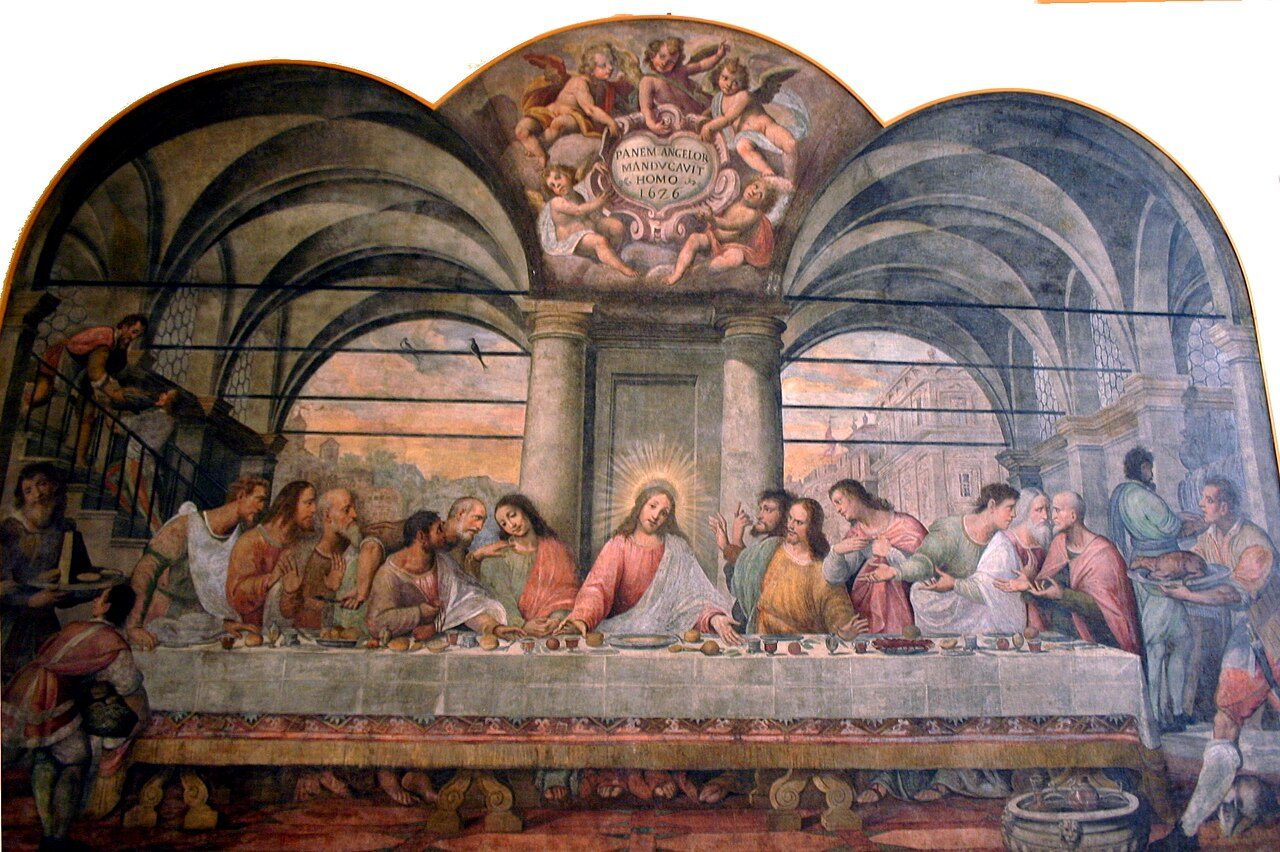
Toward the end of the route, look for a Last Supper that is not by Leonardo
The full story
Let's clear up one misunderstanding right away. Leonardo did not build these machines. He drew them. What you see are modern models, worked out from his sheets.
The models were born with the museum. When it opened, in 1953, this was the very first thing it showed: Leonardo's drawings turned into wood, rope and gears. For more than sixty years it remained the heart of the museum. Then the gallery closed, and in December 2019 it reopened, redone from scratch, for the five hundredth anniversary of his death.
A less solitary Leonardo
What changed most is the story. The old display showed the engineer, and almost nothing else. The new one puts Leonardo back in his own time, among his teachers and colleagues.
It starts in fifteenth-century Florence, in the workshop of Verrocchio, where he learns his trade. Next to his ideas you'll find those of the Tuscan engineers who came before him, whose treatises he copied and studied. Leonardo did not invent in a vacuum. He looked, copied, improved.
War, work, flight, water
Then the route reaches Milan, at the court of the Sforza, and splits up by theme. There is the art of war, with its military machines. There are machines for work: cranes and looms. There is the dream of flight, with wings copied from birds and a parachute, and there are the locks and waterways of Lombardy.
One piece of advice: look at the models as pages from a notebook, not as prototypes ready for the workshop. Leonardo drew in order to understand how the world works. Building came later, when it came at all.
Not only machines
Of roughly 170 pieces, fewer than half are models. The rest are old books, casts, paintings. There are also frescoes by followers of Leonardo, which came from the Pinacoteca di Brera, Milan's great picture gallery. In the room on the Lombard painters who took their cue from Leonardo you meet names like Boltraffio and Bernardino Luini.
The last room is the most surprising. Across the walls and the floor flow the drawings of his final years: storms, whirlpools, deluges. This is the late Leonardo, who watches nature more than machines.
If you have time for only one part of the museum, this is it. The museum carries his name, and here you understand why.
About this stop
Anecdote
Leonardo's first models never came back
In the museum's Gallerie Leonardo, the models of machines by Leonardo da Vinci, painter and inventor, had unlucky predecessors. In 1939 Milan devoted a major exhibition to him at the Palazzo dell'Arte exhibition hall, with about two hundred models built specially from his drawings. The models went around the world: in 1940 they were in New York, in 1942 in Tokyo, in the middle of the war. They did not come back. The ship carrying them home to Italy was hit, and they were lost. Many technical drawings survived. They also served to rebuild the models in military workshops and arsenals, in time for the museum's opening in 1953.
For two reasons. The first is a date: the museum was inaugurated in 1953 with an exhibition for the five hundredth anniversary of Leonardo's birth, and the models of his machines were the first core of the display. The second is an idea. For the museum, Leonardo stands for the unity of knowledge: someone who did not separate art, science and technology. It is the same thing the museum tries to do by putting frescoes, sculptures and locomotives under one roof.
No. They are modern models, built from his drawings. What survives of Leonardo is the sheets, not the machines. The museum's models are historic in their own right, though: many are the ones the museum opened with in 1953. Look at them as interpretations. Each model is an attempt to work out what Leonardo had in mind when he drew.
Next stop
Follow the signs to the Spazio exhibition, the space section, which opens with a big telescope