Stop 2 of 8
The Olivetan Cloisters
Where to stand
Under the portico of the first cloister, the one with the stone figures in the garden
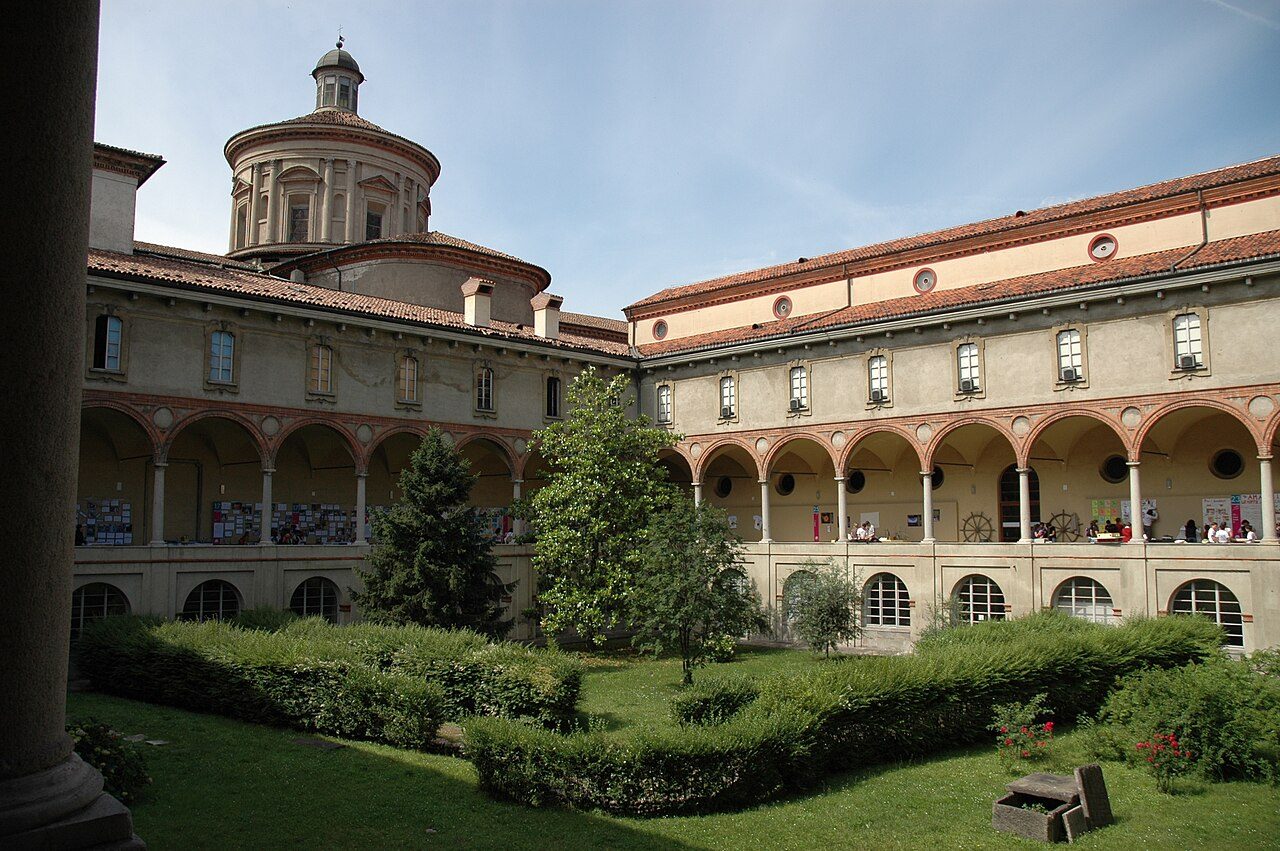
Two large from the 1500s, the heart of the monastery of San Vittore. They were a barracks for more than a century, and rubble after the bombs of 1943. In the garden, seven stone figures look at one another in silence.
Spot the detail
In the garden, look for a group of roughly carved stone figures: how many are there?
The full story
Here the museum goes quiet for a moment. No engines, no screens: a portico, columns, a lawn. You are standing where it all began.
The monks arrived at San Vittore in 1507 and started building the following year. The monastery grew around three .
The oldest is gone: it was demolished in the 1700s to open up Via San Vittore. These two remain. Scholars don't agree on the architect's name.
A is the arcaded courtyard a monastery is organized around. From here you went to church, to table, to the cells.
Under the monastery, Rome
There is an even older layer. Within the complex, the remains of a fortified enclosure from Roman times come to the surface. It protected an imperial mausoleum with an octagonal plan.
According to one theory it was designed for the family of Emperor Maximian. Later it probably held the tombs of other fourth-century emperors, Valentinian II among them. The monastery grew up beside those remains more than a thousand years later.
Soldiers in place of monks
Under Napoleon the monastery was shut down. It became a military hospital, then a barracks, and a barracks it stayed for more than a century. In August 1943 the bombing hit it full on.
When the engineer Guido Ucelli obtained the complex in 1947 to turn it into a museum, he found rubble. The restoration fell to the architect Piero Portaluppi, with Enrico Griffini and Ferdinando Reggiori. So what you see is a sixteenth-century put back on its feet in the middle of the twentieth.
Seven figures in the garden
For some years now the garden has had new residents. They are I Sette Savi, the Seven Sages, by Fausto Melotti, one of the major Italian sculptors of the twentieth century. Before he took up sculpture, Melotti had earned an engineering degree at the Politecnico di Milano, the city's technical university.
The figures are made of Viggiù stone, roughly carved, without details. They recall the mannequins in Giorgio de Chirico's paintings. They are arranged so that their gazes cross, and none of them speaks.
An artist-engineer, inside a monastery turned museum of technology. It would be hard to find a better fit.
About this stop
Because after the war that monastery was a ruin with no future. Built by the monks from 1508 on, it had become a barracks under Napoleon, and in August 1943 the bombs had devastated it. The engineer Guido Ucelli, who had spent years looking for a home for his museum of technology, obtained it in 1947. The restoration was led by the architect Piero Portaluppi. The museum opened in 1953, and the have become part of the visit.
Next stop
From the cloisters follow the signs to the Sala del Cenacolo, the monks' old dining hall