Stop 7 of 8
The night the ceiling came down
Where to stand
Outside, back in the piazza, with the convent in front of you
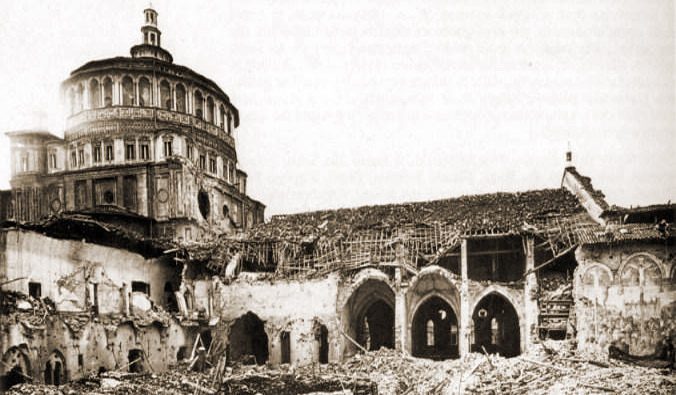
In August 1943 a bomb fell in the cloister next to the . The vault and one entire wall collapsed. The wall of the Last Supper, shored up and covered in sandbags, stayed standing amid the rubble.
Spot the detail
Think back to the room you just left: did the ceiling seem as old as the painting?
The full story
The probably struck you as a protected place, almost a vault. Try to picture it without a roof.
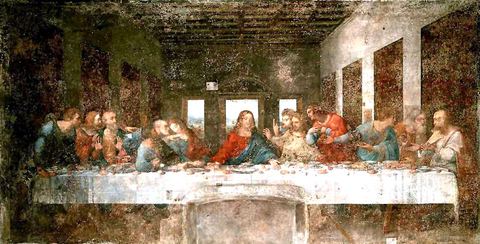
In wartime, a picture comes off its nail and goes into hiding. A wall cannot. So when Italy entered the Second World War, Leonardo's wall was defended where it stood. It was braced with scaffolding and covered with sandbags on both faces, held in place by metal tubes and wooden boards.
The bomb in the cloister
In August 1943 Milan was bombed from the air. One bomb exploded in the middle of the Chiostro dei Morti, the Cloister of the Dead, the one you passed on your way in.
It pulverized the arcade, the friars' cells and the library. In the it brought down one wall and the whole vault, the curved masonry ceiling. Montorfano's Crucifixion came out of it damaged, and so did the above the Supper.
The wall that stayed standing
Leonardo's wall stayed standing. The photographs from those days are striking: a room with its roof torn off, heaps of rubble and, at the far end, a rampart of sandbags with one of the most famous paintings in the world behind it. For a while those sandbags and a small lean-to roof were all the shelter it had.
A friar of the convent, Father Acerbi, at first thought it was a miracle. More simply, the sand had done its job.
The rebuilding was quick. By 1946 the had its walls and its vault again. Then it was the painting's turn, with a new restoration entrusted to Mauro Pellicioli.
It was not the first time the room had been through the wringer. A century and a half earlier Napoleon's French soldiers had used it as a bivouac and as a stable.
When you hear people say the Cenacolo is ruined, remember this story. It is ruined, yes. But it is there.
It did not survive because it was sturdy: everyone knew it was fragile. It survived because every time, somebody decided not to let it fall.
This stop on the map
Next stop
Last stop, still out here: how we got to the painting you have just seen